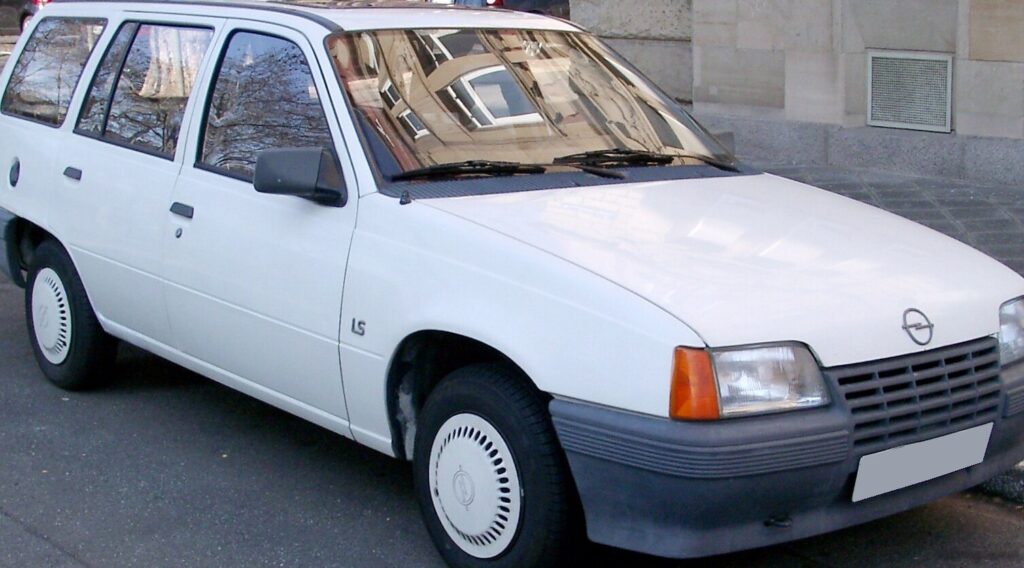
The Opel Kadett E Caravan 1.5 TD, produced between 1988 and 1991, represented a practical and fuel-efficient option within the broader Kadett E range. Positioned as an entry-level diesel variant of the Caravan (estate) body style, it catered to buyers prioritizing economy and load-carrying capacity. The Kadett E, launched in 1986, was a significant model for Opel, built on the GM T-platform (internally known as the 1HX0/A3 platform) and shared with other European GM brands like Vauxhall. The Caravan body style, offering increased cargo space, was popular in European markets for families and commercial users. This particular 1.5 TD model aimed to provide a balance between affordability and the utility expected of a station wagon.
Technical Specifications
| Brand | Opel |
| Model | Kadett |
| Generation | Kadett E Caravan |
| Type (Engine) | 1.5 TD (72 Hp) |
| Start of production | 1988 |
| End of production | 1991 |
| Powertrain Architecture | Internal Combustion engine |
| Body type | Station wagon (estate) |
| Seats | 5 |
| Doors | 3-5 |
| Fuel Type | Diesel |
| Acceleration 0 – 100 km/h | 14 sec |
| Acceleration 0 – 62 mph | 14 sec |
| Acceleration 0 – 60 mph | 13.3 sec |
| Maximum speed | 165 km/h (102.53 mph) |
| Weight-to-power ratio | 14.4 kg/Hp, 69.2 Hp/tonne |
| Weight-to-torque ratio | 7.3 kg/Nm, 137.5 Nm/tonne |
| Power | 72 Hp @ 4600 rpm |
| Power per litre | 48.4 Hp/l |
| Torque | 143 Nm @ 2600 rpm (105.47 lb.-ft. @ 2600 rpm) |
| Engine layout | Front, Transverse |
| Engine Model/Code | 15DTR |
| Engine displacement | 1488 cm3 (90.8 cu. in.) |
| Number of cylinders | 4 |
| Engine configuration | Inline |
| Cylinder Bore | 76 mm (2.99 in.) |
| Piston Stroke | 82 mm (3.23 in.) |
| Compression ratio | 22:1 |
| Number of valves per cylinder | 2 |
| Fuel injection system | Precombustion chamber injection |
| Engine aspiration | Turbocharger |
| Valvetrain | SOHC |
| Engine oil capacity | 4.5 l (4.76 US qt | 3.96 UK qt) |
| Coolant | 6.3 l (6.66 US qt | 5.54 UK qt) |
| Kerb Weight | 1040 kg (2292.81 lbs) |
| Max. weight | 1585 kg (3494.33 lbs) |
| Max load | 545 kg (1201.52 lbs) |
| Trunk (boot) space – minimum | 565 l (19.95 cu. ft.) |
| Trunk (boot) space – maximum | 1800 l (63.57 cu. ft.) |
| Fuel tank capacity | 50 l (13.21 US gal | 11 UK gal) |
| Length | 4228 mm (166.46 in.) |
| Width | 1666 mm (65.59 in.) |
| Height | 1430 mm (56.3 in.) |
| Wheelbase | 2520 mm (99.21 in.) |
| Front track | 1400 mm (55.12 in.) |
| Rear (Back) track | 1406 mm (55.35 in.) |
| Minimum turning circle | 10.5 m (34.45 ft.) |
| Drivetrain Architecture | The Internal combustion engine (ICE) drives the front wheels of the vehicle. |
| Drive wheel | Front wheel drive |
| Number of gears and type of gearbox | 5 gears, manual transmission |
| Front brakes | Disc |
| Rear brakes | Drum |
Powertrain & Engine Architecture
The heart of the Kadett E Caravan 1.5 TD was the 15DTR engine, a 1.5-liter inline-four cylinder diesel. This engine utilized precombustion chamber injection, a common diesel technology of the era, where fuel is injected into a precombustion chamber connected to the main cylinder, promoting more complete combustion. A turbocharger was employed to boost power output to 72 horsepower at 4600 rpm and 143 Nm (105.47 lb-ft) of torque at 2600 rpm. The engine featured a single overhead camshaft (SOHC) valvetrain, operating two valves per cylinder. The 5-speed manual transmission was the only gearbox option available with this engine, prioritizing fuel efficiency over outright performance. The engine’s transverse mounting within the front-wheel-drive configuration was typical for European compact cars of the time.
Driving Characteristics
The 1.5 TD engine, paired with the five-speed manual transmission, delivered modest but adequate performance for everyday driving. Acceleration to 60 mph took around 13.3 seconds, and top speed was approximately 102.53 mph. The turbocharger helped to mitigate some of the inherent lag associated with diesel engines, providing a usable boost in power at higher engine speeds. However, compared to the gasoline-powered Kadett E variants, or even the later 1.7 TD models, the 1.5 TD felt noticeably slower. The gear ratios were geared towards maximizing fuel economy, meaning the engine needed to be revved to extract the best performance. The focus was on providing a reliable and economical workhorse rather than a sporty driving experience.
Equipment & Trim Levels
The 1.5 TD Caravan typically represented the base trim level within the Kadett E Caravan range. Standard equipment generally included basic cloth upholstery, a simple dashboard layout, and manual windows and door locks. Power steering was often an optional extra, as was a radio. The interior was functional and durable, prioritizing practicality over luxury. The Caravan’s defining feature, of course, was its spacious cargo area, accessible through a large rear tailgate. Optional extras could include roof rails, tinted glass, and upgraded interior trim.
Chassis & Braking
The Kadett E Caravan utilized a relatively simple chassis design. Front suspension consisted of MacPherson struts, while the rear employed a twist-beam axle. The front brakes were disc brakes, providing adequate stopping power, while the rear brakes were drums, a cost-saving measure common in entry-level models. Stabilizer bars were often omitted on the base trim level to further reduce cost. The suspension was tuned for comfort and ride quality, rather than sporty handling. The weight distribution was reasonably balanced, contributing to predictable handling characteristics.
Market Reception & Comparison
The Kadett E Caravan 1.5 TD was generally well-received in European markets as a practical and economical choice. Critics praised its fuel efficiency and spaciousness, but noted its lack of outright performance. Compared to the gasoline-powered Kadett E models, the 1.5 TD offered significantly better fuel economy, but at the expense of acceleration and refinement. The later 1.7 TD models offered a noticeable improvement in performance, making them a more popular choice for those seeking a bit more power. The 1.5 TD appealed to buyers who prioritized low running costs and load-carrying capacity over driving excitement.
Legacy
The Opel Kadett E Caravan 1.5 TD, while not the most powerful or refined version of the Kadett E, proved to be a durable and reliable vehicle. The 15DTR engine, when properly maintained, could accumulate high mileage. Today, these vehicles are relatively rare, and well-maintained examples are sought after by enthusiasts and collectors. The simplicity of the engine and mechanical components makes them relatively easy to repair and maintain. The Kadett E Caravan 1.5 TD represents a significant example of 1980s European automotive engineering, offering a blend of practicality, economy, and durability.