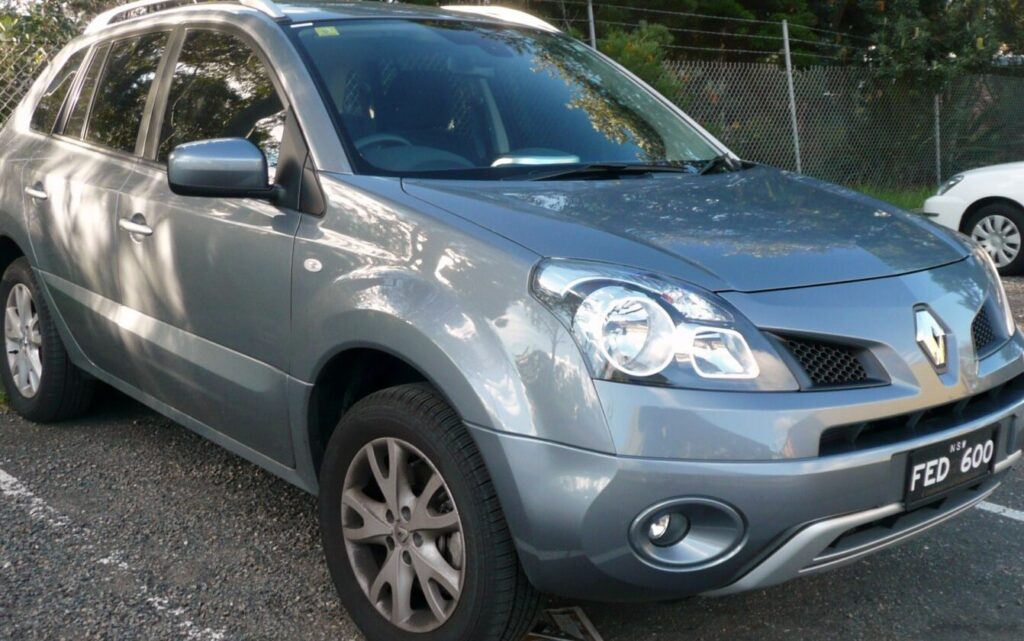
Technical Specifications
| Brand | Renault |
| Model | Koleos |
| Generation | Koleos II |
| Type (Engine) | 2.0 (144 Hp) 4×4 CVT |
| Start of production | 2016 |
| End of production | 2019 |
| Powertrain Architecture | Internal Combustion engine |
| Body type | SUV |
| Seats | 5 |
| Doors | 5 |
| Fuel consumption (urban) | 9.4 l/100 km (25 US mpg, 30.1 UK mpg, 10.6 km/l) |
| Fuel consumption (extra urban) | 6.4 l/100 km (36.8 US mpg, 44.1 UK mpg, 15.6 km/l) |
| Fuel consumption (combined) | 7.5 l/100 km (31.4 US mpg, 37.7 UK mpg, 13.3 km/l) |
| CO2 emissions | 174 g/km |
| Fuel Type | Petrol (Gasoline) |
| Acceleration 0 – 100 km/h | 11.3 sec |
| Acceleration 0 – 62 mph | 11.3 sec |
| Acceleration 0 – 60 mph | 10.7 sec |
| Maximum speed | 187 km/h (116.2 mph) |
| Weight-to-power ratio | 11.1 kg/Hp, 90 Hp/tonne |
| Weight-to-torque ratio | 8 kg/Nm, 125 Nm/tonne |
| Power | 144 Hp @ 6000 rpm |
| Power per litre | 72.1 Hp/l |
| Torque | 200 Nm @ 4400 rpm (147.51 lb.-ft. @ 4400 rpm) |
| Engine layout | Front, Transverse |
| Engine Model/Code | M5R 402 |
| Engine displacement | 1997 cm3 (121.86 cu. in.) |
| Number of cylinders | 4 |
| Engine configuration | Inline |
| Compression ratio | 11.2:1 |
| Number of valves per cylinder | 4 |
| Fuel injection system | Direct injection |
| Engine oil capacity | 4.3 l (4.54 US qt, 3.78 UK qt) |
| Coolant capacity | 8.5 l (8.98 US qt, 7.48 UK qt) |
| Kerb Weight | 1600 kg (3527.4 lbs) |
| Max. weight | 2140 kg (4717.89 lbs) |
| Max load | 540 kg (1190.5 lbs) |
| Trunk (boot) space – minimum | 538 l (19 cu. ft) |
| Trunk (boot) space – maximum | 1690 l (59.68 cu. ft) |
| Fuel tank capacity | 60 l (15.85 US gal, 13.2 UK gal) |
| Permitted trailer load with brakes (12%) | 1500 kg (3306.93 lbs) |
| Permitted trailer load without brakes | 750 kg (1653.47 lbs) |
| Length | 4672 mm (183.94 in) |
| Width | 1843 mm (72.56 in) |
| Width with mirrors folded | 1864 mm (73.39 in) |
| Width including mirrors | 2063 mm (81.22 in) |
| Height | 1673 mm (65.87 in) |
| Wheelbase | 2705 mm (106.5 in) |
| Front track | 1591 mm (62.64 in) |
| Rear (Back) track | 1586 mm (62.44 in) |
| Ride height (ground clearance) | 210 mm (8.27 in) |
| Drag coefficient (Cd) | 0.353 |
| Minimum turning circle | 11.4 m (37.4 ft) |
| Drive wheel | All wheel drive (4×4) |
| Number of gears and type of gearbox | automatic transmission CVT X-Tronic |
| Front suspension | Independent, type McPherson with coil spring and anti-roll bar |
| Rear suspension | Independent multi-link spring suspension with stabilizer |
| Front brakes | Ventilated discs, 296 mm |
| Rear brakes | Disc, 292 mm |
| Assisting systems | ABS (Anti-lock braking system) |
| Steering type | Steering rack and pinion |
| Power steering | Electric Steering |
| Tires size | 225/65 R17; 225/60 R18 |
| Wheel rims size | 7J x 17; 7J x 18 |
The Renault Koleos II 2.0 (144 Hp) 4×4 CVT, produced from 2016 to 2019, represents a mid-cycle offering within the second generation of Renault’s SUV. Positioned as a versatile, all-wheel-drive option, this variant aimed to provide a balance between fuel efficiency, practicality, and all-weather capability for European and international markets. It slotted into the Koleos II lineup as a step up from the base models, offering more power and the added security of four-wheel drive compared to the front-wheel-drive variants. The Koleos II itself was designed as a global model, sharing its platform with the Nissan X-Trail, and aimed to compete with established players in the compact SUV segment like the Hyundai Tucson and Kia Sportage.
Powertrain & Engine Architecture
The Renault Koleos II 2.0 4×4 CVT is powered by the M5R 402 engine, a 1.997-liter inline-four cylinder gasoline engine. This engine utilizes direct fuel injection, a technology that improves fuel efficiency and power output by injecting fuel directly into the combustion chamber. The engine features a double overhead camshaft (DOHC) valvetrain with four valves per cylinder, optimizing airflow for enhanced performance. The compression ratio is set at 11.2:1. The engine produces 144 horsepower at 6000 rpm and 200 Nm (147.51 lb-ft) of torque at 4400 rpm. Paired with this engine is a Continuously Variable Transmission (CVT) marketed as X-Tronic. This CVT is designed to provide smooth, stepless gear changes, contributing to improved fuel economy and driving comfort. The all-wheel-drive system is primarily front-wheel drive, engaging the rear wheels automatically when traction is lost.
Driving Characteristics
The 2.0-liter engine with the CVT transmission delivers adequate, but not particularly sporty, performance. Acceleration from 0 to 60 mph takes around 10.7 seconds, and the top speed is 116.2 mph. The CVT transmission prioritizes fuel efficiency over rapid acceleration, resulting in a smooth but sometimes less engaging driving experience. Compared to higher-output engine options available in the Koleos II range, this variant feels less powerful, especially when fully loaded or tackling steep inclines. The all-wheel-drive system provides enhanced traction in slippery conditions, making it a suitable choice for drivers in regions with inclement weather. The CVT’s gear ratios are continuously adjusted to keep the engine operating in its most efficient range, contributing to the combined fuel economy of 31.4 US mpg.
Equipment & Trim Levels
The 2.0 4×4 CVT trim typically included standard features such as air conditioning, power windows and mirrors, a touchscreen infotainment system with Bluetooth connectivity, and basic safety equipment like ABS and airbags. Higher trim levels offered additional features like leather upholstery, a panoramic sunroof, navigation system, and parking sensors. Interior upholstery was generally cloth on the base trims, with leather options available as upgrades. The dashboard layout was functional and modern, with a focus on ease of use. Optional extras included a premium sound system, heated seats, and advanced driver-assistance systems.
Chassis & Braking
The Koleos II utilizes an independent suspension system on both the front and rear axles. The front suspension employs a McPherson strut design with a coil spring and anti-roll bar, while the rear suspension features a multi-link setup with a stabilizer bar. This suspension configuration provides a comfortable ride quality and decent handling characteristics. The braking system consists of ventilated discs on the front wheels and solid discs on the rear wheels. ABS (Anti-lock Braking System) is standard, enhancing braking performance and stability. The steering is electrically assisted, providing light and precise steering feel.
Market Reception & Comparison
The Renault Koleos II 2.0 4×4 CVT was generally well-received as a practical and comfortable SUV. Critics praised its spacious interior, comfortable ride, and all-wheel-drive capability. However, some reviewers noted that the engine felt underpowered, especially when compared to competitors offering more powerful engine options. Fuel economy was considered average for the segment. Compared to the diesel variants of the Koleos II, the 2.0-liter gasoline engine offered a smoother and quieter driving experience but lacked the low-end torque and fuel efficiency of the diesel engines. The CVT transmission was a point of contention for some, with some drivers preferring the more direct feel of a traditional automatic transmission.
Legacy
The Renault Koleos II 2.0 4×4 CVT has proven to be a relatively reliable vehicle in the used car market. The M5R engine is generally considered durable, and the CVT transmission, while sometimes criticized, has demonstrated reasonable longevity with proper maintenance. Common issues reported by owners include minor electrical glitches and wear and tear on suspension components. Today, these vehicles represent a relatively affordable entry point into the compact SUV segment, offering a good balance of practicality, comfort, and all-weather capability. Its continued presence in the used car market demonstrates its enduring appeal as a versatile family vehicle.