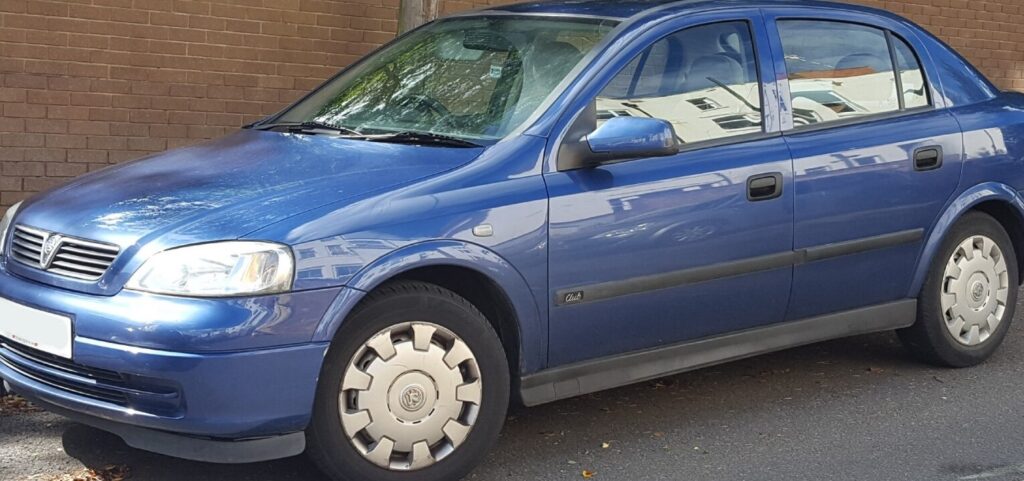
The Vauxhall Astra Mark IV, produced from 1998 to 2004, represented a significant step forward for the British marque, building upon the success of its predecessor. Within the Mark IV range, the 1.6-liter (75 horsepower) variant occupied the entry-level position, offering an affordable and practical option for buyers. This model, available in both 3-door and 5-door hatchback configurations, played a crucial role in establishing the Astra as a popular choice in the UK market, competing directly with rivals like the Ford Focus and Peugeot 306. The Astra Mark IV was built on the GM240 platform, shared with other Opel/Vauxhall models like the Zafira and Vectra.
Technical Specifications
| Brand | Vauxhall |
| Model | Astra |
| Generation | Astra Mk IV CC |
| Type (Engine) | 1.6 (75 Hp) |
| Start of production | 1998 |
| End of production | 2004 |
| Powertrain Architecture | Internal Combustion engine |
| Body type | Hatchback |
| Seats | 5 |
| Doors | 3-5 |
| Fuel consumption (urban) | 9.7 l/100 km (24.2 US mpg) |
| Fuel consumption (extra urban) | 5.8 l/100 km (40.6 US mpg) |
| Fuel Type | Petrol (Gasoline) |
| Acceleration 0 – 100 km/h | 14.5 sec |
| Acceleration 0 – 62 mph | 14.5 sec |
| Acceleration 0 – 60 mph | 13.8 sec |
| Maximum speed | 170 km/h (105.63 mph) |
| Weight-to-power ratio | 14.5 kg/Hp |
| Weight-to-torque ratio | 8.5 kg/Nm |
| Power | 75 Hp @ 5200 rpm |
| Torque | 128 Nm @ 2800 rpm (94.41 lb.-ft. @ 2800 rpm) |
| Engine layout | Front, Transverse |
| Engine Model/Code | X16SZR |
| Engine displacement | 1598 cm3 (97.52 cu. in.) |
| Number of cylinders | 4 |
| Engine configuration | Inline |
| Cylinder Bore | 79 mm (3.11 in.) |
| Piston Stroke | 81.5 mm (3.21 in.) |
| Number of valves per cylinder | 4 |
| Engine oil capacity | 3.25 l (3.43 US qt | 2.86 UK qt) |
| Coolant capacity | 5.8 l (6.13 US qt | 5.1 UK qt) |
| Kerb Weight | 1085 kg (2392.02 lbs.) |
| Max. weight | 1605 kg (3538.42 lbs.) |
| Max load | 520 kg (1146.4 lbs.) |
| Trunk (boot) space – minimum | 370 l (13.07 cu. ft.) |
| Trunk (boot) space – maximum | 1180 l (41.67 cu. ft.) |
| Fuel tank capacity | 52 l (13.74 US gal | 11.44 UK gal) |
| Length | 4110 mm (161.81 in.) |
| Width | 1710 mm (67.32 in.) |
| Width including mirrors | 1967 mm (77.44 in.) |
| Height | 1425 mm (56.1 in.) |
| Wheelbase | 2606 mm (102.6 in.) |
| Drivetrain Architecture | Front wheel drive |
| Number of gears | 5 |
| Gearbox type | Manual transmission |
| Front brakes | Ventilated discs |
| Rear brakes | Disc |
| Tires size | 185/65 R15 |
| Wheel rims size | 15 |
Powertrain & Engine Architecture
The heart of the Astra 1.6 was the X16SZR engine, a naturally aspirated, four-cylinder inline engine displacing 1.6 liters (1598 cc). This engine was a relatively simple design, utilizing a single overhead camshaft (SOHC) and multi-point fuel injection. The X16SZR produced 75 horsepower at 5200 rpm and 128 Nm (94.41 lb-ft) of torque at 2800 rpm. The engine’s design prioritized fuel efficiency and reliability over outright performance. It featured a relatively low compression ratio, contributing to its ability to run on lower octane fuel. The standard transmission was a five-speed manual gearbox, although a four-speed automatic transmission was also offered as an option, albeit less common. The automatic transmission, while providing convenience, noticeably impacted acceleration and fuel economy.
Driving Characteristics
The 1.6-liter Astra, particularly in its manual form, offered a reasonably engaging driving experience for its class. However, the 75 horsepower output meant that performance was modest. Acceleration from 0-60 mph took around 13.8 seconds, and top speed was limited to 105.63 mph. The automatic transmission version was even slower, with a noticeable delay in response. The gear ratios were tuned for economy, meaning the engine often felt strained when accelerating hard or climbing hills. Compared to the more powerful 1.8-liter and 2.0-liter variants, the 1.6 felt noticeably underpowered, especially when fully loaded. The handling was generally competent, with predictable steering and a comfortable ride, but it lacked the sharpness of some of its rivals.
Equipment & Trim Levels
The 1.6-liter Astra typically came equipped with a basic level of standard features. This included central locking, power steering, and an adjustable steering column. Interior upholstery was typically cloth, and the dashboard featured a simple, functional design. Optional extras included air conditioning, electric windows, and an upgraded stereo system. Trim levels varied slightly depending on the year and market, but generally followed a progression from base ‘Life’ to mid-range ‘Design’ and higher-spec ‘Sport’ or ‘SE’ models. The 1.6 was often found in the ‘Life’ or ‘Design’ trims, offering a good balance of affordability and essential features.
Chassis & Braking
The Astra Mark IV utilized a MacPherson strut front suspension and a torsion beam rear suspension. This setup provided a comfortable ride and adequate handling for everyday driving. The front brakes were ventilated discs, offering good stopping power, while the rear brakes were solid discs. The 1.6-liter models typically featured smaller diameter wheels and tires (185/65 R15) compared to the higher-spec variants. Stabilizer bars were fitted to both the front and rear axles, helping to reduce body roll during cornering.
Market Reception & Comparison
The Astra 1.6 was generally well-received as an affordable and practical family car. Critics praised its fuel efficiency and comfortable ride, but noted its lack of outright performance. Compared to the 1.8-liter and 2.0-liter models, the 1.6 offered significantly lower running costs but at the expense of driving enjoyment. The 1.8-liter offered a noticeable performance boost, while the 2.0-liter provided a more refined and powerful driving experience. The 1.6’s fuel economy was competitive with other cars in its class, averaging around 33 mpg on a combined cycle. Reliability was generally good, although some owners reported issues with the engine’s cooling system.
Legacy
The Astra Mark IV 1.6 remains a popular choice in the used car market, particularly for first-time drivers or those seeking an affordable and reliable vehicle. The X16SZR engine is known for its durability, and parts are readily available. While not a performance car, the 1.6-liter Astra offers a practical and economical solution for everyday transportation. Its simplicity and relatively low maintenance costs make it an attractive option for those on a budget. However, potential buyers should be aware of the potential for cooling system issues and ensure that the car has been properly maintained.