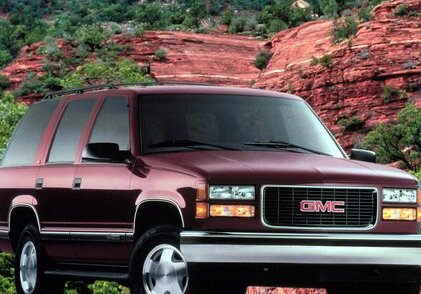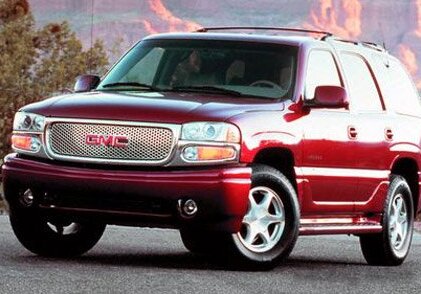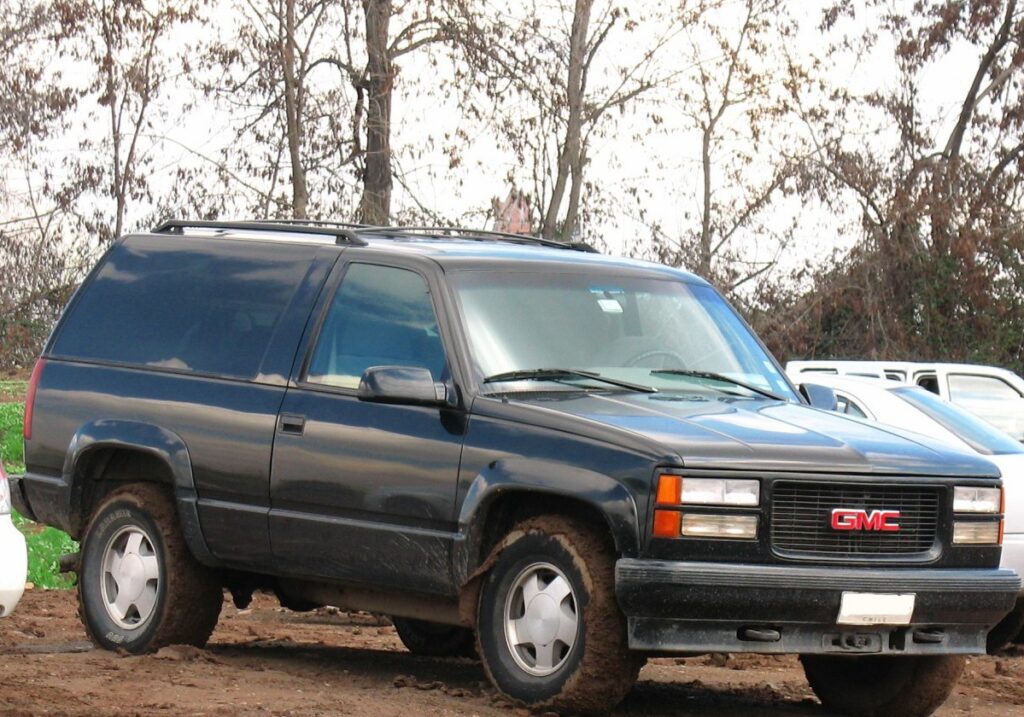
The GMC Yukon I (GMT400, 3-door) with the 5.7-liter V8 engine and automatic transmission represents a significant entry in the early full-size SUV market. Produced from 1992 to 1999, this Yukon variant occupied a unique space within the GMT400 platform family, offering a more compact, three-door configuration compared to the standard four-door Yukon and Suburban models. It aimed to provide the capability of a larger SUV in a more manageable package, appealing to buyers seeking utility without the bulk. This particular configuration, pairing the 210 horsepower V8 with a four-speed automatic, was positioned as a mid-range offering, balancing performance with affordability.
Technical Specifications
| Brand | GMC |
| Model | Yukon |
| Generation | Yukon I (GMT400, 3-door) |
| Type (Engine) | 5.7 V8 (210 Hp) Automatic |
| Start of production | 1992 |
| End of production | 1999 |
| Powertrain Architecture | Internal Combustion engine |
| Body type | SUV |
| Seats | 5 |
| Doors | 3 |
| Fuel Type | Petrol (Gasoline) |
| Power | 210 Hp @ 4000 rpm |
| Power per litre | 36.6 Hp/l |
| Torque | 407 Nm @ 2800 rpm |
| Torque (lb-ft) | 300.19 lb.-ft. @ 2800 rpm |
| Engine layout | Front, Longitudinal |
| Engine displacement | 5735 cm3 |
| Engine displacement (cu. in.) | 349.97 cu. in. |
| Number of cylinders | 8 |
| Engine configuration | V-engine |
| Cylinder Bore | 101.6 mm |
| Cylinder Bore (in.) | 4 in. |
| Piston Stroke | 88.39 mm |
| Piston Stroke (in.) | 3.48 in. |
| Compression ratio | 9.1:1 |
| Fuel injection system | Multi-port manifold injection |
| Engine aspiration | Naturally aspirated engine |
| Engine oil capacity | 4.8 l |
| Engine oil capacity (US qt) | 5.07 US qt |
| Engine oil capacity (UK qt) | 4.22 UK qt |
| Coolant capacity | 16.5 l |
| Coolant capacity (US qt) | 17.44 US qt |
| Coolant capacity (UK qt) | 14.52 UK qt |
| Max. weight | 2835 kg |
| Max. weight (lbs) | 6250.11 lbs. |
| Fuel tank capacity | 114 l |
| Fuel tank capacity (US gal) | 30.12 US gal |
| Fuel tank capacity (UK gal) | 25.08 UK gal |
| Length | 4775 mm |
| Length (in.) | 187.99 in. |
| Width | 1958 mm |
| Width (in.) | 77.09 in. |
| Height | 1839 mm |
| Height (in.) | 72.4 in. |
| Wheelbase | 2832 mm |
| Wheelbase (in.) | 111.5 in. |
| Front overhang | 899 mm |
| Front overhang (in.) | 35.39 in. |
| Rear overhang | 1044 mm |
| Rear overhang (in.) | 41.1 in. |
| Drivetrain Architecture | The Internal combustion engine (ICE) drives the rear wheels of the vehicle. |
| Drive wheel | Rear wheel drive |
| Number of gears | 4 |
| Gearbox type | automatic transmission |
| Front suspension | Independent torsion bar, double wishbone |
| Rear suspension | Leaf spring |
| Front brakes | Disc |
| Rear brakes | Drum |
| Assisting systems | ABS (Anti-lock braking system) |
| Tires size | 265/75 R16 |
| Wheel rims size | 7J x 16 |
Powertrain & Engine Architecture
The heart of this Yukon variant is the 5.7-liter (349.97 cubic inch) small-block Chevrolet V8 engine. Typically identified by engine codes like L05, this engine is a traditional pushrod design, featuring two valves per cylinder and a cast iron block with aluminum cylinder heads. The multi-port fuel injection system delivers fuel directly to each cylinder, optimizing combustion efficiency. The 9.1:1 compression ratio was a compromise between performance and the ability to run on readily available gasoline. The engine produces 210 horsepower at 4000 rpm and 300 lb-ft of torque at 2800 rpm. This torque output was particularly important for towing and hauling, key capabilities for an SUV. The four-speed automatic transmission (likely a 4L60E) was chosen for its durability and ease of use, prioritizing smooth operation over outright performance. The transmission’s gear ratios were geared towards providing adequate acceleration and maintaining reasonable fuel economy at highway speeds.
Driving Characteristics
The 5.7L V8 and automatic transmission combination in the three-door Yukon delivered a driving experience focused on usability rather than sportiness. Acceleration was adequate for everyday driving, but not particularly brisk. The automatic transmission, while smooth, lacked the responsiveness of a manual gearbox. The torque peak at 2800 rpm meant that the engine felt strongest in the mid-range, making it well-suited for merging onto highways or climbing hills. Compared to the later, more powerful 6.5L diesel or even the 6.0L V8 options, this 5.7L version was noticeably less potent. However, it offered a more refined and quieter driving experience. The shorter wheelbase of the three-door model, compared to the standard Yukon, resulted in a slightly firmer ride, but also improved maneuverability in tight spaces.
Equipment & Trim Levels
The 1992-1999 GMC Yukon I (GMT400, 3-door) 5.7 V8 Automatic typically came standard with features like air conditioning, a basic AM/FM radio, cloth upholstery, and manual windows and locks. Power steering and brakes were also standard. The interior was functional and durable, designed to withstand the rigors of SUV ownership. Optional extras included upgraded sound systems, cruise control, a tilt steering wheel, and power windows and locks. Higher trim levels might have featured leather upholstery and woodgrain interior trim. The three-door configuration meant that rear seat access was less convenient than in the four-door models, and rear passenger space was somewhat limited.
Chassis & Braking
The Yukon I utilized a body-on-frame construction, providing a robust and durable platform. The front suspension featured an independent torsion bar setup with double wishbone control arms, offering a reasonable balance of ride comfort and handling. The rear suspension employed a traditional leaf spring design, chosen for its load-carrying capacity. Braking duties were handled by disc brakes at the front and drum brakes at the rear. Anti-lock braking system (ABS) was available as an option, enhancing safety by preventing wheel lockup during hard braking. The 265/75 R16 tires provided adequate grip for both on-road and light off-road use.
Market Reception & Comparison
The three-door Yukon with the 5.7L V8 and automatic transmission was generally well-received as a practical and capable SUV. Critics praised its versatility and towing capacity, but noted that its performance was not class-leading. Compared to the four-door Yukon and Suburban, the three-door model offered a more affordable entry point into the full-size SUV segment. It also appealed to buyers who didn’t need the extra space of the larger models. Fuel economy was typical for a vehicle of its size and type, averaging around 14-16 mpg in city driving and 18-20 mpg on the highway. Reliability was generally good, although the 4L60E transmission could be prone to issues if not properly maintained.
Legacy
The GMC Yukon I (GMT400, 3-door) 5.7 V8 Automatic holds a place as a representative of the early wave of popular full-size SUVs. While not as common as the four-door models, the three-door version offered a unique combination of capability and affordability. The 5.7L V8 engine, known for its durability and relatively simple design, remains a popular choice for engine swaps and restorations. Today, these Yukons are often found in the used car market, appealing to enthusiasts and buyers seeking a classic SUV with a proven track record. The powertrain, while aging, is generally reliable if properly maintained, making it a viable option for those looking for a rugged and capable vehicle.