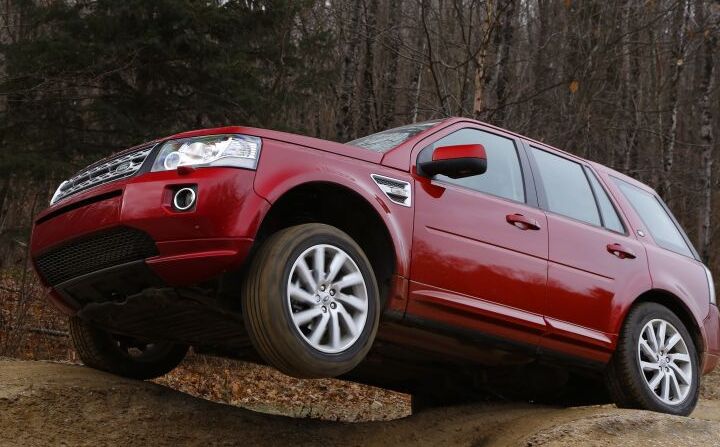
The Land Rover Freelander II (facelift 2012) 2.0 Si4 GTDi (240 Hp) AWD Automatic represents a significant refinement of the second-generation Freelander, produced from 2012 to 2014. Positioned as a mid-to-upper trim level within the Freelander II range, this variant aimed to deliver a balance of performance, luxury, and all-terrain capability. It built upon the foundation of the L359 platform, initially introduced in 2006, and benefited from updates to the engine, styling, and interior technology. This model was primarily marketed in Europe, the Middle East, and other international markets, offering a premium compact SUV option with Land Rover’s renowned four-wheel-drive system.
Technical Specifications
| Brand | Land Rover |
| Model | Freelander |
| Generation | Freelander II (facelift 2012) |
| Type (Engine) | 2.0 Si4 GTDi (240 Hp) AWD Automatic |
| Start of production | 2012 |
| End of production | 2014 |
| Powertrain Architecture | Internal Combustion engine |
| Body type | SUV |
| Seats | 5 |
| Doors | 5 |
| Fuel consumption (economy) – urban | 13.5 l/100 km (17.4 US mpg, 20.9 UK mpg, 7.4 km/l) |
| Fuel consumption (economy) – extra urban | 7.5 l/100 km (31.4 US mpg, 37.7 UK mpg, 13.3 km/l) |
| Fuel consumption (economy) – combined | 9.6 l/100 km (24.5 US mpg, 29.4 UK mpg, 10.4 km/l) |
| CO2 emissions | 224 g/km |
| Fuel Type | Petrol (Gasoline) |
| Acceleration 0 – 100 km/h | 8.8 sec |
| Acceleration 0 – 62 mph | 8.8 sec |
| Acceleration 0 – 60 mph | 8.4 sec |
| Maximum speed | 200 km/h (124.27 mph) |
| Emission standard | Euro 5 |
| Weight-to-power ratio | 7.1 kg/Hp, 141.2 Hp/tonne |
| Weight-to-torque ratio | 5 kg/Nm, 200 Nm/tonne |
| Power | 240 Hp @ 5500 rpm |
| Power per litre | 120.1 Hp/l |
| Torque | 340 Nm @ 3200 rpm (250.77 lb.-ft. @ 3200 rpm) |
| Engine layout | Front, Transverse |
| Engine Model/Code | 204PT |
| Engine displacement | 1999 cm3 (121.99 cu. in.) |
| Number of cylinders | 4 |
| Engine configuration | Inline |
| Cylinder Bore | 87.5 mm (3.44 in.) |
| Piston Stroke | 83.1 mm (3.27 in.) |
| Compression ratio | 10:1 |
| Number of valves per cylinder | 4 |
| Fuel injection system | Direct injection |
| Engine aspiration | Turbocharger, Intercooler |
| Valvetrain | DOHC |
| Engine oil capacity | 5.4 l (5.71 US qt | 4.75 UK qt) |
| Coolant | 8.4 l (8.88 US qt | 7.39 UK qt) |
| Kerb Weight | 1700 kg (3747.86 lbs.) |
| Max. weight | 2505 kg (5522.58 lbs.) |
| Max load | 805 kg (1774.72 lbs.) |
| Trunk (boot) space – minimum | 755 l (26.66 cu. ft.) |
| Trunk (boot) space – maximum | 1670 l (58.98 cu. ft.) |
| Fuel tank capacity | 70 l (18.49 US gal | 15.4 UK gal) |
| Max. roof load | 75 kg (165.35 lbs.) |
| Permitted trailer load with brakes (12%) | 2000 kg (4409.25 lbs.) |
| Permitted trailer load without brakes | 750 kg (1653.47 lbs.) |
| Permitted towbar download | 150 kg (330.69 lbs.) |
| Length | 4500 mm (177.17 in.) |
| Width with mirrors folded | 2005 mm (78.94 in.) |
| Width including mirrors | 2195 mm (86.42 in.) |
| Height | 1740 mm (68.5 in.) |
| Wheelbase | 2660 mm (104.72 in.) |
| Front track | 1601 mm (63.03 in.) |
| Rear (Back) track | 1614 mm (63.54 in.) |
| Ride height (ground clearance) | 210 mm (8.27 in.) |
| Minimum turning circle (turning diameter) | 11.3 m (37.07 ft.) |
| Approach angle | 31° |
| Departure angle | 34° |
| Ramp-over (brakeover) angle | 23° |
| Wading depth | 500 mm (19.69 in.) |
| Drivetrain Architecture | The Internal combustion engine (ICE) drives the front wheels permanently, and the rear wheels are driven through an electrically or mechanically operated clutch if necessary. |
| Drive wheel | All wheel drive (4×4) |
| Number of gears and type of gearbox | 6 gears, automatic transmission |
| Front suspension | Independent, type McPherson with coil spring and anti-roll bar |
| Rear suspension | Independent coil spring |
| Front brakes | Ventilated discs, 316 mm |
| Rear brakes | Ventilated discs, 302 mm |
| Assisting systems | ABS (Anti-lock braking system) |
| Steering type | Steering rack and pinion |
| Power steering | Electric Steering |
| Wheel rims size | 17; 18; 19 |
Powertrain & Engine Architecture
The heart of the Freelander II 2.0 Si4 GTDi is the 204PT engine, a 1999cc inline-four cylinder petrol engine. This engine is part of the Ford EcoBoost family, developed during Land Rover’s ownership under Ford. It features direct fuel injection and a single turbocharger with an intercooler, enabling it to produce 240 horsepower at 5500 rpm and 340 Nm (250.77 lb-ft) of torque at 3200 rpm. The engine utilizes a double overhead camshaft (DOHC) valvetrain with four valves per cylinder. The 6-speed automatic transmission, sourced from Aisin, was specifically tuned to handle the engine’s torque output and provide smooth gear changes. This transmission offered a ‘Sport’ mode for more aggressive shifting and a manual shift option for greater driver control.
Driving Characteristics
The 2.0 Si4 GTDi Automatic offered a noticeable step up in performance compared to the lower-powered Freelander variants. Acceleration from 0-60 mph was achieved in approximately 8.4 seconds, and the vehicle had a top speed of 124.27 mph. The automatic transmission, while providing convenience, did slightly diminish the responsiveness compared to the 6-speed manual option. Gear ratios were optimized for a balance between fuel efficiency and acceleration. In real-world driving, the engine provided ample power for everyday use and confident overtaking. The all-wheel-drive system, a key Land Rover feature, provided excellent traction in various conditions, making it capable on both paved and unpaved surfaces.
Equipment & Trim Levels
The GTDi trim level typically included a generous array of standard features. Interior appointments included leather upholstery, heated front seats, and a premium audio system. Standard equipment also included automatic climate control, parking sensors, and alloy wheels (typically 18 or 19 inch). Optional extras included a panoramic sunroof, upgraded navigation system, and adaptive cruise control. The interior design was generally well-appointed, reflecting Land Rover’s focus on providing a comfortable and refined driving experience.
Chassis & Braking
The Freelander II utilized an independent suspension system on both the front and rear axles. The front suspension employed McPherson struts with coil springs and an anti-roll bar, while the rear featured independent coil springs. This setup provided a comfortable ride quality while maintaining reasonable handling characteristics. Braking duties were handled by ventilated discs on all four wheels, providing adequate stopping power. The vehicle was equipped with ABS (Anti-lock Braking System) as standard, enhancing safety during emergency braking situations.
Market Reception & Comparison
The Freelander II 2.0 Si4 GTDi Automatic was generally well-received by automotive critics. It was praised for its blend of performance, comfort, and off-road capability. However, some reviewers noted that the fuel economy, at 24.5 US mpg combined, was not class-leading. Compared to the 2.2-liter diesel variants, the petrol engine offered more immediate power but at the expense of fuel efficiency. The GTDi trim level was positioned above the base models but below the HSE trim, offering a compelling value proposition for buyers seeking a well-equipped and capable SUV.
Legacy
The 204PT engine, while generally reliable, has been known to exhibit occasional issues with timing chain tensioners and oil pump wear, particularly with higher mileage examples. The Aisin automatic transmission has proven to be robust and durable. Today, the Freelander II 2.0 Si4 GTDi Automatic remains a popular choice in the used car market, offering a relatively affordable entry point into Land Rover ownership. Its combination of performance, practicality, and all-terrain capability continues to appeal to buyers seeking a versatile and capable SUV.