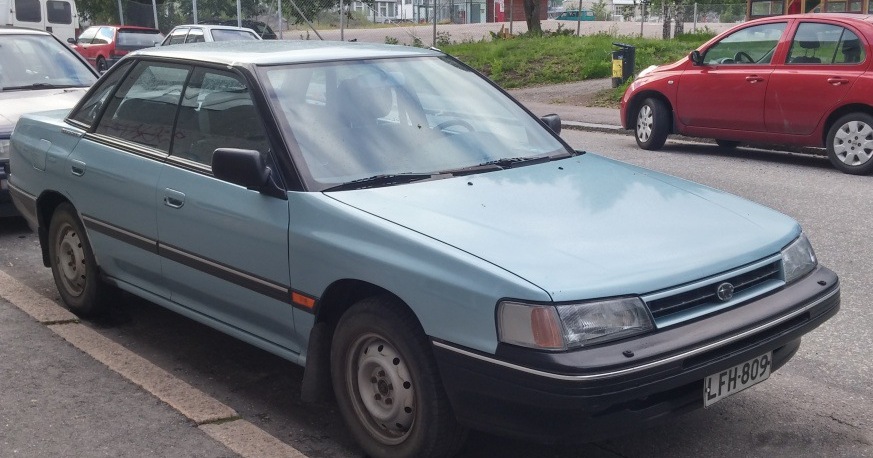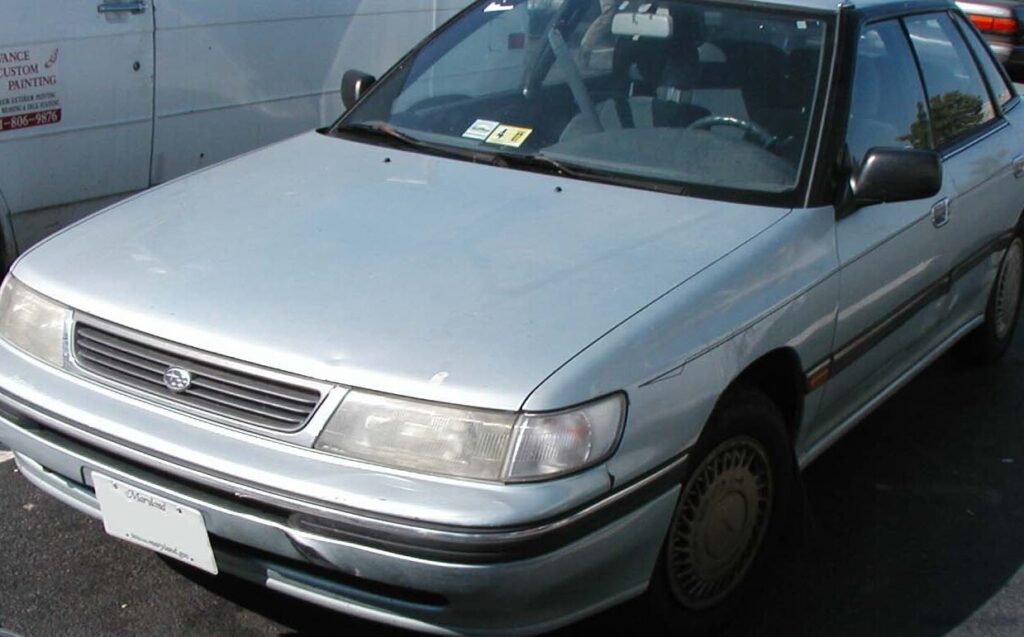
The Subaru Legacy I (BC, facelift released in 1991) marked Subaru’s foray into the mid-size family sedan segment, offering a more spacious and refined alternative to their smaller models like the Leone. The 1600 variant, producing 95 horsepower, was a significant model, especially in markets prioritizing smaller displacement engines due to taxation or fuel economy. Production of this facelifted version spanned from 1991 to 1994, building upon the original BC platform launched in 1989. This model was a foundational step for Subaru, establishing the Legacy as a competitor against established Japanese and European sedans.
Technical Specifications
| Brand | Subaru |
| Model | Legacy |
| Generation | Legacy I (BC, facelift 1991) |
| Type (Engine) | 1600 (95 Hp) |
| Start of production | 1991 |
| End of production | 1994 |
| Powertrain Architecture | Internal Combustion engine |
| Body type | Sedan |
| Seats | 5 |
| Doors | 4 |
| Fuel Type | Petrol (Gasoline) |
| Power | 95 Hp @ 6400 rpm |
| Power per litre | 59.5 Hp/l |
| Torque | 123 Nm @ 3200 rpm / 90.72 lb.-ft. @ 3200 rpm |
| Engine layout | Front, Longitudinal |
| Engine Model/Code | EJ16 |
| Engine displacement | 1597 cm3 / 97.45 cu. in. |
| Number of cylinders | 4 |
| Engine configuration | Boxer |
| Cylinder Bore | 87.9 mm / 3.46 in. |
| Piston Stroke | 65.8 mm / 2.59 in. |
| Compression ratio | 8.9:1 |
| Number of valves per cylinder | 4 |
| Fuel injection system | Multi-port manifold injection |
| Engine aspiration | Naturally aspirated engine |
| Engine oil capacity | 4 l / 4.23 US qt | 3.52 UK qt |
| Coolant | 6.3 l / 6.66 US qt | 5.54 UK qt |
| Trunk (boot) space – minimum | 405 l / 14.3 cu. ft. |
| Trunk (boot) space – maximum | 630 l / 22.25 cu. ft. |
| Fuel tank capacity | 60 l / 15.85 US gal | 13.2 UK gal |
| Length | 4545 mm / 178.94 in. |
| Width | 1690 mm / 66.54 in. |
| Height | 1380 mm / 54.33 in. |
| Wheelbase | 2580 mm / 101.57 in. |
| Front track | 1475 mm / 58.07 in. |
| Rear (Back) track | 1460 mm / 57.48 in. |
| Ride height (ground clearance) | 160 mm / 6.3 in. |
| Minimum turning circle (turning diameter) | 10.1 m / 33.14 ft. |
| Drivetrain Architecture | The Internal combustion engine (ICE) drives the front wheels of the vehicle. |
| Drive wheel | Front wheel drive |
| Number of gears and type of gearbox | 5 gears, manual transmission |
| Front suspension | Independent type McPherson |
| Rear suspension | Several levers and rods |
| Front brakes | Ventilated discs |
| Rear brakes | Drum |
| Assisting systems | ABS (Anti-lock braking system) |
| Steering type | Steering rack and pinion |
| Power steering | Hydraulic Steering |
| Wheel rims size | 13 |
Powertrain & Engine Architecture
The 1600 Legacy’s engine was the EJ16, a 1.6-liter, naturally aspirated, four-cylinder boxer engine. Subaru’s horizontally-opposed “boxer” design was a key feature, providing inherent balance and a lower center of gravity compared to traditional inline engines. The EJ16 featured multi-port fuel injection, a relatively advanced system for the time, improving fuel efficiency and smoothing power delivery. The engine produced 95 horsepower at 6400 rpm and 123 Nm (90.72 lb-ft) of torque at 3200 rpm. The 8.9:1 compression ratio balanced performance with the ability to run on commonly available fuel grades. This engine was standard with a five-speed manual transmission, giving drivers control over the engine’s power band.
Driving Characteristics
The 1.6L engine, while not powerful, offered adequate performance for daily driving. Acceleration was modest, and overtaking required planning. The five-speed manual transmission allowed drivers to keep the engine in its optimal range, but it lacked the low-end torque of larger engines. Compared to the later 2.2L models, the 1.6L Legacy felt noticeably slower, especially when loaded. The front-wheel-drive configuration provided predictable handling, though not as engaging as Subaru’s future all-wheel-drive systems. The suspension prioritized ride comfort over sporty handling.
Equipment & Trim Levels
The 1600 Legacy typically represented the entry-level trim in many markets. Standard equipment included cloth upholstery, a simple dashboard, and manual windows and locks. Power steering was often standard, but air conditioning and other features were usually optional. The interior was functional and durable, prioritizing practicality. Optional extras included upgraded audio systems, alloy wheels, and a sunroof. The trim level was usually indicated by a badge on the rear of the vehicle.
Chassis & Braking
The Legacy I used a McPherson strut front suspension and a multi-link rear suspension, providing a comfortable ride and reasonable handling. The front brakes were ventilated discs, offering good stopping power, while the rear brakes were drums, a cost-saving measure. ABS (Anti-lock Braking System) was optional, enhancing safety during emergency braking. The chassis balanced rigidity with weight reduction, contributing to handling. The relatively narrow tires (typically 175/70R13 or 185/60R14) prioritized fuel economy over grip.
Market Reception & Comparison
The 1600 Legacy was generally well-received as a practical and reliable family sedan. Critics praised its spacious interior, comfortable ride, and fuel efficiency. However, the engine’s lack of power was a common criticism compared to competitors with larger engines. Compared to the higher-spec 2.2L models, the 1.6L Legacy offered a more affordable entry point, appealing to budget-conscious buyers. Fuel economy was a key selling point, making it attractive in markets with high fuel prices or strict emissions regulations. The 1.6L model was seen as a sensible and economical choice for commuting.
Legacy
The EJ16 engine, while not high-performance, proved remarkably durable and reliable. Many examples are still on the road today, demonstrating Subaru’s engineering quality. The 1600 Legacy, often overshadowed by its more powerful siblings, played a crucial role in establishing the Legacy as a successful model line. In the used car market, these models are sought after by enthusiasts looking for a simple, affordable, and reliable classic Subaru. Maintenance is generally straightforward, and parts availability remains reasonable, though some components may be harder to find. The 1.6L Legacy represents a solid and dependable entry point into classic Subaru ownership.