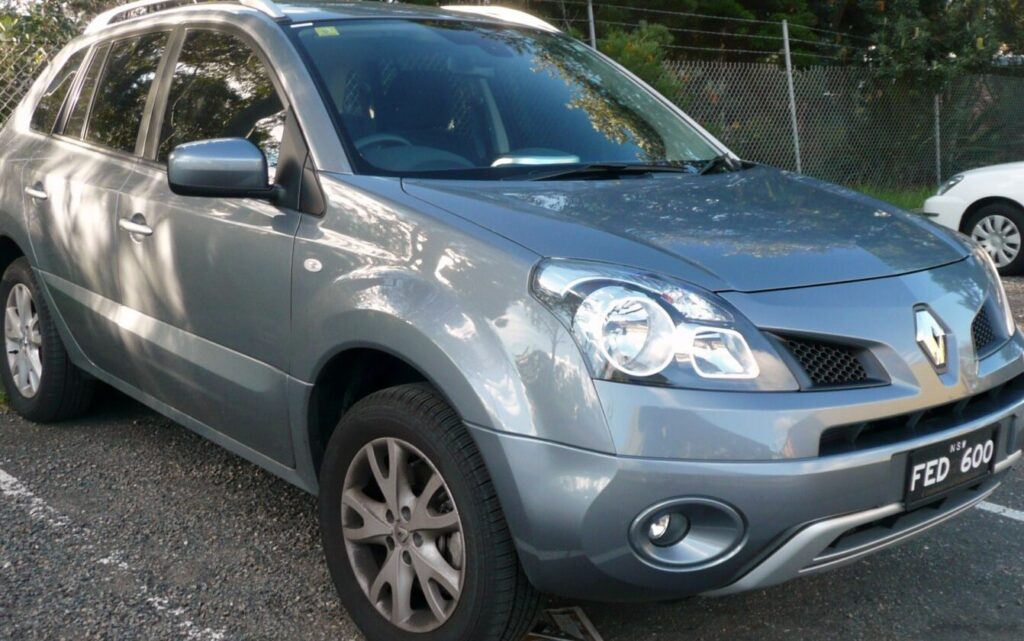
The Renault Koleos II 2.0 dCi (175 Hp) CVT was a front-wheel-drive compact SUV produced by the French manufacturer Renault from July 2018 through 2019. Positioned as a mid-range offering within the Koleos II lineup, it aimed to provide a balance between fuel efficiency, comfortable driving, and practicality for families. This variant was primarily marketed in Europe and other international markets, leveraging Renault’s established presence in the SUV segment. It was built on the Renault-Nissan Alliance’s Common Module Family (CMF) platform, specifically the CMF-C/D architecture, shared with models like the Nissan X-Trail and Qashqai.
Technical Specifications
| Brand | Renault |
| Model | Koleos |
| Generation | Koleos II |
| Type (Engine) | 2.0 dCi (175 Hp) CVT |
| Start of production | July, 2018 |
| End of production | 2019 |
| Powertrain Architecture | Internal Combustion engine |
| Body type | SUV |
| Seats | 5 |
| Doors | 5 |
| Fuel consumption (urban) | 5.8 l/100 km (40.6 US mpg, 48.7 UK mpg, 17.2 km/l) |
| Fuel consumption (extra urban) | 5.4 l/100 km (43.6 US mpg, 52.3 UK mpg, 18.5 km/l) |
| Fuel consumption (combined) | 5.5 l/100 km (42.8 US mpg, 51.4 UK mpg, 18.2 km/l) |
| CO2 emissions | 146 g/km |
| Fuel Type | Diesel |
| Acceleration 0 – 100 km/h | 9.3 sec |
| Acceleration 0 – 62 mph | 9.3 sec |
| Acceleration 0 – 60 mph | 8.8 sec |
| Maximum speed | 202 km/h (125.52 mph) |
| Emission standard | Euro 6b |
| Weight-to-power ratio | 9.9 kg/Hp, 100.9 Hp/tonne |
| Weight-to-torque ratio | 4.6 kg/Nm, 219 Nm/tonne |
| Power | 175 Hp @ 3750 rpm |
| Power per litre | 87.7 Hp/l |
| Torque | 380 Nm @ 2000 rpm (280.27 lb.-ft. @ 2000 rpm) |
| Engine layout | Front, Transverse |
| Engine Model/Code | M9R |
| Engine displacement | 1995 cm3 (121.74 cu. in.) |
| Number of cylinders | 4 |
| Engine configuration | Inline |
| Number of valves per cylinder | 4 |
| Fuel injection system | Diesel Commonrail |
| Engine aspiration | Turbocharger, Intercooler |
| Engine oil capacity | 7.4 l (7.82 US qt | 6.51 UK qt) |
| Coolant capacity | 7.9 l (8.35 US qt | 6.95 UK qt) |
| Kerb Weight | 1735 kg (3825.02 lbs.) |
| Max. weight | 2300 kg (5070.63 lbs.) |
| Max load | 565 kg (1245.61 lbs.) |
| Trunk (boot) space – minimum | 530 l (18.72 cu. ft.) |
| Trunk (boot) space – maximum | 1677 l (59.22 cu. ft.) |
| Fuel tank capacity | 60 l (15.85 US gal | 13.2 UK gal) |
| Max. roof load | 80 kg (176.37 lbs.) |
| Permitted trailer load with brakes (12%) | 2000 kg (4409.25 lbs.) |
| Permitted trailer load without brakes | 750 kg (1653.47 lbs.) |
| Permitted towbar download | 75 kg (165.35 lbs.) |
| Length | 4673 mm (183.98 in.) |
| Width | 1843 mm (72.56 in.) |
| Width with mirrors folded | 1864 mm (73.39 in.) |
| Width including mirrors | 2063 mm (81.22 in.) |
| Height | 1673 mm (65.87 in.) |
| Wheelbase | 2705 mm (106.5 in.) |
| Front track | 1591 mm (62.64 in.) |
| Rear track | 1586 mm (62.44 in.) |
| Front overhang | 930 mm (36.61 in.) |
| Rear overhang | 1038 mm (40.87 in.) |
| Ride height (ground clearance) | 210 mm (8.27 in.) |
| Minimum turning circle | 11.4 m (37.4 ft.) |
| Drivetrain | Front wheel drive |
| Number of gears and type of gearbox | automatic transmission CVT |
| Front brakes | Ventilated discs |
| Rear brakes | Ventilated discs |
| Tires size | 225/55 R19 |
| Wheel rims size | 19 |
INTRODUCTION
The Renault Koleos II, launched in 2017, represented Renault’s attempt to gain a stronger foothold in the increasingly popular mid-size SUV market. The 2.0 dCi 175 Hp CVT variant, introduced in 2018, offered a diesel-powered option with the convenience of a continuously variable transmission. This model aimed to appeal to buyers seeking a comfortable, practical, and relatively fuel-efficient SUV for everyday use. It sat in the middle of the Koleos II range, offering more power and refinement than the base models, but remaining more accessible than the higher-specification trims.
Powertrain & Engine Architecture
At the heart of the Koleos II 2.0 dCi CVT lies the Renault M9R engine, a 1.995-liter inline-four cylinder diesel engine. This engine utilizes a common-rail direct injection system, delivering fuel at extremely high pressure for optimized combustion. The M9R engine is equipped with a turbocharger and intercooler, enhancing power output and efficiency. The 175 horsepower output is achieved at 3750 rpm, while peak torque of 380 Nm (280 lb-ft) is available from 2000 rpm, providing good low-end responsiveness. Paired with this engine is a CVT (Continuously Variable Transmission), offering seamless gear changes and contributing to improved fuel economy. Unlike traditional automatic transmissions with fixed gear ratios, a CVT uses a belt and pulley system to provide an infinite number of gear ratios within its operating range.
Driving Characteristics
The Koleos II 2.0 dCi CVT delivers a comfortable and relaxed driving experience. The CVT transmission, while not offering the sporty feel of a traditional automatic, provides smooth acceleration and eliminates noticeable gear shifts. Acceleration from 0 to 100 km/h (0-62 mph) takes approximately 9.3 seconds, which is adequate for everyday driving but doesn’t position it as a performance-oriented SUV. The readily available torque from the diesel engine makes overtaking at highway speeds relatively effortless. Compared to the manual transmission versions of the same engine, the CVT prioritizes smoothness and fuel efficiency over outright performance. Higher-output versions of the 2.0 dCi, available in some markets, offered more spirited acceleration, but at the expense of fuel economy.
Equipment & Trim Levels
The 2.0 dCi CVT trim typically included a generous level of standard equipment. Interior features generally included cloth upholstery, a leather-wrapped steering wheel, and a touchscreen infotainment system with navigation. Safety features such as ABS, electronic stability control, and multiple airbags were standard. Optional extras included leather seats, a panoramic sunroof, parking sensors, and a premium audio system. The Koleos II aimed for a comfortable and well-equipped interior, focusing on practicality and ease of use.
Chassis & Braking
The Koleos II utilizes a MacPherson strut front suspension and a multi-link rear suspension, providing a comfortable ride quality. The suspension is tuned to prioritize comfort over sporty handling. Braking duties are handled by ventilated discs on all four wheels, providing adequate stopping power. The Koleos II’s chassis is designed to provide stability and control, particularly when fully loaded. The front-wheel-drive configuration contributes to reduced weight and improved fuel efficiency compared to all-wheel-drive variants.
Market Reception & Comparison
The Renault Koleos II 2.0 dCi CVT received generally positive reviews, with critics praising its comfortable ride, spacious interior, and fuel efficiency. However, some reviewers noted that the CVT transmission could feel somewhat unresponsive at times, and the overall driving experience wasn’t as engaging as some of its competitors. Compared to other diesel SUVs in its class, such as the Peugeot 3008 or the Volkswagen Tiguan, the Koleos II offered a competitive level of equipment and value for money. The fuel economy of around 5.5 l/100 km (42.8 US mpg) was considered respectable for a vehicle of its size and weight.
Legacy
The Renault Koleos II 2.0 dCi CVT, while not a groundbreaking vehicle, proved to be a reliable and practical SUV for many owners. The M9R diesel engine, while having a history of potential issues with particulate filters and turbochargers if not properly maintained, generally proved durable. On the used car market, these models represent a relatively affordable option for buyers seeking a spacious and comfortable SUV. Regular maintenance, particularly regarding the diesel particulate filter, is crucial for ensuring the long-term reliability of this powertrain.