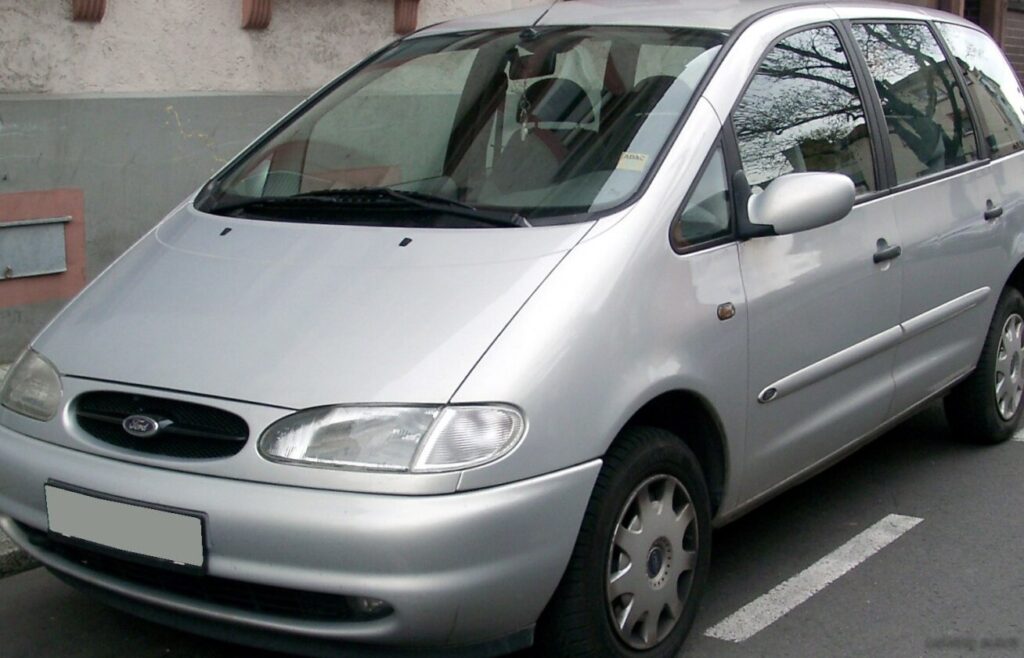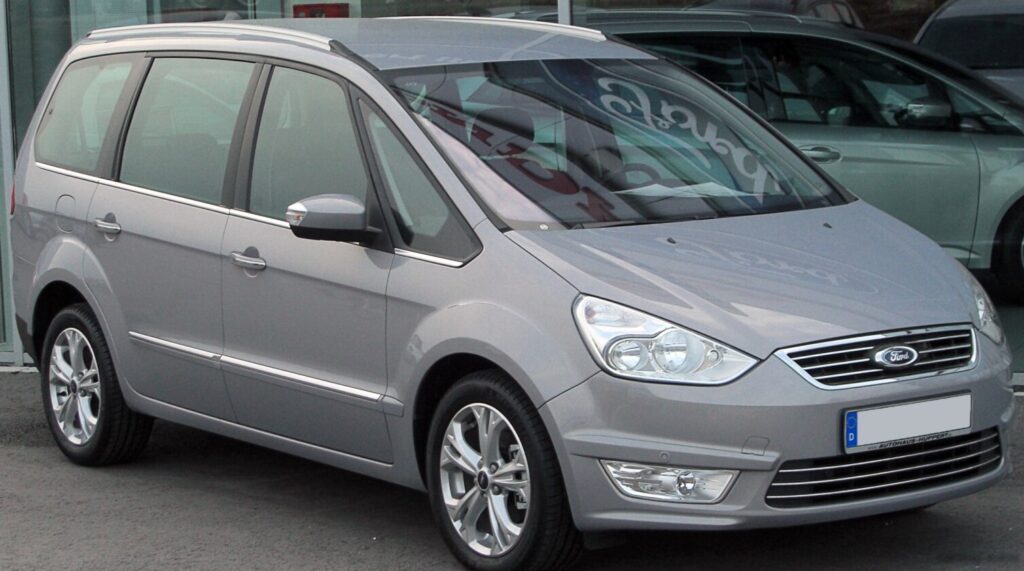
The Ford Galaxy II, specifically the 2.0 TDCi variant producing 140 horsepower, represents a significant iteration in Ford’s minivan offerings. Introduced with the facelift in May 2010 and continuing through 2015, this model year built upon the success of the first-generation Galaxy, further refining its blend of practicality, space, and driving comfort. Positioned as a mid-range option within the Galaxy II lineup, the 2.0 TDCi 140hp offered a balance between fuel efficiency and performance, appealing to families and those requiring a versatile seven-seater. It was a key model for Ford in the European market, where large MPVs remained popular, competing with vehicles like the Renault Espace and Volkswagen Sharan.
Technical Specifications
| Brand | Ford |
| Model | Galaxy |
| Generation | Galaxy II (facelift 2010) |
| Type (Engine) | 2.0 TDCi (140 Hp) |
| Start of production | May, 2010 |
| End of production | 2015 |
| Powertrain Architecture | Internal Combustion engine |
| Body type | Minivan |
| Seats | 7 |
| Doors | 5 |
| Fuel consumption (economy) – urban (NEDC) | 6.5 l/100 km (36.2 US mpg, 43.5 UK mpg, 15.4 km/l) |
| Fuel consumption (economy) – extra urban (NEDC) | 4.7 l/100 km (50 US mpg, 60.1 UK mpg, 21.3 km/l) |
| Fuel consumption (economy) – combined (NEDC) | 5.3 l/100 km (44.4 US mpg, 53.3 UK mpg, 18.9 km/l) |
| CO2 emissions (NEDC) | 139 g/km |
| Fuel Type | Diesel |
| Acceleration 0 – 100 km/h | 10.6 sec |
| Acceleration 0 – 62 mph | 10.6 sec |
| Acceleration 0 – 60 mph | 10.1 sec |
| Maximum speed | 193 km/h (119.92 mph) |
| Emission standard | Euro 5 |
| Weight-to-power ratio | 11.8 kg/Hp, 84.4 Hp/tonne |
| Weight-to-torque ratio | 5.2 kg/Nm, 193 Nm/tonne |
| Power | 140 Hp @ 3750 rpm |
| Power per litre | 70.1 Hp/l |
| Torque | 320 Nm @ 1750-2750 rpm (236.02 lb.-ft. @ 1750-2750 rpm) |
| Engine layout | Front, Transverse |
| Engine Model/Code | UFWA |
| Engine displacement | 1997 cm3 (121.86 cu. in.) |
| Number of cylinders | 4 |
| Engine configuration | Inline |
| Cylinder Bore | 85 mm (3.35 in.) |
| Piston Stroke | 88 mm (3.46 in.) |
| Number of valves per cylinder | 4 |
| Fuel injection system | Diesel Commonrail |
| Engine aspiration | Turbocharger, Intercooler |
| Valvetrain | DOHC |
| Engine oil capacity | 5.5 l (5.81 US qt | 4.84 UK qt) |
| Coolant | 8.1 l (8.56 US qt | 7.13 UK qt) |
| Kerb Weight | 1658 kg (3655.26 lbs.) |
| Max. weight | 2505 kg (5522.58 lbs.) |
| Max load | 847 kg (1867.32 lbs.) |
| Trunk (boot) space – minimum | 308 l (10.88 cu. ft.) |
| Trunk (boot) space – maximum | 2325 l (82.11 cu. ft.) |
| Fuel tank capacity | 70 l (18.49 US gal | 15.4 UK gal) |
| Max. roof load | 75 kg (165.35 lbs.) |
| Permitted trailer load with brakes (8%) | 2000 kg (4409.25 lbs.) |
| Permitted trailer load with brakes (12%) | 1800 kg (3968.32 lbs.) |
| Permitted trailer load without brakes | 750 kg (1653.47 lbs.) |
| Permitted towbar download | 90 kg (198.42 lbs.) |
| Length | 4819 mm (189.72 in.) |
| Width | 1884 mm (74.17 in.) |
| Width with mirrors folded | 1961 mm (77.2 in.) |
| Width including mirrors | 2154 mm (84.8 in.) |
| Height | 1770-1811 mm (69.69 – 71.3 in.) |
| Wheelbase | 2850 mm (112.2 in.) |
| Front track | 1578-1588 mm (62.13 – 62.52 in.) |
| Rear (Back) track | 1595-1605 mm (62.8 – 63.19 in.) |
| Minimum turning circle (turning diameter) | 11.9 m (39.04 ft.) |
| Drivetrain Architecture | The Internal combustion engine (ICE) drives the front wheels of the vehicle. |
| Drive wheel | Front wheel drive |
| Number of gears and type of gearbox | 6 gears, manual transmission |
| Front suspension | Independent, type McPherson with coil spring and anti-roll bar |
| Rear suspension | Independent multi-link spring suspension with stabilizer |
| Front brakes | Ventilated discs |
| Rear brakes | Disc |
| Assisting systems | ABS (Anti-lock braking system) |
| Steering type | Steering rack and pinion |
| Power steering | Electric Steering |
| Tires size | 215/60 R16; 225/50 R17; 235/45 R18 |
| Wheel rims size | 6.5J x 16; 7J x 17; 8J x 18 |
INTRODUCTION
The Ford Galaxy II (facelift 2010) 2.0 TDCi 140hp is a front-wheel-drive minivan produced by Ford between 2010 and 2015. This version falls within the second generation of the Galaxy (WA6), which was jointly developed with the Volkswagen Sharan and SEAT Alhambra, sharing the Volkswagen Group’s PQ46 platform. The 2010 facelift brought revised styling, improved interior materials, and updated engine options, including this 2.0-liter turbodiesel. The Galaxy, in general, was designed to cater to European families needing a spacious and versatile vehicle, offering seven seats as standard and a large boot capacity. The 2.0 TDCi 140hp variant was positioned as a sensible choice, balancing running costs with adequate performance for everyday driving.
Powertrain & Engine Architecture
The heart of this Galaxy variant is the 2.0-liter TDCi diesel engine, designated with the engine code UFWA. This engine is a four-cylinder, inline configuration, utilizing a common-rail direct fuel injection system. The TDCi (Turbo Diesel Common Injection) technology, developed by Ford, delivers fuel directly into the cylinders at very high pressure, optimizing combustion and improving efficiency. The engine features a turbocharger with an intercooler, boosting power output and torque. The double overhead camshaft (DOHC) valvetrain, with four valves per cylinder, further enhances breathing and performance. The 140 horsepower peak is achieved at 3750 rpm, while the 320 Nm (236 lb-ft) of torque is available between 1750 and 2750 rpm, providing good low-end grunt for effortless cruising and overtaking. The engine is paired with a six-speed manual transmission, delivering power to the front wheels. While an automatic transmission was available on other Galaxy models, the 140hp version was primarily offered with the manual gearbox.
Driving Characteristics
The 2.0 TDCi 140hp Galaxy offers a comfortable and composed driving experience. While not particularly sporty, the engine provides sufficient power for typical family duties. Acceleration from 0-62 mph takes around 10.6 seconds, which is adequate for merging onto highways and overtaking slower traffic. The readily available torque makes it feel more responsive than the figures suggest, particularly in the mid-range. The six-speed manual transmission is well-matched to the engine, allowing drivers to keep the engine in its optimal power band. Compared to the higher-output 2.0 TDCi variants (typically 163hp), this version feels less eager to rev, but it compensates with improved fuel economy. The Galaxy’s suspension is tuned for comfort, absorbing bumps and imperfections in the road effectively. The steering is light and precise, making it easy to maneuver in urban environments.
Equipment & Trim Levels
The 2.0 TDCi 140hp Galaxy typically came equipped with a respectable level of standard features. These included air conditioning, electric front windows, a CD stereo system, and alloy wheels. Higher trim levels, such as Titanium, added features like automatic climate control, rear parking sensors, cruise control, and upgraded interior trim. Interior upholstery was typically cloth, with options for leather available on higher-spec models. The dashboard layout was functional and user-friendly, with clear instrumentation and logically placed controls. Optional extras included a panoramic sunroof, satellite navigation, and a rear entertainment system.
Chassis & Braking
The Galaxy II utilizes an independent suspension setup on both the front and rear axles. The front suspension employs a McPherson strut design with coil springs and an anti-roll bar, while the rear features a multi-link setup, also with coil springs and a stabilizer bar. This configuration provides a good balance between ride comfort and handling. Braking duties are handled by ventilated discs on the front wheels and solid discs on the rear. Anti-lock Braking System (ABS) is standard, enhancing safety and stability during emergency braking. The steering system is a rack and pinion type with electric power assistance, providing a light and responsive feel.
Market Reception & Comparison
The Ford Galaxy II 2.0 TDCi 140hp was generally well-received by automotive critics. It was praised for its spacious interior, comfortable ride, and fuel efficiency. However, some reviewers noted that the engine could feel a little underpowered when fully loaded with passengers and luggage. Compared to the more powerful 2.0 TDCi variants, the 140hp version offered better fuel economy – around 5.3 l/100km (44.4 US mpg) combined – making it an attractive option for those prioritizing running costs. The 1.9 TDI versions of the Volkswagen Sharan and SEAT Alhambra offered similar fuel economy and performance, but the Galaxy often provided better value for money.
Legacy
The 2.0 TDCi UFWA engine, while generally reliable, is known to require regular maintenance, particularly regarding the diesel particulate filter (DPF). Proper servicing and the use of high-quality diesel fuel are crucial to prevent DPF blockages. The Galaxy II, as a whole, has proven to be a durable and practical vehicle, and well-maintained examples continue to be popular on the used car market. The 2.0 TDCi 140hp variant represents a sensible and affordable option for families seeking a spacious and versatile MPV, offering a good balance of fuel efficiency, comfort, and practicality. Its enduring appeal lies in its ability to comfortably accommodate seven passengers and a substantial amount of luggage, making it a valuable asset for those with active lifestyles.