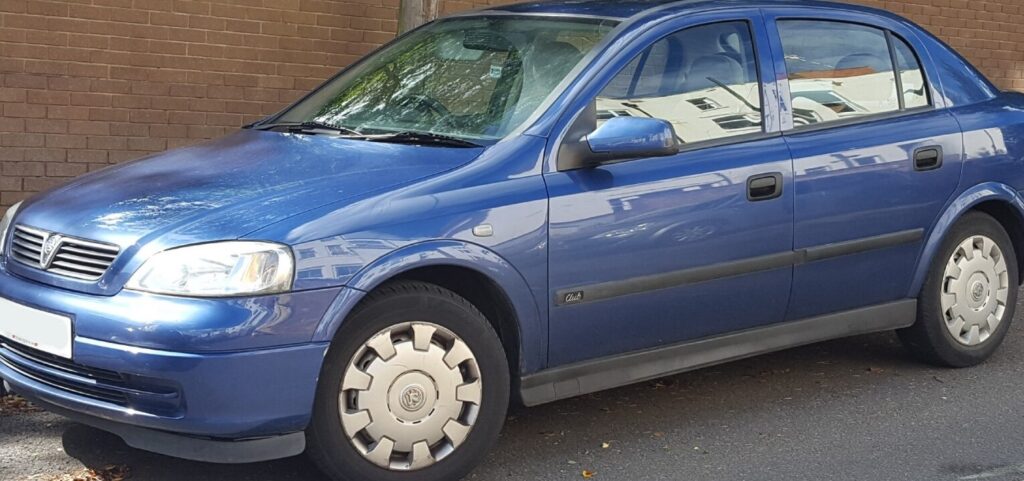
The Vauxhall Astra Mark IV, produced from 1998 to 2004, represented a significant step forward for the British marque, sharing its platform (the 1HX0/A3) with the Opel Astra. Within the fourth-generation Astra range, the 1.7 TD variant, powered by the X17DTL engine and producing 68 horsepower, occupied the entry-level position. This model was primarily aimed at buyers prioritizing fuel economy and low running costs, particularly in European markets where diesel engines were increasingly popular. While not known for its outright performance, the 1.7 TD offered a practical and affordable option within the compact family car segment.
Technical Specifications
| Brand | Vauxhall |
| Model | Astra |
| Generation | Astra Mk IV CC |
| Type (Engine) | 1.7 TD (68 Hp) |
| Start of production | 1998 |
| End of production | 2004 |
| Powertrain Architecture | Internal Combustion engine |
| Body type | Hatchback |
| Seats | 5 |
| Doors | 3-5 |
| Fuel consumption (urban) | 7.7 l/100 km (30.5 US mpg, 36.7 UK mpg, 13 km/l) |
| Fuel consumption (extra urban) | 4.9 l/100 km (48 US mpg, 57.6 UK mpg, 20.4 km/l) |
| Fuel consumption (combined) | 5.9 l/100 km (39.9 US mpg, 47.9 UK mpg, 16.9 km/l) |
| Fuel Type | Diesel |
| Acceleration 0 – 100 km/h | 17 sec |
| Acceleration 0 – 62 mph | 17 sec |
| Acceleration 0 – 60 mph | 16.2 sec |
| Maximum speed | 163 km/h (101.28 mph) |
| Weight-to-power ratio | 16.4 kg/Hp |
| Weight-to-torque ratio | 8.4 kg/Nm |
| Power | 68 Hp @ 4500 rpm |
| Power per litre | 40.3 Hp/l |
| Torque | 132 Nm @ 1800 rpm (97.36 lb.-ft. @ 1800 rpm) |
| Engine layout | Front, Transverse |
| Engine Model/Code | X17DTL |
| Engine displacement | 1686 cm3 (102.89 cu. in.) |
| Number of cylinders | 4 |
| Engine configuration | Inline |
| Cylinder Bore | 79 mm (3.11 in.) |
| Piston Stroke | 86 mm (3.39 in.) |
| Compression ratio | 18.4:1 |
| Number of valves per cylinder | 4 |
| Fuel injection system | Precombustion chamber injection |
| Engine aspiration | Turbocharger |
| Engine oil capacity | 5.5 l (5.81 US qt | 4.84 UK qt) |
| Coolant capacity | 8.7 l (9.19 US qt | 7.65 UK qt) |
| Kerb Weight | 1115 kg (2458.15 lbs.) |
| Max. weight | 1665 kg (3670.7 lbs.) |
| Max load | 550 kg (1212.54 lbs.) |
| Trunk (boot) space – minimum | 370 l (13.07 cu. ft.) |
| Trunk (boot) space – maximum | 1180 l (41.67 cu. ft.) |
| Fuel tank capacity | 52 l (13.74 US gal | 11.44 UK gal) |
| Length | 4110 mm (161.81 in.) |
| Width | 1710 mm (67.32 in.) |
| Width including mirrors | 1967 mm (77.44 in.) |
| Height | 1425 mm (56.1 in.) |
| Wheelbase | 2606 mm (102.6 in.) |
| Ride height (ground clearance) | 130 mm (5.12 in.) |
| Minimum turning circle | 10 m (32.81 ft.) |
| Drivetrain Architecture | Front wheel drive |
| Number of gears | 5 |
| Gearbox type | Manual transmission |
| Front brakes | Ventilated discs |
| Rear brakes | Drum |
| Tires size | 195/60 R15 |
| Wheel rims size | 15 |
Powertrain & Engine Architecture
The heart of the Astra 1.7 TD was the X17DTL engine, a 1.7-liter inline-four diesel. This engine utilized a precombustion chamber injection system, a common technology in diesel engines of the era. This system involved injecting fuel into a precombustion chamber, where it partially ignited before being fully combusted in the main cylinder. This design aided in smoother combustion and reduced engine noise. The engine was turbocharged, providing a modest boost in power and torque. The five-speed manual transmission was the only gearbox option available with this engine, prioritizing fuel efficiency over sporty driving dynamics. The X17DTL, while not a powerhouse, was known for its durability and relatively simple mechanical design.
Driving Characteristics
The 1.7 TD Astra was not designed for rapid acceleration. Its 68 horsepower and 132 Nm (97 lb-ft) of torque resulted in a 0-60 mph time of around 16.2 seconds and a top speed of 101 mph. The engine felt strained at higher speeds, and overtaking required careful planning. However, the engine’s torque delivery was relatively strong at lower RPMs, making it suitable for everyday driving and urban commutes. The five-speed manual transmission was well-matched to the engine’s characteristics, allowing drivers to keep the engine in its optimal power band. Compared to the more powerful Astra variants, such as the 1.8-liter petrol or the 2.0-liter diesel, the 1.7 TD offered a significantly more economical driving experience, but at the expense of performance.
Equipment & Trim Levels
The 1.7 TD Astra typically came with a basic level of equipment, reflecting its position as the entry-level model. Standard features generally included central locking, power steering, and an adjustable steering column. Interior upholstery was typically cloth, and the dashboard featured a simple, functional design. Optional extras, such as air conditioning, electric windows, and alloy wheels, were available, but often added a significant cost to the vehicle. Trim levels varied slightly depending on the market, but generally focused on adding cosmetic enhancements and convenience features.
Chassis & Braking
The Astra Mk IV utilized a MacPherson strut front suspension and a torsion beam rear suspension. This setup provided a comfortable ride quality, although it wasn’t particularly sporty. The front brakes were ventilated discs, offering adequate stopping power, while the rear brakes were drums, a cost-saving measure common in entry-level models. The 1.7 TD Astra’s relatively light weight helped to compensate for the less powerful braking system. Stabilizer bars were fitted to both the front and rear axles, helping to reduce body roll during cornering.
Market Reception & Comparison
The Astra 1.7 TD was well-received by buyers seeking an economical and reliable family car. Critics praised its fuel efficiency and low running costs, but noted its lack of performance. Compared to other trims in the Astra lineup, the 1.7 TD offered the lowest purchase price and the best fuel economy. However, the more powerful petrol and diesel variants provided a more engaging driving experience. In terms of reliability, the X17DTL engine proved to be generally robust, although regular maintenance was essential to prevent issues with the turbocharger and fuel injection system.
Legacy
The Vauxhall Astra Mk IV 1.7 TD has become a popular choice among budget-conscious used car buyers. Its simple mechanical design and relatively low maintenance costs make it an attractive option for those seeking affordable transportation. While not a collector’s item, well-maintained examples are still relatively common on the roads today. The X17DTL engine, despite its age, is known for its durability, and many examples have exceeded 200,000 miles. The Astra 1.7 TD represents a practical and economical choice for drivers prioritizing fuel efficiency and reliability over outright performance.