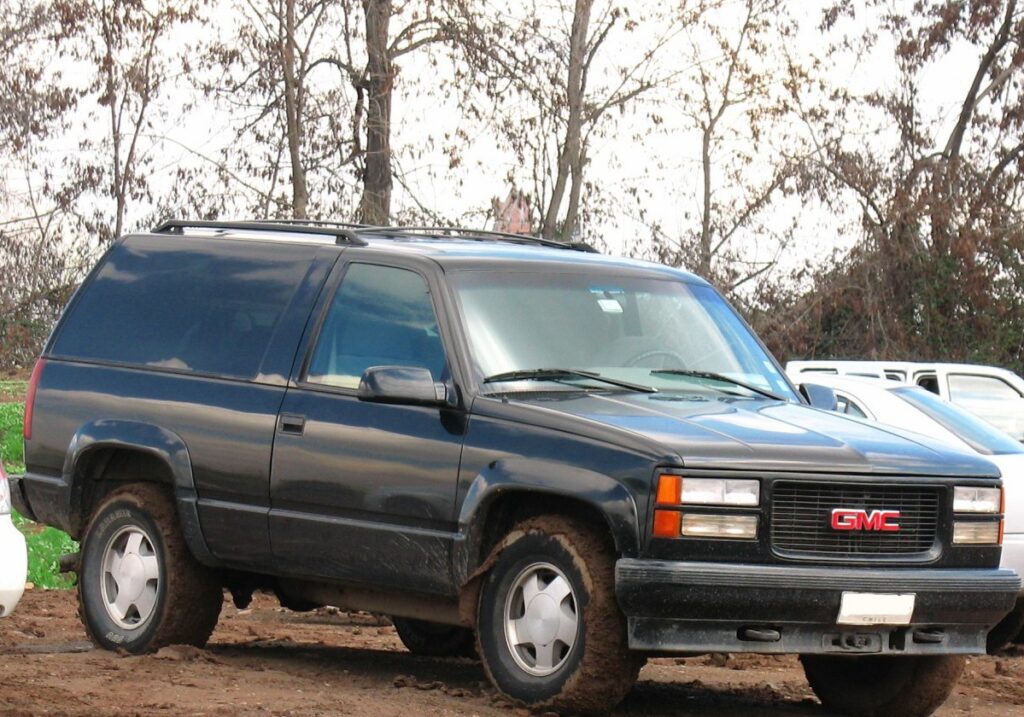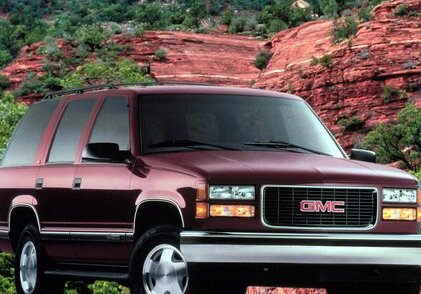
The GMC Yukon I, specifically the 5-door model equipped with the 5.7-liter V8 engine and automatic transmission, represents a significant entry in the full-size SUV market of the mid-1990s. Produced from 1995 through 1999, this iteration of the Yukon (based on the GMT400 platform) served as GMC’s offering in a segment increasingly popular with American families and those needing substantial towing capacity. It shared its core architecture with the Chevrolet Tahoe and Cadillac Escalade, but distinguished itself through unique styling and trim options. This particular 5.7L automatic configuration occupied a mid-range position within the Yukon lineup, offering a balance between performance and affordability, slotting below the more expensive, and often 4×4 equipped, higher trim levels.
Technical Specifications
| Brand | GMC |
| Model | Yukon |
| Generation | Yukon I (GMT400, 5-door) |
| Type (Engine) | 5.7 i V8 (258 Hp) Automatic |
| Start of production | 1995 |
| End of production | 1999 |
| Powertrain Architecture | Internal Combustion engine |
| Body type | SUV |
| Seats | 5 |
| Doors | 5 |
| Fuel consumption (urban) | 15.7 l/100 km (15 US mpg / 18 UK mpg) |
| Fuel consumption (extra urban) | 12.4 l/100 km (19 US mpg / 22.8 UK mpg) |
| Fuel Type | Petrol (Gasoline) |
| Weight-to-power ratio | 8.8 kg/Hp |
| Weight-to-torque ratio | 5.1 kg/Nm |
| Power | 258 Hp @ 4600 rpm |
| Power per litre | 45 Hp/l |
| Torque | 447 Nm @ 2800 rpm (329.69 lb.-ft. @ 2800 rpm) |
| Engine layout | Front, Longitudinal |
| Engine displacement | 5733 cm3 (349.85 cu. in.) |
| Number of cylinders | 8 |
| Engine configuration | V-engine |
| Number of valves per cylinder | 2 |
| Fuel injection system | Multi-port manifold injection |
| Engine oil capacity | 4.8 l (5.07 US qt / 4.22 UK qt) |
| Coolant capacity | 16.5 l (17.44 US qt / 14.52 UK qt) |
| Kerb Weight | 2280 kg (5026.54 lbs) |
| Max. weight | 2858 kg (6300.81 lbs) |
| Max load | 578 kg (1274.27 lbs) |
| Trunk (boot) space – maximum | 3347 l (118.2 cu. ft) |
| Fuel tank capacity | 114 l (30.12 US gal / 25.08 UK gal) |
| Length | 5070 mm (199.61 in) |
| Width | 1951 mm (76.81 in) |
| Height | 1848 mm (72.76 in) |
| Wheelbase | 2985 mm (117.52 in) |
| Front track | 1590 mm (62.6 in) |
| Rear track | 1615 mm (63.58 in) |
| Drivetrain Architecture | Rear wheel drive |
| Number of gears | 4 |
| Gearbox type | Automatic transmission |
| Front brakes | Disc |
| Rear brakes | Drum |
| Tires size | 235/75/ R16 |
| Wheel rims size | 16 |
Powertrain & Engine Architecture
The heart of this Yukon variant is the 5.7-liter (349.85 cubic inch) small-block Chevrolet V8 engine. This engine, internally designated as the Vortec 5700, represented a significant upgrade over previous generations. It featured a cast iron block and aluminum cylinder heads, incorporating sequential multi-port fuel injection (SMPI) for improved fuel efficiency and power delivery. The engine produced 258 horsepower at 4600 rpm and 329.69 lb-ft of torque at 2800 rpm. The 4L60E four-speed automatic transmission was the standard pairing for this engine. This transmission was electronically controlled, offering smoother shifts and improved reliability compared to earlier iterations. The 4L60E featured a torque converter lock-up clutch to enhance fuel economy at highway speeds.
Driving Characteristics
The 5.7L Yukon with the 4L60E automatic provided adequate, though not exhilarating, performance. Acceleration from 0 to 60 mph typically took around 8-9 seconds. The automatic transmission’s gear ratios were optimized for towing and everyday driving, prioritizing usability over outright speed. While the manual transmission equipped Yukons offered a more engaging driving experience, the automatic provided a more relaxed and convenient option, particularly in city traffic. The torque converter did introduce some power loss, making the automatic feel slightly less responsive than its manual counterpart. However, for the majority of Yukon buyers, the convenience and ease of use outweighed the performance deficit.
Equipment & Trim Levels
The base Yukon trim level, when equipped with the 5.7L engine and automatic transmission, typically included features such as air conditioning, power windows and locks, an AM/FM stereo, and cloth upholstery. Optional extras included leather upholstery, a premium sound system, a sunroof, and upgraded wheels. The Yukon also offered a range of convenience packages, bundling popular options together. The interior design was functional and durable, prioritizing practicality over luxury. The dashboard layout was straightforward, with easy-to-read gauges and logically placed controls.
Chassis & Braking
The GMT400 platform utilized a body-on-frame construction, providing a robust and durable chassis. The front suspension consisted of independent coil springs, while the rear suspension employed a leaf spring setup. This configuration was chosen for its load-carrying capacity and durability. The base Yukon models featured disc brakes in the front and drum brakes in the rear. While adequate for most driving conditions, the drum brakes in the rear were a point of criticism, particularly when towing heavy loads. Stabilizer bars were included to reduce body roll during cornering, but the Yukon’s high center of gravity and substantial weight limited its handling capabilities.
Market Reception & Comparison
The 1995-1999 GMC Yukon with the 5.7L V8 and automatic transmission was generally well-received by critics and consumers alike. It offered a compelling combination of space, comfort, and capability at a competitive price point. Compared to the 4.3L V6 Yukon, the 5.7L provided significantly more power and torque, making it a better choice for towing and hauling. However, it also consumed more fuel. Compared to the higher-trim Yukons with four-wheel drive, the 2WD 5.7L model was more affordable and offered better fuel economy, but lacked the off-road capability. Reliability was generally good, although the 4L60E transmission was known to have some issues if not properly maintained.
Legacy
The GMT400 Yukon, particularly the 5.7L automatic variant, remains a popular choice in the used car market today. Its robust construction, spacious interior, and relatively simple mechanicals make it a reliable and affordable option for those needing a full-size SUV. While fuel economy is not its strong suit, the 5.7L V8 provides ample power for most tasks. The 4L60E transmission, while potentially requiring maintenance, is generally well-supported with aftermarket parts. These Yukons are often sought after by those looking for a classic American SUV with a proven track record.