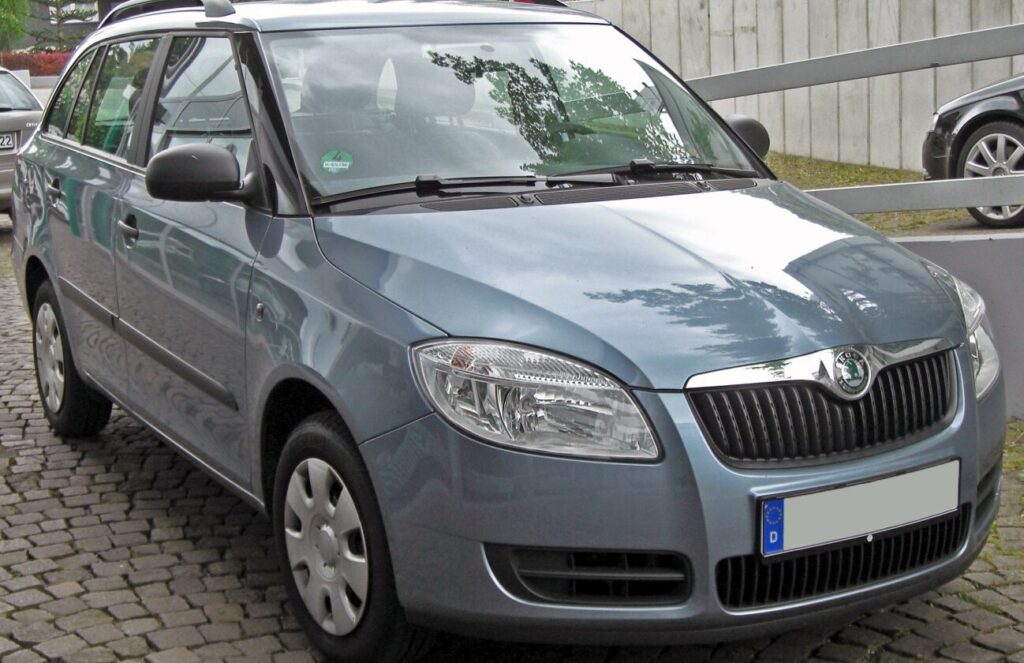
The Skoda Fabia II Combi 1.9 TDI (105 hp) DPF was a station wagon variant produced between 2007 and 2010, representing a practical and fuel-efficient option within the second generation Fabia lineup (Typ 5J). Positioned as a mid-range offering, it catered to buyers seeking the versatility of a wagon body style combined with the economy of a diesel engine. This model was primarily sold in Europe, where compact wagons were – and continue to be – a popular choice for families and individuals needing flexible cargo space. It was built on the Volkswagen Group’s A05 (Polo) platform, also known as the 1HX0/A3 platform, shared with the Volkswagen Polo Mk4 and SEAT Ibiza Mk3.
Technical Specifications
| Brand | Skoda |
| Model | Fabia |
| Generation | Fabia II Combi |
| Type (Engine) | 1.9 TDI (105 Hp) DPF |
| Start of production | 2007 |
| End of production | 2010 |
| Powertrain Architecture | Internal Combustion engine |
| Body type | Station wagon (estate) |
| Seats | 5 |
| Doors | 5 |
| Fuel consumption (urban) | 6.5 l/100 km (36.2 US mpg, 43.5 UK mpg) |
| Fuel consumption (extra urban) | 4.1 l/100 km (57.4 US mpg, 68.9 UK mpg) |
| Fuel consumption (combined) | 5 l/100 km (47 US mpg, 56.5 UK mpg) |
| CO2 emissions | 130 g/km |
| Fuel Type | Diesel |
| Acceleration 0 – 100 km/h | 11 sec |
| Acceleration 0 – 62 mph | 11 sec |
| Acceleration 0 – 60 mph | 10.5 sec |
| Maximum speed | 191 km/h (118.68 mph) |
| Emission standard | Euro 4 |
| Weight-to-power ratio | 11.2 kg/Hp |
| Weight-to-torque ratio | 4.9 kg/Nm |
| Power | 105 Hp @ 4000 rpm |
| Torque | 240 Nm @ 1900 rpm (177.01 lb.-ft. @ 1900 rpm) |
| Engine layout | Front, Transverse |
| Engine Model/Code | EA188 / BLS |
| Engine displacement | 1896 cm3 (115.7 cu. in.) |
| Number of cylinders | 4 |
| Engine configuration | Inline |
| Cylinder Bore | 79.5 mm (3.13 in.) |
| Piston Stroke | 95.5 mm (3.76 in.) |
| Compression ratio | 19:1 |
| Number of valves per cylinder | 2 |
| Fuel injection system | Pump-nozzle (Unit Injector) |
| Engine aspiration | Turbocharger, Intercooler |
| Valvetrain | SOHC |
| Engine oil capacity | 4.3 l (4.54 US qt | 3.78 UK qt) |
| Coolant capacity | 6.8 l (7.19 US qt | 5.98 UK qt) |
| Kerb Weight | 1175 kg (2590.43 lbs.) |
| Max. weight | 1705 kg (3758.88 lbs.) |
| Max load | 530 kg (1168.45 lbs.) |
| Trunk (boot) space – minimum | 505 l (17.83 cu. ft.) |
| Trunk (boot) space – maximum | 1485 l (52.44 cu. ft.) |
| Fuel tank capacity | 45 l (11.89 US gal | 9.9 UK gal) |
| Max. roof load | 75 kg (165.35 lbs.) |
| Permitted trailer load (braked) | 1200 kg (2645.55 lbs.) |
| Permitted trailer load (unbraked) | 450 kg (992.08 lbs.) |
| Permitted towbar download | 50 kg (110.23 lbs.) |
| Length | 4239 mm (166.89 in.) |
| Width | 1642 mm (64.65 in.) |
| Height | 1498 mm (58.98 in.) |
| Wheelbase | 2462 mm (96.93 in.) |
| Front track | 1420-1436 mm (55.91 – 56.54 in.) |
| Rear track | 1410-1426 mm (55.51 – 56.14 in.) |
| Ride height | 135 mm (5.31 in.) |
| Drag coefficient (Cd) | 0.32 |
| Minimum turning circle | 10 m (32.81 ft.) |
| Drivetrain | Front wheel drive |
| Number of gears | 5 |
| Gearbox type | Manual transmission |
| Front suspension | Independent type McPherson, Transverse stabilizer |
| Rear suspension | Coil spring, Torsion |
| Front brakes | Ventilated discs |
| Rear brakes | Disc |
| Assisting systems | ABS (Anti-lock braking system) |
| Steering type | Steering rack and pinion |
| Power steering | Electric |
| Tires size | 165/70 R14; 185/60 R14; 195/55 R15 |
| Wheel rims size | 5J x 14; 6J x 14; 6J x 15 |
INTRODUCTION
The Skoda Fabia II Combi 1.9 TDI (105 hp) DPF, produced from 2007 to 2010, was a key variant in Skoda’s expanding model range. It built upon the success of the Fabia II hatchback, offering increased practicality through its station wagon (estate) body style. This version specifically utilized the 1.9-liter TDI engine, a popular choice in Europe for its blend of fuel efficiency and reasonable performance. The “DPF” designation indicates the inclusion of a Diesel Particulate Filter, a crucial component for meeting increasingly stringent European emission standards. Within the Fabia II Combi range, this 105 hp TDI model occupied a middle ground, offering a step up in performance and refinement compared to the lower-powered engine options, while remaining more affordable than the higher-specification trims.
Powertrain & Engine Architecture
The heart of this Fabia Combi is the EA188 series 1.9-liter inline-four cylinder diesel engine, specifically the BLS code. This engine is a direct injection diesel, employing pump-nozzle (unit injector) technology. This system delivers fuel directly into the combustion chamber at extremely high pressure, promoting efficient combustion and reducing emissions. The engine features a single overhead camshaft (SOHC) operating two valves per cylinder. A turbocharger with an intercooler is used to increase power output by forcing more air into the engine. The intercooler cools the compressed air, further enhancing efficiency. The engine produces 105 horsepower at 4000 rpm and 240 Nm (177 lb-ft) of torque at 1900 rpm. The engine is transversely mounted in the front of the vehicle. The transmission is a five-speed manual gearbox, chosen for its efficiency and cost-effectiveness. The gear ratios are tuned to prioritize fuel economy and provide adequate acceleration for everyday driving.
Driving Characteristics
The 1.9 TDI 105 hp engine, paired with the five-speed manual transmission, provided a competent, if not exhilarating, driving experience. Acceleration from 0-60 mph took around 10.5 seconds, and top speed was approximately 118.68 mph. The engine’s strong low-end torque made it well-suited for everyday driving, providing ample power for overtaking and climbing hills. However, it lacked the outright punch of higher-powered TDI variants or the petrol engines. The gear ratios were relatively long, contributing to good fuel economy but requiring frequent downshifts when accelerating quickly. Compared to the 1.4-liter petrol engine, the 1.9 TDI offered significantly more torque and better fuel economy, but at the expense of some refinement. The 1.9 TDI was noticeably quieter and more refined than the smaller petrol engines, but it couldn’t match the smoothness of the more powerful 2.0 TDI models.
Equipment & Trim Levels
The Fabia II Combi 1.9 TDI (105 hp) DPF typically came with a reasonable level of standard equipment. This included central locking, electric front windows, power steering, an adjustable steering column, and an immobilizer. Interior upholstery was typically cloth, with a functional, if somewhat basic, dashboard layout. Optional extras included alloy wheels, air conditioning, a CD stereo, and rear electric windows. Higher trim levels, such as the Elegance, added features like climate control, upgraded upholstery, and parking sensors. The Combi body style itself was a key feature, offering a generous 505 liters of boot space (17.83 cu. ft.) with the rear seats up, expanding to 1485 liters (52.44 cu. ft.) with the seats folded down.
Chassis & Braking
The Fabia II Combi 1.9 TDI utilized a MacPherson strut independent suspension at the front and a torsion beam suspension at the rear. This setup provided a comfortable ride, although it wasn’t particularly sporty. The front brakes were ventilated discs, while the rear brakes were solid discs. ABS (Anti-lock Braking System) was standard. The suspension was tuned to prioritize ride comfort and stability, rather than handling precision. Stabilizer bars were fitted to both the front and rear axles to reduce body roll. The steering was a rack and pinion system with electric power assistance, providing light and easy steering feel.
Market Reception & Comparison
The Skoda Fabia II Combi 1.9 TDI (105 hp) DPF was generally well-received by automotive critics as a practical and economical family car. It was praised for its spacious interior, fuel efficiency, and competitive price. However, some critics noted that the engine could feel strained when fully loaded or driving uphill. Compared to other trims in the Fabia II Combi lineup, the 1.9 TDI offered a good balance between performance and economy. The lower-powered 1.4 TDI was more affordable but lacked the 1.9 TDI’s torque and refinement. The higher-powered 2.0 TDI offered more performance but came at a higher price. In terms of reliability, the 1.9 TDI engine proved to be generally robust, although the DPF could be prone to clogging if the vehicle was primarily used for short journeys.
Legacy
The 1.9 TDI engine, in various iterations, became a mainstay of the Volkswagen Group’s diesel lineup for many years. The BLS code engine found in the Fabia II Combi is known for its durability and relatively straightforward maintenance. Today, used examples of this model are readily available and generally offer good value for money. However, potential buyers should be aware of the potential for DPF issues and ensure that the vehicle has been properly maintained. The Fabia II Combi 1.9 TDI remains a popular choice for those seeking a practical, economical, and reliable station wagon.