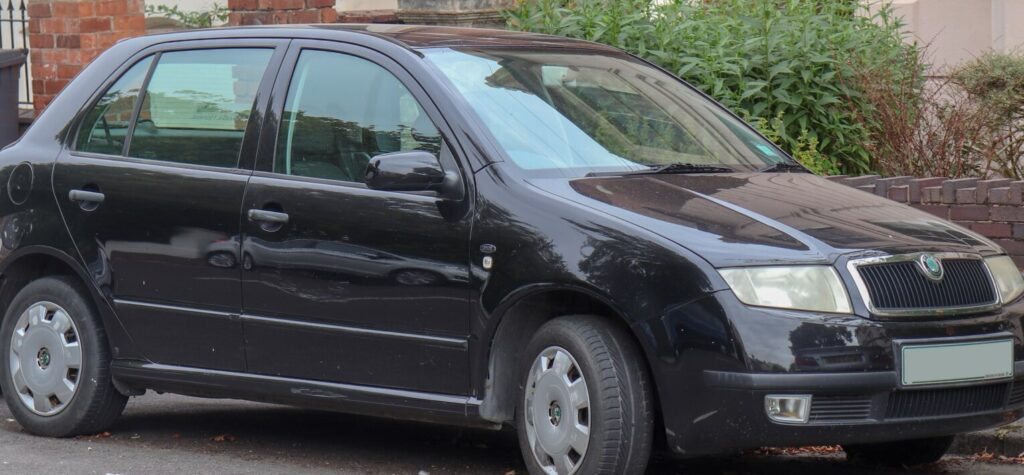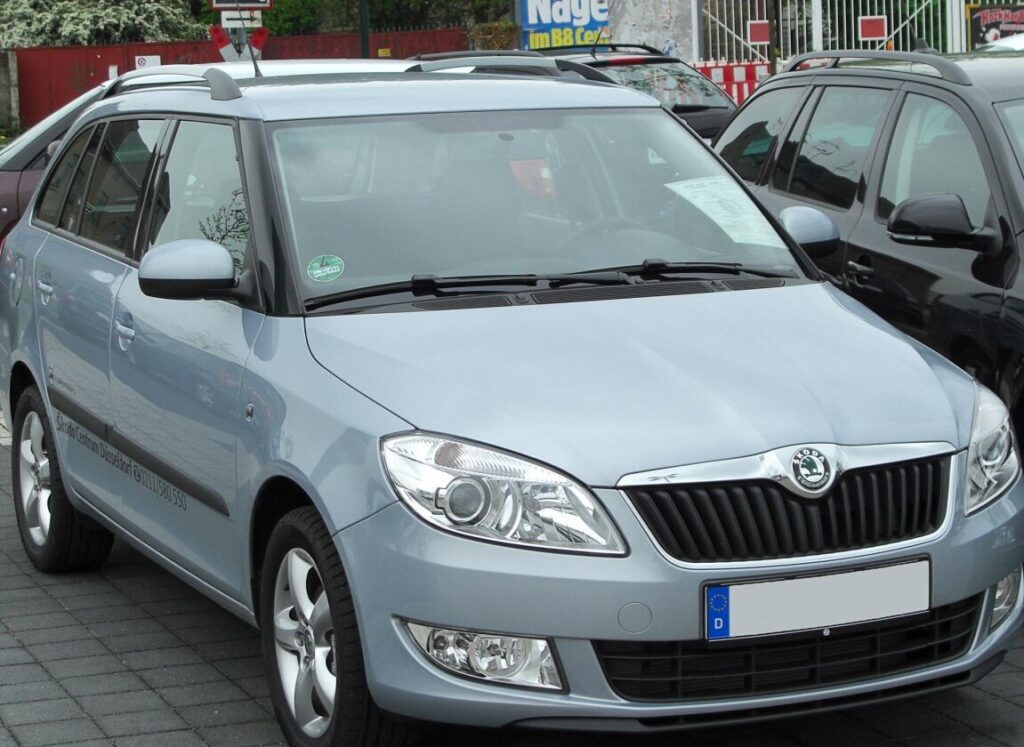
The Skoda Fabia II Combi 1.2 MPI (70 hp) is a subcompact estate car produced by the Czech manufacturer Skoda Auto between 2010 and 2014, as part of the Fabia II facelift series (designated 5J). This variant occupied the entry-level position in the Fabia Combi range, offering an affordable and economical option for buyers prioritizing practicality and fuel efficiency over outright performance. It was primarily marketed in Europe, where the demand for small, versatile estates remained strong. The 1.2 MPI engine, coupled with a five-speed manual transmission, aimed to provide a balance between acceptable performance and low running costs.
Technical Specifications
| Brand | Skoda |
| Model | Fabia |
| Generation | Fabia II Combi (facelift 2010) |
| Type (Engine) | 1.2 MPI (70 Hp) |
| Start of production | 2010 |
| End of production | 2014 |
| Powertrain Architecture | Internal Combustion engine |
| Body type | Station wagon (estate) |
| Seats | 5 |
| Doors | 5 |
| Fuel consumption (urban) | 7.3 l/100 km (32.2 US mpg, 38.7 UK mpg, 13.7 km/l) |
| Fuel consumption (extra urban) | 4.5 l/100 km (52.3 US mpg, 62.8 UK mpg, 22.2 km/l) |
| Fuel consumption (combined) | 5.5 l/100 km (42.8 US mpg, 51.4 UK mpg, 18.2 km/l) |
| CO2 emissions | 128 g/km |
| Fuel Type | Petrol (Gasoline) |
| Acceleration 0 – 100 km/h | 15 sec |
| Acceleration 0 – 62 mph | 15 sec |
| Acceleration 0 – 60 mph | 14.3 sec |
| Maximum speed | 164 km/h (101.9 mph) |
| Emission standard | Euro 5 |
| Weight-to-power ratio | 14.9 kg/Hp, 67.3 Hp/tonne |
| Weight-to-torque ratio | 9.3 kg/Nm, 107.7 Nm/tonne |
| Power | 70 Hp @ 5400 rpm |
| Power per litre | 58.4 Hp/l |
| Torque | 112 Nm @ 3000 rpm (82.61 lb.-ft. @ 3000 rpm) |
| Engine layout | Front, Transverse |
| Engine Model/Code | EA111 / CGPA |
| Engine displacement | 1198 cm3 (73.11 cu. in.) |
| Number of cylinders | 3 |
| Engine configuration | Inline |
| Cylinder Bore | 76.5 mm (3.01 in.) |
| Piston Stroke | 86.9 mm (3.42 in.) |
| Compression ratio | 10.5:1 |
| Number of valves per cylinder | 4 |
| Fuel injection system | Multi-port manifold injection |
| Engine aspiration | Naturally aspirated engine |
| Valvetrain | DOHC |
| Engine oil capacity | 2.8 l (2.96 US qt | 2.46 UK qt) |
| Coolant capacity | 5.5 l (5.81 US qt | 4.84 UK qt) |
| Kerb Weight | 1040 kg (2292.81 lbs.) |
| Max. weight | 1570 kg (3461.26 lbs.) |
| Max load | 530 kg (1168.45 lbs.) |
| Trunk (boot) space – minimum | 505 l (17.83 cu. ft.) |
| Trunk (boot) space – maximum | 1485 l (52.44 cu. ft.) |
| Fuel tank capacity | 45 l (11.89 US gal | 9.9 UK gal) |
| Max. roof load | 75 kg (165.35 lbs.) |
| Permitted trailer load with brakes (12%) | 800 kg (1763.7 lbs.) |
| Permitted trailer load without brakes | 450 kg (992.08 lbs.) |
| Permitted towbar download | 50 kg (110.23 lbs.) |
| Length | 4247 mm (167.2 in.) |
| Width | 1642 mm (64.65 in.) |
| Width including mirrors | 1886 mm (74.25 in.) |
| Height | 1498 mm (58.98 in.) |
| Wheelbase | 2465 mm (97.05 in.) |
| Front track | 1433 mm (56.42 in.) |
| Rear track | 1426 mm (56.14 in.) |
| Front overhang | 860 mm (33.86 in.) |
| Rear overhang | 922 mm (36.3 in.) |
| Ride height (ground clearance) | 135 mm (5.31 in.) |
| Drag coefficient (Cd) | 0.31 |
| Minimum turning circle | 10 m (32.81 ft.) |
| Approach angle | 14.1° |
| Departure angle | 12.1° |
| Drivetrain Architecture | Front wheel drive |
| Number of gears and type of gearbox | 5 gears, manual transmission |
| Front suspension | Independent, type McPherson with coil spring and anti-roll bar |
| Rear suspension | Coil spring, Torsion |
| Front brakes | Ventilated discs |
| Rear brakes | Drum |
| Assisting systems | ABS (Anti-lock braking system) |
| Steering type | Steering rack and pinion |
| Power steering | Electric Steering |
| Tires size | 165/70 R14; 185/60 R14; 195/55 R15 |
| Wheel rims size | 5J x 14; 6J x 14; 6J x 15 |
Powertrain & Engine Architecture
The Fabia II Combi 1.2 MPI utilized the EA111 engine family, specifically the CGPA code. This is a naturally aspirated, three-cylinder engine displacing 1198 cc. It featured multi-point fuel injection and a double overhead camshaft (DOHC) valvetrain with four valves per cylinder. The engine’s relatively simple design prioritized reliability and fuel economy over high performance. The 1.2 MPI engine produced 70 horsepower at 5400 rpm and 112 Nm (82.61 lb-ft) of torque at 3000 rpm. The five-speed manual transmission was the only gearbox option available with this engine. The transmission’s gear ratios were tuned for economy, with a relatively long final drive to maximize fuel efficiency at cruising speeds.
Driving Characteristics
The 1.2 MPI-equipped Fabia Combi offered modest performance. Acceleration from 0 to 100 km/h (0-62 mph) took approximately 15 seconds. While adequate for urban driving and short trips, it could feel strained when fully loaded or tackling steep inclines. Compared to the more powerful 1.4 TSI or 1.6 MPI variants, the 1.2 MPI lacked the responsiveness and overall punch. However, the engine was smooth and relatively refined for a three-cylinder unit. The manual transmission provided precise shifts, and the light clutch pedal made it easy to drive in stop-and-go traffic. The focus was clearly on providing a comfortable and economical driving experience rather than sporty handling.
Equipment & Trim Levels
The 1.2 MPI trim typically represented the base level of the Fabia Combi range. Standard equipment generally included central locking, power front windows, a basic audio system, and ABS brakes. Air conditioning was often an optional extra. Interior upholstery was typically cloth, and the dashboard featured a functional but somewhat basic design. Higher trim levels added features like alloy wheels, a more sophisticated audio system, climate control, and additional safety equipment. The 1.2 MPI was often chosen by buyers who prioritized affordability and practicality over luxury features.
Chassis & Braking
The Fabia II Combi featured a typical front-wheel-drive chassis layout. The front suspension utilized McPherson struts with coil springs and an anti-roll bar, while the rear suspension employed a torsion beam setup. This configuration provided a good balance between ride comfort and handling. The braking system consisted of ventilated discs on the front wheels and drum brakes on the rear. ABS was standard, providing enhanced braking performance in emergency situations. The suspension tuning was geared towards comfort, resulting in a relatively soft ride quality.
Market Reception & Comparison
The Skoda Fabia II Combi 1.2 MPI was generally well-received as an affordable and practical estate car. Critics praised its fuel efficiency and spacious interior, but noted its lack of outright performance. Compared to other engines in the Fabia lineup, the 1.2 MPI offered the lowest running costs but also the slowest acceleration. The 1.4 TSI, while more expensive, provided a significant performance boost. The 1.6 MPI offered a compromise between performance and economy. The 1.2 MPI appealed to buyers who primarily used their cars for commuting and everyday errands.
Legacy
The EA111 1.2 MPI engine, while not known for its performance, proved to be relatively reliable. Common issues included occasional problems with the throttle body and ignition coils. However, these were generally not major concerns. Today, used Fabia II Combi 1.2 MPI models are available at very affordable prices. They represent a practical and economical option for buyers seeking a small estate car. While not a particularly exciting vehicle, the 1.2 MPI Fabia Combi remains a testament to Skoda’s commitment to providing value for money.