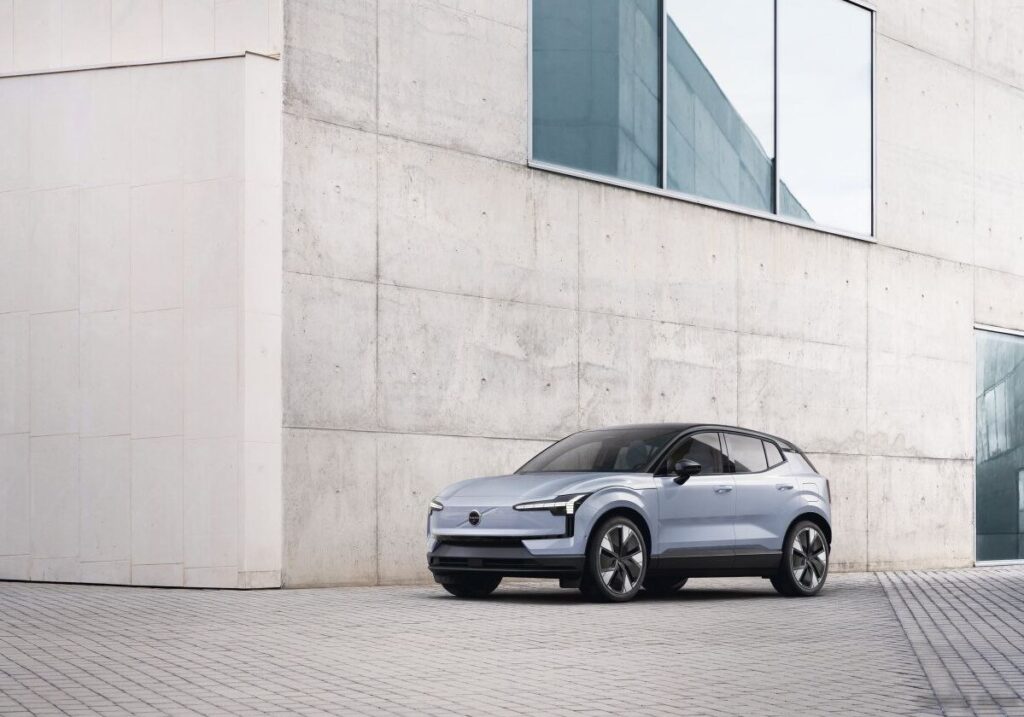
The Volvo EX30 69 kWh (428 Hp) AWD Twin Motor Performance is Volvo’s entry into the rapidly expanding compact electric SUV segment. Introduced in June 2023, this variant represents a performance-oriented option within the EX30 lineup, positioned above the base single-motor configurations. Built upon Volvo’s dedicated electric vehicle platform, the EX30 aims to deliver a blend of Scandinavian design, advanced technology, and sustainable materials in a smaller, more accessible package. It’s intended to appeal to a younger demographic and those new to the electric vehicle market, offering a premium experience without the traditional size and price tag associated with larger Volvo SUVs.
Technical Specifications
| Brand | Volvo |
| Model | EX30 |
| Generation | EX30 |
| Type (Engine) | 69 kWh (428 Hp) AWD Twin Motor Performance |
| Start of production | June, 2023 |
| Powertrain Architecture | BEV (Electric Vehicle) |
| Body type | SUV |
| Seats | 5 |
| Doors | 5 |
| Fuel Type | Electricity |
| Acceleration 0 – 100 km/h | 3.6 sec |
| Acceleration 0 – 62 mph | 3.6 sec |
| Acceleration 0 – 60 mph | 3.4 sec |
| Maximum speed | 180 km/h (111.85 mph) |
| 100 km/h – 0 | 38 m |
| Gross battery capacity | 69 kWh |
| Net (usable) battery capacity | 64 kWh |
| Battery technology | Lithium nickel manganese cobalt oxides (Li-NMC) |
| Battery location | Below the floor |
| All-electric range (WLTP) | 460 km (285.83 mi) |
| All-electric range (EPA) | 426.5 km (265.01 mi) |
| Electric motor 1 power | 156 Hp |
| Electric motor 1 Torque | 200 Nm (147.51 lb.-ft.) |
| Electric motor 1 location | Front axle, Transverse |
| Electric motor 1 type | Synchronous |
| Electric motor 2 power | 272 Hp |
| Electric motor 2 Torque | 343 Nm (252.98 lb.-ft.) |
| Electric motor 2 location | Rear axle, Transverse |
| Electric motor 2 type | Synchronous |
| System power | 428 Hp @ 5375-9536 rpm |
| System torque | 543 Nm @ 112-5475 rpm (400.5 lb.-ft. @ 112-5475 rpm) |
| Trunk (boot) space – minimum | 234 l (8.26 cu. ft.) |
| Trunk (boot) space – maximum | 904 l (31.92 cu. ft.) |
| Max. roof load | 75 kg (165.35 lbs.) |
| Permitted trailer load with brakes (12%) | 1600 kg (3527.4 lbs.) |
| Length | 4233 mm (166.65 in.) |
| Width | 1837 mm (72.32 in.) |
| Width with mirrors folded | 1940 mm (76.38 in.) |
| Width including mirrors | 2032 mm (80 in.) |
| Height | 1549 mm (60.98 in.) |
| Wheelbase | 2650 mm (104.33 in.) |
| Front track | 1590 mm (62.6 in.) |
| Rear (Back) track | 1595 mm (62.8 in.) |
| Front overhang | 788 mm (31.02 in.) |
| Rear overhang | 795 mm (31.3 in.) |
| Ride height (ground clearance) | 165 mm (6.5 in.) |
| Drag coefficient (Cd) | 0.28 |
| Minimum turning circle (turning diameter) | 11 m (36.09 ft.) |
| Approach angle | 17.9° |
| Departure angle | 24.5° |
| Ramp-over (brakeover) angle | 16.3° |
| Wading depth | 500 mm (19.69 in.) |
| Drivetrain Architecture | One electric motor drives the front wheels, one electric motor drives the rear wheels. |
| Drive wheel | All wheel drive (4×4) |
| Number of gears and type of gearbox | 1 gears, automatic transmission |
| Front suspension | Spring Strut, Independent type McPherson, Transverse stabilizer |
| Rear suspension | Spring Strut, Independent multi-link suspension, Transverse stabilizer |
| Front brakes | Ventilated discs, 350×30 mm |
| Rear brakes | Ventilated discs, 333×20 mm |
| Assisting systems | ABS (Anti-lock braking system) |
| Steering type | Steering rack and pinion |
| Power steering | Electric Steering |
Powertrain & Engine Architecture
The EX30 69 kWh Performance utilizes a dual-motor all-wheel-drive (AWD) powertrain. Each axle is powered by a permanent magnet synchronous motor. The front motor produces 156 horsepower and 200 Nm (147.51 lb-ft) of torque, while the rear motor generates 272 horsepower and 343 Nm (252.98 lb-ft) of torque. Combined, the system delivers a total output of 428 horsepower and 543 Nm (400.5 lb-ft) of torque. The battery pack, with a gross capacity of 69 kWh and a usable capacity of 64 kWh, is a Lithium Nickel Manganese Cobalt Oxide (Li-NMC) unit positioned under the vehicle floor to optimize weight distribution and passenger space. The EX30 employs a single-speed automatic transmission, typical of electric vehicles, providing seamless acceleration. Charging is handled via a CCS (Combined Charging System) port, allowing for DC fast charging capabilities. The vehicle’s electrical architecture is designed for over-the-air (OTA) software updates, enabling continuous improvement and feature additions.
Driving Characteristics
The dual-motor AWD configuration of the EX30 Performance results in brisk acceleration. The 0-60 mph sprint is achieved in just 3.4 seconds, making it one of the quicker vehicles in its class. The instant torque delivery characteristic of electric motors provides responsive acceleration in all driving situations. Compared to the single-motor rear-wheel-drive EX30 variants, the Performance model offers significantly enhanced traction and stability, particularly in adverse weather conditions. The single-speed transmission provides a linear power delivery, although some drivers may miss the gear changes found in traditional internal combustion engine vehicles. The relatively low center of gravity, thanks to the underfloor battery pack, contributes to confident handling and reduced body roll. The steering is precise and well-weighted, providing a connected feel to the road.
Equipment & Trim Levels
The EX30 69 kWh Performance trim comes standard with a comprehensive suite of features. Interior appointments include a minimalist Scandinavian design with sustainable materials like recycled denim and flax composites. A large, vertically oriented touchscreen infotainment system dominates the dashboard, controlling most vehicle functions. Standard safety features include automatic emergency braking, lane keeping assist, and adaptive cruise control. Optional extras include a premium sound system, panoramic sunroof, and advanced driver-assistance systems like Pilot Assist. The Performance trim typically features unique exterior styling elements, such as a specific wheel design and contrasting roof color, to differentiate it from other EX30 models.
Chassis & Braking
The EX30 utilizes a McPherson strut front suspension and a multi-link rear suspension, both incorporating transverse stabilizer bars to minimize body roll. The suspension is tuned to provide a balance between comfort and handling. Braking duties are handled by ventilated disc brakes on all four wheels, with diameters of 350mm at the front and 333mm at the rear. The EX30 incorporates an energy recuperation system that utilizes regenerative braking to capture energy during deceleration, increasing efficiency and extending range. Anti-lock Braking System (ABS) is standard, enhancing braking performance and stability.
Market Reception & Comparison
The Volvo EX30 has been generally well-received by automotive critics, praised for its stylish design, advanced technology, and competitive pricing. The Performance variant, in particular, has been lauded for its impressive acceleration and engaging driving dynamics. Compared to other compact electric SUVs like the Hyundai Kona Electric and the Kia Niro EV, the EX30 offers a more premium interior and a more powerful powertrain in the Performance trim. However, some critics have noted that the EX30’s rear seat space is somewhat limited compared to some competitors. Fuel economy, expressed as MPGe (miles per gallon equivalent), is competitive within the electric SUV segment, with the EX30 achieving an EPA-estimated range of 265.01 miles.
Legacy
As a relatively new model, the long-term reliability of the EX30 is still being established. However, Volvo has a strong reputation for safety and build quality, and the EX30 benefits from the company’s extensive experience in electric vehicle technology. The use of a dedicated EV platform and a relatively simple powertrain design suggests that the EX30 should prove to be a reliable and durable vehicle. On the used car market, the EX30 is expected to hold its value well, particularly the Performance variant, due to its desirable combination of performance, technology, and style. The EX30 represents a significant step forward for Volvo in its electrification strategy, and it is poised to become a popular choice among consumers looking for a compact, premium electric SUV.