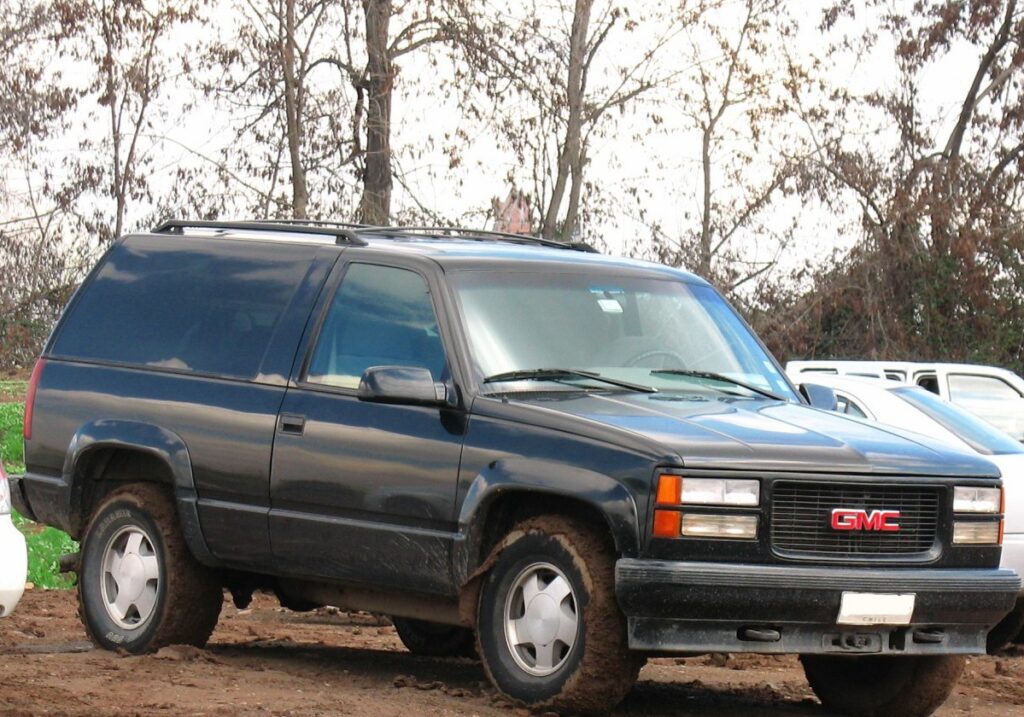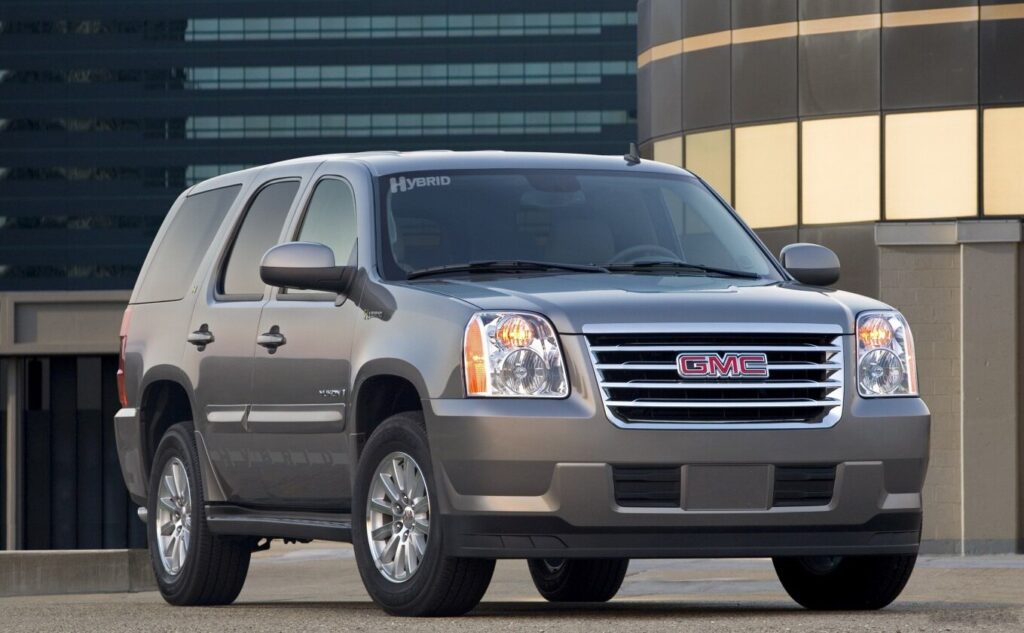
The GMC Yukon III, produced from 2010 to 2014, represents the third generation of the full-size Yukon SUV. Built on the GMT900 platform, it shared its underpinnings with the Chevrolet Tahoe and Cadillac Escalade. This generation marked a significant step forward in refinement and capability for the Yukon, offering a blend of spaciousness, towing capacity, and available luxury features. The 5.3 i V8 16V (320/326 Hp) FlexFuel 4×4 Automatic variant occupied a central position in the Yukon lineup, providing a balance between performance, fuel efficiency, and cost, making it a popular choice for families and those needing a versatile full-size SUV. It was positioned above the base V8 models and below the more powerful 6.2L V8 and diesel options.
Technical Specifications
| Brand | GMC |
| Model | Yukon |
| Generation | Yukon III (GMT900) |
| Type | 5.3 i V8 16V (320/326 Hp) FlexFuel 4×4 Automatic |
| Start of production | 2010 |
| End of production | 2014 |
| Powertrain Architecture | Internal Combustion engine |
| Body type | SUV |
| Seats | 9 |
| Doors | 5 |
| Fuel consumption (economy) – urban | 15.7 l/100 km (15 US mpg, 18 UK mpg) |
| Fuel consumption (economy) – urban (Ethanol – E85) | 23.5 l/100 km |
| Fuel consumption (economy) – extra urban | 11.2 l/100 km (21 US mpg, 25.2 UK mpg) |
| Fuel consumption (economy) – extra urban (Ethanol – E85) | 15.7 l/100 km |
| Fuel Type | Petrol / Ethanol – E85 |
| Power | 320 Hp @ 5200 rpm |
| Power per litre | 60.1 Hp/l |
| Power (Ethanol – E85) | 326 Hp @ 5300 rpm |
| Power per litre (Ethanol – E85) | 61.2 Hp/l |
| Torque | 454 Nm @ 4400 rpm (334.85 lb.-ft. @ 4400 rpm) |
| Torque (Ethanol – E85) | 475 Nm @ 4400 rpm |
| Maximum engine speed | 6000 rpm |
| Engine layout | Front, Longitudinal |
| Engine Model/Code | LMG |
| Engine displacement | 5328 cm3 (325.13 cu. in.) |
| Number of cylinders | 8 |
| Engine configuration | V-engine |
| Cylinder Bore | 96 mm (3.78 in.) |
| Piston Stroke | 92 mm (3.62 in.) |
| Compression ratio | 9.9:1 |
| Number of valves per cylinder | 2 |
| Fuel injection system | Multi-port manifold injection |
| Engine aspiration | Naturally aspirated engine |
| Engine oil capacity | 5.7 l (6.02 US qt | 5.02 UK qt) |
| Coolant | 15.9 l (16.8 US qt | 13.99 UK qt) |
| Max. weight | 3311 kg (7299.51 lbs.) |
| Trunk (boot) space – minimum | 478 l (16.88 cu. ft.) |
| Trunk (boot) space – maximum | 3084 l (108.91 cu. ft.) |
| Fuel tank capacity | 98 l (25.89 US gal | 21.56 UK gal) |
| Permitted trailer load with brakes (12%) | 3719 kg (8198.99 lbs.) |
| Length | 5130 mm (201.97 in.) |
| Width | 2007 mm (79.02 in.) |
| Height | 1955 mm (76.97 in.) |
| Wheelbase | 2946 mm (115.98 in.) |
| Front track | 1732 mm (68.19 in.) |
| Rear (Back) track | 1702 mm (67.01 in.) |
| Ride height (ground clearance) | 228 mm (8.98 in.) |
| Minimum turning circle (turning diameter) | 11.9 m (39.04 ft.) |
| Approach angle | 17.21° |
| Departure angle | 21.74° |
| Drive wheel | All wheel drive (4×4) |
| Number of gears and type of gearbox | 6 gears, automatic transmission |
| Front suspension | Independent, type McPherson with coil spring and anti-roll bar |
| Rear suspension | Independent multi-link suspension, Coil spring |
| Front brakes | Disc, 330×30 mm |
| Rear brakes | Disc, 345×20 mm |
| Assisting systems | ABS (Anti-lock braking system) |
| Steering type | Steering rack and pinion |
| Tires size | 265/70 R17; 265/65 R18 112S; 275/55 R20 |
| Wheel rims size | 7.5J x 17; 8.0J x 18; 8.5J x 20 |
Powertrain & Engine Architecture
The heart of this Yukon variant is the 5.3-liter (325 cubic inch) LMG V8 engine. This engine is a member of GM’s Vortec family, known for its robust construction and relatively simple design. It features a cast iron block with aluminum cylinder heads, two valves per cylinder, and a multi-port fuel injection system. The LMG engine is designed for flexibility, offering compatibility with both regular gasoline and E85 ethanol fuel, providing a slight power increase when running on E85. The engine’s 9.9:1 compression ratio is a compromise between performance and fuel efficiency. The engine is paired with a six-speed automatic transmission (likely the 6L80E), chosen for its smooth shifting and ability to handle the engine’s torque output. This transmission features electronically controlled shifting and overdrive for improved fuel economy at highway speeds.
Driving Characteristics
The 5.3L V8 with the six-speed automatic delivers adequate performance for a full-size SUV. While not a sports car, it provides sufficient power for everyday driving, merging onto highways, and towing. The automatic transmission is tuned for comfort and smooth operation, prioritizing drivability over aggressive shifts. Compared to the available 6.2L V8, the 5.3L offers less outright acceleration, but it provides better fuel economy. The six-speed automatic helps keep the engine in its optimal power band, but the Yukon’s substantial weight (over 7,300 pounds) does limit its responsiveness. The 4×4 system provides enhanced traction in inclement weather and off-road conditions, making it a capable all-weather vehicle.
Equipment & Trim Levels
The 5.3L Yukon typically came standard with features like tri-zone automatic climate control, a premium audio system, power-adjustable front seats, and a rear vision camera. Higher trim levels, such as the SLT and Denali, added features like leather upholstery, heated and cooled front seats, a navigation system, and advanced safety technologies. Optional extras included a sunroof, rear-seat entertainment system, and upgraded towing packages. The interior generally featured a spacious cabin with comfortable seating for up to nine passengers, depending on the configuration.
Chassis & Braking
The GMT900 Yukon utilizes a body-on-frame construction, providing a robust and durable platform. The front suspension consists of an independent McPherson strut setup with coil springs and an anti-roll bar, while the rear features an independent multi-link suspension with coil springs. This suspension setup aims to balance ride comfort with handling stability. Braking duties are handled by disc brakes on all four wheels, with ABS (Anti-lock Braking System) as standard equipment. The Yukon’s substantial weight necessitates a capable braking system, and the disc brakes provide adequate stopping power for most driving situations.
Market Reception & Comparison
The 5.3L Yukon was generally well-received by critics and consumers alike. It was praised for its spacious interior, comfortable ride, and strong towing capacity. However, its fuel economy was often criticized, especially compared to smaller SUVs. Compared to the 6.2L Yukon, the 5.3L offered a more affordable price point and slightly better fuel efficiency, making it a more practical choice for many buyers. The 5.3L also offered a good alternative to the diesel-powered Yukon, providing similar torque output without the higher maintenance costs associated with diesel engines.
Legacy
The GMT900 Yukon, particularly the 5.3L V8 variant, has proven to be a relatively reliable vehicle. The LMG engine is known for its durability, and the six-speed automatic transmission has also demonstrated good longevity. In the used car market, these Yukons remain popular choices for those seeking a spacious, capable, and affordable full-size SUV. Common maintenance items include regular oil changes, transmission fluid flushes, and brake pad replacements. While some owners have reported issues with the air suspension system (if equipped), the 5.3L powertrain itself is generally considered to be quite robust, contributing to the Yukon’s continued presence on roads today.