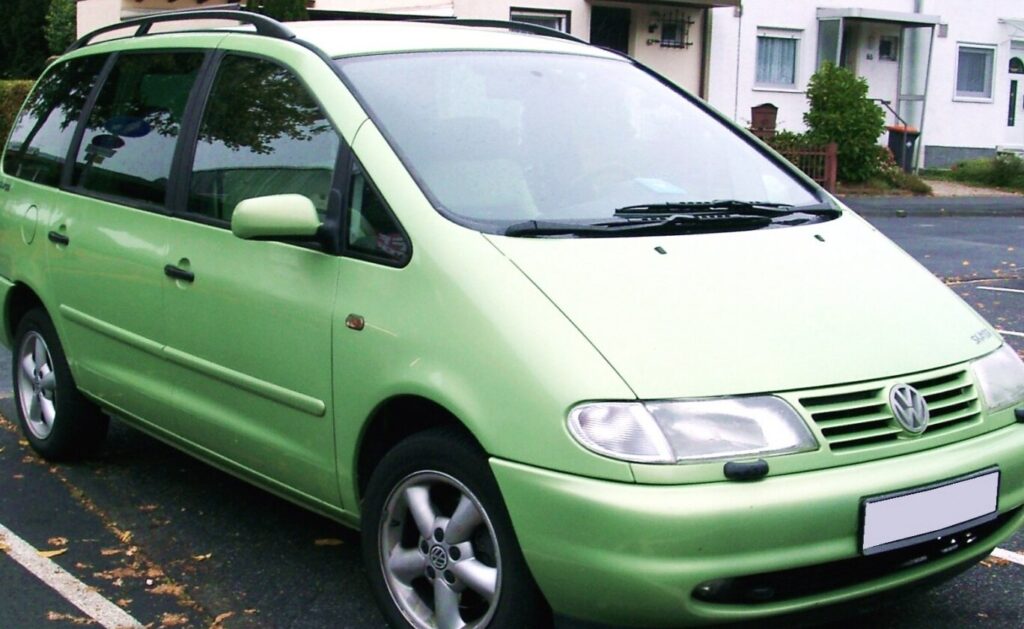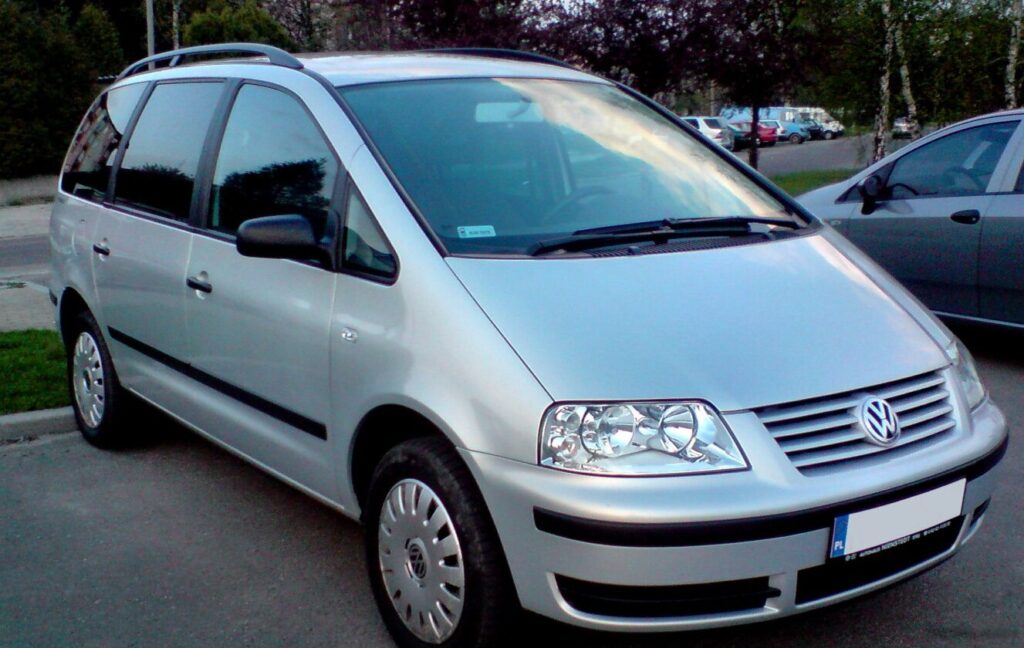
The Volkswagen Sharan I (facelift, introduced in 2000) 2.8 V6 4MOTION represents a high-performance variant within the first generation of the Sharan, a minivan designed to compete in the European MPV (Multi-Purpose Vehicle) market. Produced from 2000 to 2004, this model combined a potent VR6 engine with Volkswagen’s 4MOTION all-wheel-drive system, offering a unique blend of practicality and driving dynamics. The facelift brought styling updates and refinements to the original Sharan, solidifying its position as a premium family vehicle. This particular configuration was positioned as the top-of-the-line Sharan, appealing to buyers seeking more power and all-weather capability than the base models.
Technical Specifications
| Brand | Volkswagen |
| Model | Sharan |
| Generation | Sharan I (facelift 2000) |
| Type (Engine) | 2.8 V6 (204 Hp) 4MOTION |
| Start of production | 2000 year |
| End of production | 2004 year |
| Powertrain Architecture | Internal Combustion engine |
| Body type | Minivan, MPV |
| Seats | 7 |
| Doors | 5 |
| Fuel consumption (economy) – urban (NEDC) | 15.5 l/100 km (15.2 US mpg, 18.2 UK mpg, 6.5 km/l) |
| Fuel consumption (economy) – extra urban (NEDC) | 9.3 l/100 km (25.3 US mpg, 30.4 UK mpg, 10.8 km/l) |
| Fuel consumption (economy) – combined (NEDC) | 11.6 l/100 km (20.3 US mpg, 24.4 UK mpg, 8.6 km/l) |
| CO2 emissions (NEDC) | 278 g/km |
| Fuel Type | Petrol (Gasoline) |
| Acceleration 0 – 100 km/h | 10.3 sec |
| Acceleration 0 – 62 mph | 10.3 sec |
| Acceleration 0 – 60 mph | 9.8 sec |
| Maximum speed | 214 km/h (132.97 mph) |
| Emission standard | Euro 4 |
| Weight-to-power ratio | 9.7 kg/Hp, 103.4 Hp/tonne |
| Weight-to-torque ratio | 7.4 kg/Nm, 134.4 Nm/tonne |
| Power | 204 Hp @ 6200 rpm |
| Power per litre | 73.1 Hp/l |
| Torque | 265 Nm @ 3400 rpm (195.45 lb.-ft. @ 3400 rpm) |
| Engine layout | Front, Transverse |
| Engine Model/Code | AYL |
| Engine displacement | 2792 cm3 (170.38 cu. in.) |
| Number of cylinders | 6 |
| Engine configuration | VR-engine |
| Cylinder Bore | 81 mm (3.19 in.) |
| Piston Stroke | 90.3 mm (3.56 in.) |
| Compression ratio | 10.5:1 |
| Number of valves per cylinder | 4 |
| Fuel injection system | Multi-port manifold injection |
| Engine aspiration | Naturally aspirated engine |
| Valvetrain | DOHC |
| Engine oil capacity | 5.7 l (6.02 US qt, 5.02 UK qt) |
| Coolant | 11 l (11.62 US qt, 9.68 UK qt) |
| Kerb Weight | 1972 kg (4347.52 lbs.) |
| Max. weight | 2500 kg (5511.56 lbs.) |
| Max load | 528 kg (1164.04 lbs.) |
| Trunk (boot) space – minimum | 256 l (9.04 cu. ft.) |
| Trunk (boot) space – maximum | 2610 l (92.17 cu. ft.) |
| Fuel tank capacity | 70 l (18.49 US gal, 15.4 UK gal) |
| Max. roof load | 75 kg (165.35 lbs.) |
| Permitted trailer load with brakes (12%) | 2000 kg (4409.25 lbs.) |
| Permitted trailer load without brakes | 700 kg (1543.24 lbs.) |
| Permitted towbar download | 85 kg (187.39 lbs.) |
| Length | 4634 mm (182.44 in.) |
| Width | 1810 mm (71.26 in.) |
| Height | 1759 mm (69.25 in.) |
| Wheelbase | 2841 mm (111.85 in.) |
| Front track | 1530 mm (60.24 in.) |
| Rear (Back) track | 1524 mm (60 in.) |
| Minimum turning circle | 11.9 m (39.04 ft.) |
| Drivetrain Architecture | All wheel drive (4×4). ICE drives front wheels, rear driven via clutch. |
| Drive wheel | All wheel drive (4×4) |
| Number of gears and type of gearbox | 6 gears, manual transmission |
| Front suspension | Independent type McPherson, Transverse stabilizer |
| Rear suspension | Transverse stabilizer, Trailing arm, Coil spring |
| Front brakes | Ventilated discs |
| Rear brakes | Disc |
| Assisting systems | ABS (Anti-lock braking system) |
| Steering type | Steering rack and pinion |
| Power steering | Hydraulic Steering |
| Tires size | 215/55 R16 |
| Wheel rims size | 7J x 16 |
INTRODUCTION
The Volkswagen Sharan I, launched in 1995 and facelifted in 2000, was Volkswagen’s entry into the burgeoning MPV segment. Developed in collaboration with Ford (resulting in the Ford Galaxy), the Sharan aimed to provide a spacious, versatile, and relatively premium alternative to traditional family cars. The 2.8 V6 4MOTION variant, produced from 2000-2004, represented the performance pinnacle of the first-generation Sharan. It catered to buyers who needed the space of an MPV but desired stronger acceleration and enhanced stability, particularly in inclement weather. This model was primarily sold in Europe, where the demand for MPVs was significantly higher than in North America.
Powertrain & Engine Architecture
At the heart of the Sharan 2.8 V6 4MOTION lies the AYL engine code, a 2.8-liter naturally aspirated VR6 engine. This engine is characterized by its narrow V-angle (15 degrees), which allows it to be packaged more compactly than a traditional V6. The AYL engine utilizes multi-port fuel injection and a double overhead camshaft (DOHC) valvetrain, contributing to its smooth power delivery. The engine produces 204 horsepower at 6200 rpm and 265 Nm (195 lb-ft) of torque at 3400 rpm. The engine’s VR configuration and relatively high compression ratio (10.5:1) contribute to its responsiveness. The 4MOTION system is a permanent all-wheel-drive system utilizing a viscous coupling to distribute power between the front and rear axles. This system provides enhanced traction and stability, especially on slippery surfaces. The transmission is a 6-speed manual, offering precise gear changes and contributing to the vehicle’s overall driving experience.
Driving Characteristics
The Sharan 2.8 V6 4MOTION offered a noticeably more engaging driving experience than its four-cylinder counterparts. The VR6 engine provided ample power for effortless cruising and confident overtaking. While not a sports car, the Sharan V6 could accelerate from 0 to 100 km/h (0-62 mph) in approximately 10.3 seconds. The 4MOTION system significantly improved handling and stability, particularly in wet or snowy conditions. The manual transmission allowed for greater driver control, although the Sharan’s size and weight meant it wasn’t as nimble as smaller vehicles. The gear ratios were well-chosen to provide a balance between acceleration and fuel economy, although the combined fuel consumption of 11.6 l/100 km (20.3 mpg) reflected the engine’s displacement and the vehicle’s weight.
Equipment & Trim Levels
The 2.8 V6 4MOTION Sharan typically came well-equipped, reflecting its position as the range-topping model. Standard features often included air conditioning, power windows, central locking, and an upgraded audio system. Higher trim levels offered options such as leather upholstery, sunroof, and upgraded alloy wheels. Interior appointments were generally comfortable and practical, with a focus on durability and ease of cleaning. The Sharan’s modular seating arrangement allowed for flexible cargo and passenger configurations, making it ideal for families.
Chassis & Braking
The Sharan’s chassis featured an independent McPherson strut suspension at the front and a trailing arm setup at the rear. This configuration provided a comfortable ride while maintaining reasonable handling characteristics. Stabilizer bars were fitted to both axles to reduce body roll. The braking system consisted of ventilated discs at the front and solid discs at the rear, providing adequate stopping power for the vehicle’s weight. Anti-lock braking system (ABS) was standard, enhancing safety and control during emergency braking situations.
Market Reception & Comparison
The Sharan 2.8 V6 4MOTION was generally well-received by automotive critics, who praised its spacious interior, comfortable ride, and strong performance. However, its relatively high price and fuel consumption were noted as potential drawbacks. Compared to the base Sharan models with smaller engines, the V6 4MOTION offered a significant performance upgrade but at a considerable cost. The 1.9 TDI diesel variant, while less powerful, offered superior fuel economy and was a popular choice for those prioritizing efficiency. The V6 appealed to buyers who valued performance and all-weather capability over fuel savings.
Legacy
The Volkswagen Sharan I 2.8 V6 4MOTION remains a sought-after vehicle among enthusiasts and collectors. The VR6 engine is known for its reliability and distinctive sound, and the 4MOTION system provides a level of all-weather capability that is still appreciated today. While maintenance costs can be higher than for simpler models, the Sharan V6 4MOTION offers a unique combination of practicality, performance, and durability. Finding well-maintained examples can be challenging, but these vehicles continue to provide a comfortable and capable driving experience for those willing to invest in their upkeep.