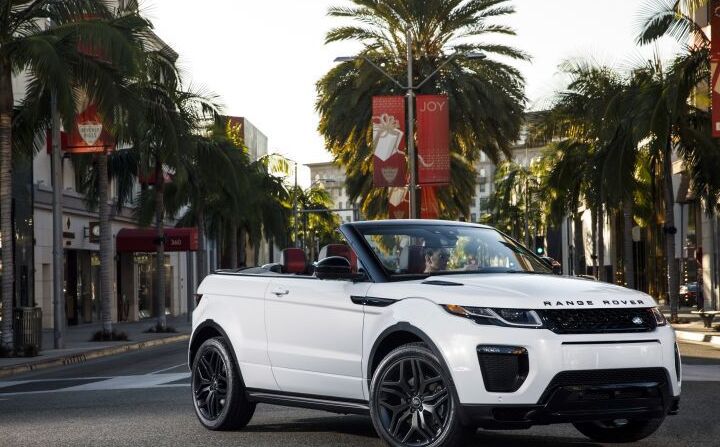
The Land Rover Range Rover Evoque I Convertible 2.0 TD4 (150 hp) AWD Automatic, produced from 2015 to 2018, represents a unique offering within the Evoque lineup. This variant combined the stylish aesthetics of the Evoque Convertible with a fuel-efficient diesel engine and the convenience of an automatic transmission, targeting buyers seeking a premium, all-weather capable open-top SUV. It sat in the mid-range of the Evoque Convertible offerings, providing a balance between performance and economy. The facelifted model, introduced in 2015, brought updated styling cues and technological enhancements to the original Evoque platform (L538), which was based on the Land Rover-Ford joint venture D8 architecture, also underpinning the Freelander 2.
Technical Specifications
| Brand | Land Rover |
| Model | Range Rover Evoque |
| Generation | Range Rover Evoque I convertible (facelift 2015) |
| Type (Engine) | 2.0 TD4 (150 Hp) AWD Automatic |
| Start of production | 2015 |
| End of production | 2018 |
| Powertrain Architecture | Internal Combustion engine |
| Body type | Cabriolet, SUV |
| Seats | 4 |
| Doors | 2 |
| Fuel consumption (urban) | 6.7 l/100 km (35.1 US mpg, 42.2 UK mpg, 14.9 km/l) |
| Fuel consumption (extra urban) | 5.1 l/100 km (46.1 US mpg, 55.4 UK mpg, 19.6 km/l) |
| Fuel consumption (combined) | 5.7 l/100 km (41.3 US mpg, 49.6 UK mpg, 17.5 km/l) |
| CO2 emissions | 149 g/km |
| Fuel Type | Diesel |
| Acceleration 0 – 100 km/h | 12 sec |
| Acceleration 0 – 62 mph | 12 sec |
| Acceleration 0 – 60 mph | 11.4 sec |
| Maximum speed | 180 km/h (111.85 mph) |
| Emission standard | Euro 6 |
| Weight-to-power ratio | 13.1 kg/Hp, 76.3 Hp/tonne |
| Weight-to-torque ratio | 5.2 kg/Nm, 193.2 Nm/tonne |
| Power | 150 Hp @ 4000 rpm |
| Power per litre | 75 Hp/l |
| Torque | 380 Nm @ 1750 rpm (280.27 lb.-ft. @ 1750 rpm) |
| Engine layout | Front, Transverse |
| Engine Model/Code | Ingenium / 204DTD |
| Engine displacement | 1999 cm3 (121.99 cu. in.) |
| Number of cylinders | 4 |
| Engine configuration | Inline |
| Cylinder Bore | 83 mm (3.27 in.) |
| Piston Stroke | 92.35 mm (3.64 in.) |
| Compression ratio | 15.5:1 |
| Number of valves per cylinder | 4 |
| Fuel injection system | Diesel Commonrail |
| Engine aspiration | Turbocharger, Intercooler |
| Engine oil capacity | 6.5 l (6.87 US qt | 5.72 UK qt) |
| Coolant | 11 l (11.62 US qt | 9.68 UK qt) |
| Kerb Weight | 1967 kg (4336.49 lbs.) |
| Trunk (boot) space – minimum | 251 l (8.86 cu. ft.) |
| Fuel tank capacity | 54 l (14.27 US gal | 11.88 UK gal) |
| Length | 4370 mm (172.05 in.) |
| Width with mirrors folded | 1980 mm (77.95 in.) |
| Width including mirrors | 2085 mm (82.09 in.) |
| Height | 1609 mm (63.35 in.) |
| Wheelbase | 2660 mm (104.72 in.) |
| Ride height (ground clearance) | 215 mm (8.46 in.) |
| Drag coefficient (Cd) | 0.39 |
| Minimum turning circle | 11.3 m (37.07 ft.) |
| Approach angle | 19° |
| Departure angle | 31° |
| Drive wheel | All wheel drive (4×4) |
| Number of gears and type of gearbox | 9 gears, automatic transmission |
| Front suspension | Independent, type McPherson with coil spring and anti-roll bar |
| Rear suspension | Independent multi-link suspension |
| Front brakes | Ventilated discs |
| Rear brakes | Disc |
Powertrain & Engine Architecture
The 2.0 TD4 variant utilizes Land Rover’s Ingenium engine family, specifically the 204DTD code. This engine is a four-cylinder, turbocharged diesel, featuring direct injection and variable valve timing. The Ingenium engines were designed for modularity and efficiency, allowing for a range of power outputs and configurations. The 204DTD produces 150 horsepower at 4,000 rpm and a substantial 380 Nm (280 lb-ft) of torque from as low as 1,750 rpm. This torque delivery is a key characteristic of the engine, providing good low-end responsiveness. The engine employs a diesel particulate filter (DPF) to meet stringent Euro 6 emissions standards. Paired with the engine is a ZF 9-speed automatic transmission, known for its smooth shifts and wide gear ratio spread. This transmission contributes to both fuel efficiency and improved on-road refinement.
Driving Characteristics
The 150 hp output and automatic transmission combination delivers a comfortable, rather than sporty, driving experience. Acceleration from 0-60 mph takes around 11.4 seconds, and while adequate for everyday driving, it’s noticeably slower than higher-powered Evoque variants like the 240 hp Si4. The 9-speed automatic transmission is well-tuned, providing smooth gear changes and helping to keep the engine in its optimal torque band. The all-wheel-drive system provides confident traction in various weather conditions, a hallmark of the Range Rover brand. The convertible top does add some weight, slightly impacting handling compared to the standard hardtop Evoque, but the suspension is well-damped, offering a reasonable balance between comfort and control.
Equipment & Trim Levels
The 2.0 TD4 Automatic Convertible typically came equipped with leather upholstery, automatic climate control, a touchscreen infotainment system with navigation, and parking sensors. Standard safety features included multiple airbags, ABS, and stability control. Optional extras included upgraded sound systems, heated seats, and various styling packages. The trim level often dictated the availability of certain features, with higher trims offering more luxurious appointments and advanced technology.
Chassis & Braking
The Evoque Convertible utilizes an independent suspension setup at all four corners, with McPherson struts at the front and a multi-link system at the rear. This provides a comfortable ride quality, even on uneven surfaces. The braking system consists of ventilated discs at the front and solid discs at the rear. ABS (Anti-lock Braking System) is standard, enhancing braking performance and stability. The steering is electrically assisted, providing a light and precise feel.
Market Reception & Comparison
The Evoque Convertible 2.0 TD4 Automatic was generally well-received by critics as a stylish and practical option. Fuel economy was a strong point, with combined figures around 41.3 US mpg. However, some reviewers noted the performance was adequate but not exhilarating. Compared to the petrol-powered Evoque variants, the TD4 offered significantly better fuel economy, making it a more economical choice for long-distance driving. Against competitors like the BMW X1 and Audi Q3, the Evoque Convertible stood out with its unique convertible body style and premium brand image.
Legacy
The Ingenium engine family has proven to be relatively reliable, although like any modern diesel, it’s susceptible to issues with the DPF if not properly maintained. Regular servicing and the use of quality diesel fuel are crucial for long-term reliability. On the used car market, the Evoque Convertible 2.0 TD4 Automatic holds its value reasonably well, thanks to its desirability and the Range Rover badge. It remains a popular choice for buyers seeking a stylish and capable open-top SUV.