Technical Specifications
| Brand | GMC |
| Model | Yukon |
| Generation | Yukon III (GMT900) |
| Type (Engine) | 5.3 i V8 16V (320 Hp) Automatic |
| Start of production | 2007 |
| End of production | 2009 |
| Powertrain Architecture | Internal Combustion engine |
| Body type | SUV |
| Seats | 9 |
| Doors | 5 |
| Fuel consumption (urban) | 16.8 l/100 km (14 US mpg, 16.8 UK mpg) |
| Fuel consumption (extra urban) | 11.8 l/100 km (19.9 US mpg, 23.9 UK mpg) |
| Fuel Type | Petrol (Gasoline) |
| Weight-to-power ratio | 7.6 kg/Hp, 131.4 Hp/tonne |
| Weight-to-torque ratio | 5.3 kg/Nm, 189.3 Nm/tonne |
| Power | 320 Hp @ 5200 rpm |
| Power per litre | 60.1 Hp/l |
| Torque | 461 Nm @ 4200 rpm (340.02 lb.-ft. @ 4200 rpm) |
| Engine layout | Front, Longitudinal |
| Engine Model/Code | LY5 |
| Engine displacement | 5328 cm3 (325.13 cu. in.) |
| Number of cylinders | 8 |
| Engine configuration | V-engine |
| Cylinder Bore | 96 mm (3.78 in.) |
| Piston Stroke | 92 mm (3.62 in.) |
| Compression ratio | 9.9:1 |
| Number of valves per cylinder | 2 |
| Fuel injection system | Multi-port manifold injection |
| Engine aspiration | Naturally aspirated engine |
| Engine oil capacity | 5.7 l (6.02 US qt | 5.02 UK qt) |
| Coolant | 17.3 l (18.28 US qt | 15.22 UK qt) |
| Kerb Weight | 2435 kg (5368.26 lbs.) |
| Max. weight | 3220 kg (7098.88 lbs.) |
| Max load | 785 kg (1730.63 lbs.) |
| Trunk (boot) space – minimum | 479 l (16.92 cu. ft.) |
| Trunk (boot) space – maximum | 3084 l (108.91 cu. ft.) |
| Fuel tank capacity | 98 l (25.89 US gal | 21.56 UK gal) |
| Permitted trailer load with brakes (12%) | 3810 kg (8399.61 lbs.) |
| Length | 5130 mm (201.97 in.) |
| Width | 2007 mm (79.02 in.) |
| Height | 1956 mm (77.01 in.) |
| Wheelbase | 2946 mm (115.98 in.) |
| Front track | 1732 mm (68.19 in.) |
| Rear (Back) track | 1702 mm (67.01 in.) |
| Minimum turning circle | 11.9 m (39.04 ft.) |
| Drivetrain Architecture | Rear wheel drive |
| Number of gears and type of gearbox | 4 gears, automatic transmission |
| Front suspension | Independent, type McPherson with coil spring and anti-roll bar |
| Rear suspension | Independent multi-link suspension, Coil spring |
| Front brakes | Disc, 330×30 mm |
| Rear brakes | Disc, 345×20 mm |
| Assisting systems | ABS (Anti-lock braking system) |
| Steering type | Steering rack and pinion |
| Tires size | 265/70 R17 |
| Wheel rims size | 7.5J x 17 |
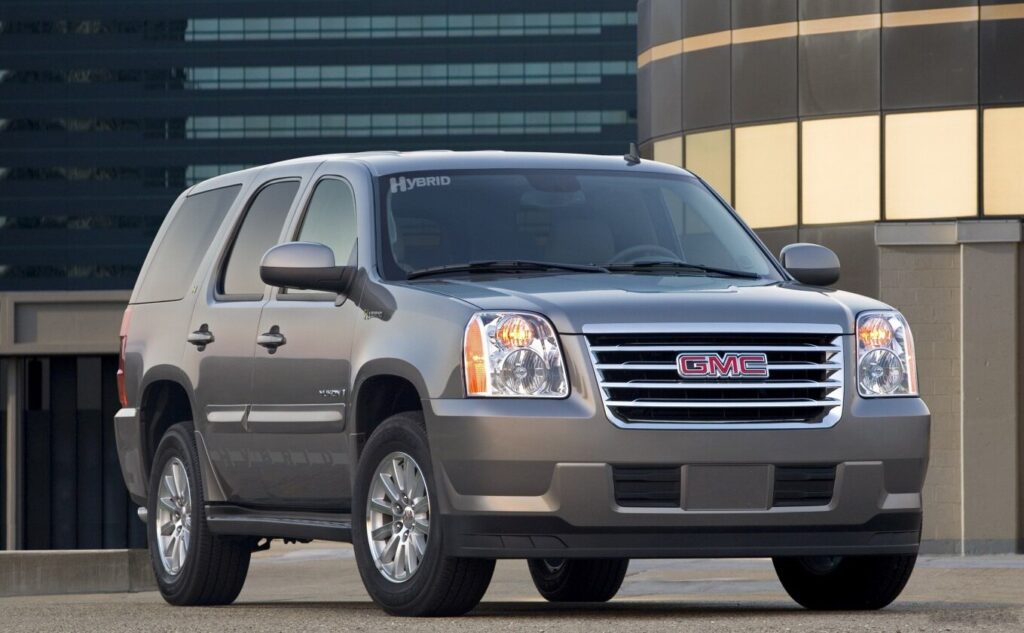
The GMC Yukon III, specifically the 5.3L V8 Automatic variant, was a mainstay of GMC’s SUV offerings from 2007 to 2009. Built on the GMT900 platform, it represented a significant update over the previous generation, offering improved interior space, enhanced safety features, and a more refined driving experience. This particular trim level aimed to provide a sweet spot in the Yukon lineup, appealing to buyers who desired a capable and comfortable SUV without the higher price tag of the more powerful 6.2L models. It was a popular choice for families, offering three rows of seating and ample cargo space, as well as for those needing a vehicle capable of towing boats, trailers, or other recreational equipment.
Powertrain & Engine Architecture
At the heart of the Yukon III 5.3L was the LY5 engine, a 5.3-liter (325 cubic inch) V8. This engine featured a cast iron block with aluminum cylinder heads, and utilized a 9.9:1 compression ratio. The LY5 employed a multi-port fuel injection system, delivering fuel directly to each cylinder for optimized combustion. The valvetrain consisted of two valves per cylinder, operated by a single camshaft. The engine produced 320 horsepower at 5200 rpm and 461 lb-ft of torque at 4200 rpm. Paired with the LY5 was a four-speed automatic transmission (likely the 4L60E), chosen for its durability and suitability for towing. This transmission featured electronically controlled shifting and overdrive for improved fuel efficiency at highway speeds. The transmission was calibrated to provide smooth shifts and adequate power delivery for everyday driving and towing scenarios.
Driving Characteristics
The 5.3L V8 Automatic Yukon III offered a comfortable and capable driving experience. While not as quick as the 6.2L variant, the 5.3L provided sufficient power for most driving situations. Acceleration from a standstill was adequate, and the engine delivered strong torque for merging onto highways and passing other vehicles. The four-speed automatic transmission, while not as sophisticated as newer transmissions with more gears, provided smooth and predictable shifts. The gear ratios were optimized for both towing and fuel economy. Compared to the manual transmission options available on other Yukon trims, the automatic offered greater convenience, particularly in city driving. However, it did result in a slight decrease in fuel efficiency and a less engaging driving experience for enthusiasts.
Equipment & Trim Levels
The Yukon III 5.3L Automatic typically came standard with a range of features, including air conditioning, power windows and locks, a CD player with an auxiliary input, and cloth upholstery. Higher trim levels, such as the SLT, added features like leather upholstery, heated front seats, a premium sound system, and a navigation system. Optional extras included a sunroof, rear-seat entertainment system, and upgraded towing packages. The interior design was functional and spacious, with seating for up to nine passengers depending on the configuration. The dashboard layout was straightforward and easy to use, with clearly labeled controls.
Chassis & Braking
The Yukon III utilized a body-on-frame construction, providing a robust and durable platform. The front suspension consisted of an independent McPherson strut setup with coil springs and an anti-roll bar, while the rear suspension featured an independent multi-link design with coil springs. This suspension setup provided a comfortable ride, even on rough roads. Braking duties were handled by disc brakes on all four wheels, with ABS (Anti-lock Braking System) as standard equipment. The Yukon III’s braking performance was adequate for its weight class, providing sufficient stopping power in most situations. The rear brakes were slightly smaller in diameter than the front brakes, reflecting the vehicle’s weight distribution.
Market Reception & Comparison
The Yukon III 5.3L Automatic was generally well-received by critics and consumers alike. It was praised for its spacious interior, comfortable ride, and strong towing capability. However, some critics noted that the fuel economy was relatively poor compared to newer SUVs. Compared to the 4.8L V8 Yukon, the 5.3L offered a significant increase in power and torque, making it a more capable vehicle for towing and hauling. Compared to the 6.2L V8 Yukon, the 5.3L was more affordable and offered slightly better fuel economy, although it lacked the 6.2L’s outright performance. Reliability was generally good, although some owners reported issues with the electronic stability control system and the automatic transmission.
Legacy
The GMC Yukon III 5.3L Automatic remains a popular choice in the used car market today. Its combination of spaciousness, capability, and affordability makes it an attractive option for families and those needing a versatile SUV. The LY5 engine is known for its durability and relatively low maintenance costs, although regular maintenance is essential to ensure long-term reliability. Common issues to watch out for include oil leaks, coolant leaks, and potential transmission problems. Overall, the Yukon III 5.3L Automatic represents a solid and dependable SUV that continues to provide years of service for its owners.