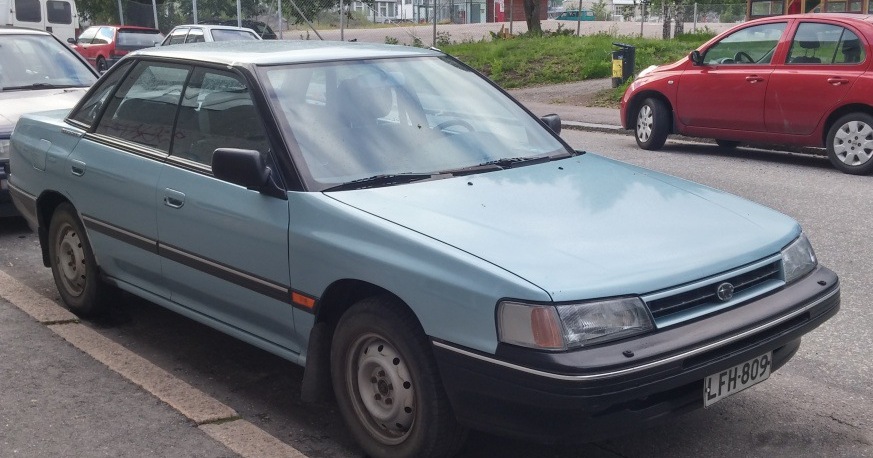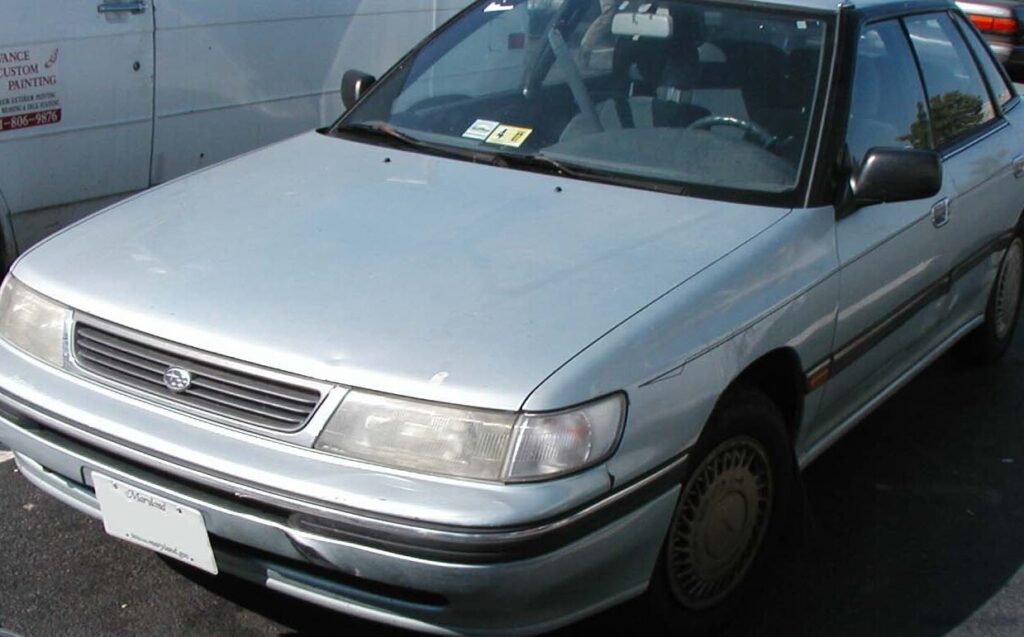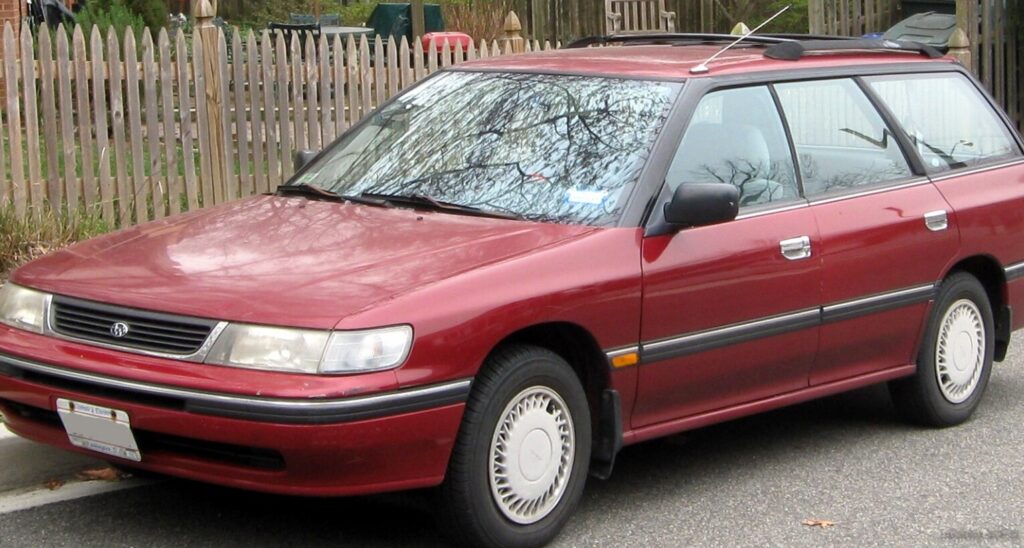
The Subaru Legacy I Station Wagon, specifically the BJF facelift model produced from 1991 to 1994, represented Subaru’s entry into the competitive mid-size wagon segment. This variant, equipped with the 1.6-liter EJ16 engine producing 95 horsepower, served as the base model for the Legacy wagon range in many markets, particularly in Europe and Japan. It offered a practical and affordable alternative to sedans, capitalizing on the growing popularity of station wagons for family transport and recreational use. The BJF facelift brought subtle styling updates and refinements to the original Legacy, enhancing its appeal and solidifying its position as a reliable and versatile vehicle.
Technical Specifications
| Brand | Subaru |
| Model | Legacy |
| Generation | Legacy I Station Wagon (BJF, facelift 1991) |
| Type (Engine) | 1600 (95 Hp) |
| Start of production | 1991 |
| End of production | 1994 |
| Powertrain Architecture | Internal Combustion engine |
| Body type | Station wagon (estate) |
| Seats | 5 |
| Doors | 5 |
| Fuel Type | Petrol (Gasoline) |
| Weight-to-power ratio | 12.4 kg/Hp, 80.5 Hp/tonne |
| Weight-to-torque ratio | 9.6 kg/Nm, 104.2 Nm/tonne |
| Power | 95 Hp @ 6400 rpm |
| Power per litre | 59.5 Hp/l |
| Torque | 123 Nm @ 3200 rpm (90.72 lb.-ft. @ 3200 rpm) |
| Engine layout | Front, Longitudinal |
| Engine Model/Code | EJ16 |
| Engine displacement | 1597 cm3 (97.45 cu. in.) |
| Number of cylinders | 4 |
| Engine configuration | Boxer |
| Cylinder Bore | 87.9 mm (3.46 in.) |
| Piston Stroke | 65.8 mm (2.59 in.) |
| Compression ratio | 8.9:1 |
| Number of valves per cylinder | 4 |
| Fuel injection system | Multi-port manifold injection |
| Engine aspiration | Naturally aspirated engine |
| Engine oil capacity | 4 l (4.23 US qt | 3.52 UK qt) |
| Coolant | 6.3 l (6.66 US qt | 5.54 UK qt) |
| Kerb Weight | 1180 kg (2601.45 lbs.) |
| Max. weight | 1900 kg (4188.78 lbs.) |
| Max load | 720 kg (1587.33 lbs.) |
| Trunk (boot) space – minimum | 420 l (14.83 cu. ft.) |
| Trunk (boot) space – maximum | 1550 l (54.74 cu. ft.) |
| Fuel tank capacity | 60 l (15.85 US gal | 13.2 UK gal) |
| Length | 4620 mm (181.89 in.) |
| Width | 1690 mm (66.54 in.) |
| Height | 1420 mm (55.91 in.) |
| Wheelbase | 2580 mm (101.57 in.) |
| Front track | 1475 mm (58.07 in.) |
| Rear (Back) track | 1460 mm (57.48 in.) |
| Ride height (ground clearance) | 160 mm (6.3 in.) |
| Minimum turning circle (turning diameter) | 10.2 m (33.46 ft.) |
| Drivetrain Architecture | The Internal combustion engine (ICE) drives the front wheels of the vehicle. |
| Drive wheel | Front wheel drive |
| Number of gears and type of gearbox | 5 gears, manual transmission |
| Front suspension | Independent type McPherson |
| Rear suspension | Several levers and rods |
| Front brakes | Ventilated discs |
| Rear brakes | Drum |
| Assisting systems | ABS (Anti-lock braking system) |
| Steering type | Steering rack and pinion |
| Power steering | Hydraulic Steering |
| Wheel rims size | 13 |
Powertrain & Engine Architecture
The heart of this Legacy variant was the EJ16, a 1.6-liter naturally aspirated, horizontally-opposed (boxer) four-cylinder engine. Subaru’s boxer engine design, with its pistons moving horizontally, offered inherent balance and a lower center of gravity, contributing to the car’s handling characteristics. The EJ16 featured multi-port fuel injection, a relatively common technology at the time, providing improved fuel efficiency and smoother power delivery compared to carbureted engines. The engine produced 95 horsepower at 6400 rpm and 123 Nm (90.72 lb-ft) of torque at 3200 rpm. This power was transmitted to the front wheels through a five-speed manual transmission. The longitudinal engine layout, typical of Subaru, further aided weight distribution.
Driving Characteristics
The 1.6-liter engine, paired with the five-speed manual gearbox, provided adequate, though not exhilarating, performance. Acceleration was modest, and overtaking required careful planning. The engine’s torque peak at 3200 rpm meant that it felt relatively responsive in everyday driving situations, but lacked the punch of the larger 2.0-liter and 2.2-liter engines offered in other Legacy models. The manual transmission offered precise shifts, and the front-wheel-drive configuration provided predictable handling. Compared to the automatic transmission option available on other Legacy trims, the manual version offered better fuel economy and a more engaging driving experience. The relatively light weight of the wagon, at 1180 kg (2601.45 lbs), helped to mitigate the engine’s power deficit.
Equipment & Trim Levels
The base-level 1.6-liter Legacy wagon was typically equipped with a functional, rather than luxurious, interior. Standard features generally included cloth upholstery, a basic stereo system, and manual windows and door locks. Air conditioning was often an optional extra. The dashboard layout was straightforward and focused on practicality. Higher trim levels, such as the GL and GX, offered upgrades like power windows, central locking, and upgraded audio systems. The 1.6L model was positioned as the entry point to the Legacy wagon range, appealing to budget-conscious buyers who prioritized practicality and reliability over outright performance and luxury.
Chassis & Braking
The Legacy I wagon utilized an independent McPherson strut suspension at the front, providing a comfortable ride and decent handling. The rear suspension employed a multi-link setup, further enhancing ride quality and stability. Braking duties were handled by ventilated discs at the front and drum brakes at the rear. Anti-lock braking system (ABS) was available as an option, improving braking performance and safety, particularly on slippery surfaces. The steering was rack-and-pinion with hydraulic power assistance, offering light and precise steering feel. The suspension setup was tuned for comfort, prioritizing a smooth ride over sporty handling.
Market Reception & Comparison
The 1.6-liter Legacy wagon was generally well-received as a practical and reliable family vehicle. Critics praised its spacious interior, comfortable ride, and fuel efficiency. However, the engine’s modest power output was often cited as a drawback, particularly when compared to the more powerful 2.0-liter and 2.2-liter options. The 1.6L model offered a more affordable entry point into the Legacy range, making it attractive to buyers who didn’t require the extra performance of the larger engines. Fuel economy was a strong point, making it a cost-effective choice for daily commuting and long-distance travel. Compared to rivals like the Ford Mondeo wagon and the Opel/Vauxhall Vectra wagon, the Legacy offered a unique combination of all-wheel-drive availability (on higher trims) and a comfortable, well-equipped interior.
Legacy
The EJ16 engine, while not known for its high performance, proved to be a durable and reliable unit. Properly maintained examples continue to operate reliably today. The Legacy I wagon, in general, has earned a reputation for longevity and dependability. In the used car market, the 1.6-liter variant represents an affordable entry point into Subaru ownership. While it may not offer the same level of performance as higher-spec models, its simplicity and reliability make it a popular choice for those seeking a practical and dependable family vehicle. Parts availability remains good, and the relatively straightforward mechanical design makes it accessible to home mechanics.