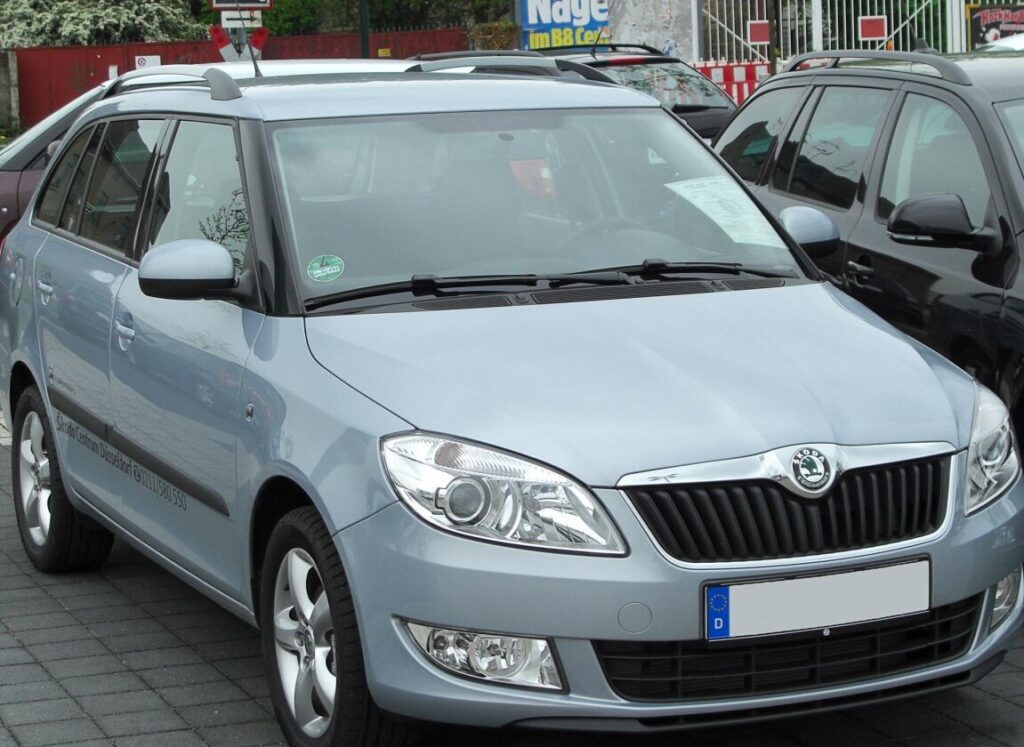
The Skoda Fabia II Combi 1.6 TDI (90 hp) is a compact station wagon produced by the Czech automaker Skoda between 2010 and 2014, following the facelift of the second-generation Fabia. This variant occupied a key position in the Fabia Combi lineup, offering a balance between fuel efficiency, practicality, and affordability. It was primarily aimed at buyers seeking a cost-effective and economical family vehicle, particularly in European markets where diesel engines and station wagon body styles were highly popular. The 1.6 TDI 90 hp model represented an entry-level diesel option within the Combi range, slotting below the more powerful 1.6 TDI 105 hp and the petrol-powered variants.
Technical Specifications
| Brand | Skoda |
| Model | Fabia |
| Generation | Fabia II Combi (facelift 2010) |
| Type (Engine) | 1.6 TDI (90 Hp) |
| Start of production | March, 2010 |
| End of production | 2014 |
| Powertrain Architecture | Internal Combustion engine |
| Body type | Station wagon (estate) |
| Seats | 5 |
| Doors | 5 |
| Fuel consumption (urban) | 5.1 l/100 km (46.1 US mpg, 55.4 UK mpg, 19.6 km/l) |
| Fuel consumption (extra urban) | 3.6 l/100 km (65.3 US mpg, 78.5 UK mpg, 27.8 km/l) |
| Fuel consumption (combined) | 4.2 l/100 km (56 US mpg, 67.3 UK mpg, 23.8 km/l) |
| CO2 emissions | 109 g/km |
| Fuel Type | Diesel |
| Acceleration 0 – 100 km/h | 12.7 sec |
| Acceleration 0 – 62 mph | 12.7 sec |
| Acceleration 0 – 60 mph | 12.1 sec |
| Maximum speed | 177 km/h (109.98 mph) |
| Emission standard | Euro 5 |
| Weight-to-power ratio | 12.8 kg/Hp, 78.3 Hp/tonne |
| Weight-to-torque ratio | 5 kg/Nm, 200.2 Nm/tonne |
| Power | 90 Hp @ 4200 rpm |
| Power per litre | 56.3 Hp/l |
| Torque | 230 Nm @ 1500-2500 rpm (169.64 lb.-ft. @ 1500-2500 rpm) |
| Engine layout | Front, Transverse |
| Engine Model/Code | EA189 / CAYB |
| Engine displacement | 1598 cm3 (97.52 cu. in.) |
| Number of cylinders | 4 |
| Engine configuration | Inline |
| Cylinder Bore | 79.5 mm (3.13 in.) |
| Piston Stroke | 80.5 mm (3.17 in.) |
| Compression ratio | 16.5:1 |
| Number of valves per cylinder | 4 |
| Fuel injection system | Diesel Commonrail |
| Engine aspiration | Turbocharger, Intercooler |
| Valvetrain | DOHC |
| Engine oil capacity | 4.3 l (4.54 US qt | 3.78 UK qt) |
| Coolant | 8.4 l (8.88 US qt | 7.39 UK qt) |
| Kerb Weight | 1149 kg (2533.11 lbs.) |
| Max. weight | 1679 kg (3701.56 lbs.) |
| Max load | 530 kg (1168.45 lbs.) |
| Trunk (boot) space – minimum | 505 l (17.83 cu. ft.) |
| Trunk (boot) space – maximum | 1485 l (52.44 cu. ft.) |
| Fuel tank capacity | 45 l (11.89 US gal | 9.9 UK gal) |
| Max. roof load | 75 kg (165.35 lbs.) |
| Permitted trailer load with brakes (12%) | 1200 kg (2645.55 lbs.) |
| Permitted trailer load without brakes | 450 kg (992.08 lbs.) |
| Permitted towbar download | 50 kg (110.23 lbs.) |
| Length | 4247 mm (167.2 in.) |
| Width | 1642 mm (64.65 in.) |
| Width including mirrors | 1886 mm (74.25 in.) |
| Height | 1498 mm (58.98 in.) |
| Wheelbase | 2465 mm (97.05 in.) |
| Front track | 1433 mm (56.42 in.) |
| Rear track | 1426 mm (56.14 in.) |
| Front overhang | 860 mm (33.86 in.) |
| Rear overhang | 922 mm (36.3 in.) |
| Ride height (ground clearance) | 135 mm (5.31 in.) |
| Drag coefficient (Cd) | 0.31 |
| Minimum turning circle | 10 m (32.81 ft.) |
| Approach angle | 14.1° |
| Departure angle | 12.1° |
| Drivetrain Architecture | The Internal combustion engine (ICE) drives the front wheels of the vehicle. |
| Drive wheel | Front wheel drive |
| Number of gears and type of gearbox | 5 gears, manual transmission |
| Front suspension | Independent, type McPherson with coil spring and anti-roll bar |
| Rear suspension | Coil spring, Torsion |
| Front brakes | Ventilated discs |
| Rear brakes | Disc |
| Assisting systems | ABS (Anti-lock braking system) |
| Steering type | Steering rack and pinion |
| Power steering | Electric Steering |
| Tires size | 165/70 R14; 185/60 R14; 195/55 R15 |
| Wheel rims size | 5J x 14; 6J x 14; 6J x 15 |
INTRODUCTION
The Skoda Fabia II Combi 1.6 TDI (90 hp) was introduced as part of the facelifted second-generation Fabia range in March 2010, continuing through the 2014 model year. Built on the Volkswagen Group’s A05 (1HX0/A3) platform, the Combi variant offered increased cargo capacity compared to the hatchback, making it a practical choice for families and those requiring additional space. The 1.6 TDI engine, part of the EA189 family, was a key component of Skoda’s strategy to offer fuel-efficient diesel options in its mainstream models. This particular configuration, producing 90 horsepower, was designed to provide a balance between performance and economy, appealing to a broad customer base.
Powertrain & Engine Architecture
The heart of the Fabia Combi 1.6 TDI is the EA189 series 1.6-liter inline-four diesel engine, specifically the CAYB engine code. This engine utilizes a common rail direct injection system, delivering fuel directly into the combustion chamber at high pressure for improved efficiency and reduced emissions. The engine features a turbocharger with an intercooler, enhancing power output and responsiveness. The 16-valve DOHC (Double Overhead Camshaft) valvetrain optimizes airflow into and out of the cylinders. The 5-speed manual transmission was standard, chosen for its simplicity and contribution to fuel economy. The engine’s design prioritized low-end torque, making it suitable for everyday driving conditions.
Driving Characteristics
The 90 hp 1.6 TDI engine in the Fabia Combi provided adequate, though not exhilarating, performance. Acceleration from 0-60 mph took around 12.1 seconds, and the top speed was approximately 109.98 mph. The engine’s strength lay in its usable torque, available from as low as 1500 rpm, which made it easy to navigate city traffic and maintain comfortable cruising speeds on the highway. Compared to the more powerful 1.6 TDI 105 hp variant, the 90 hp version felt noticeably less responsive, particularly during overtaking maneuvers. The 5-speed gearbox was well-matched to the engine’s characteristics, offering smooth shifts and reasonable gear ratios. However, it lacked the refinement and wider range of a 6-speed transmission.
Equipment & Trim Levels
The Fabia Combi 1.6 TDI (90 hp) typically came equipped with a reasonable level of standard features. These included central locking, electric front windows, a basic audio system, and ABS brakes. Depending on the specific market and optional packages selected, additional features could include air conditioning, alloy wheels, a trip computer, and front fog lights. Interior upholstery was typically cloth, with a functional and durable design. Higher trim levels offered upgrades such as leather steering wheels, upgraded audio systems, and more sophisticated interior trim.
Chassis & Braking
The Fabia Combi’s chassis featured an independent McPherson strut front suspension and a torsion beam rear suspension. This setup provided a comfortable ride quality, although it wasn’t particularly sporty. The front brakes were ventilated discs, while the rear brakes were solid discs. ABS (Anti-lock Braking System) was standard, enhancing safety and stability during braking. The suspension was tuned to prioritize ride comfort over handling precision, making it well-suited for everyday driving conditions. Stabilizer bars were included to reduce body roll during cornering.
Market Reception & Comparison
The Skoda Fabia Combi 1.6 TDI (90 hp) was generally well-received by automotive critics as a practical and economical family car. It was praised for its spacious interior, fuel efficiency, and competitive pricing. However, some reviewers noted that the engine lacked refinement and could feel strained when fully loaded or driving uphill. Compared to other diesel estate cars in its class, such as the Volkswagen Golf Estate or Ford Focus Estate, the Fabia Combi offered a more affordable option, albeit with a slightly less refined driving experience. Fuel economy was a key selling point, with combined figures around 56 US mpg.
Legacy
The 1.6 TDI engine, while generally reliable, has been subject to scrutiny regarding emissions compliance, particularly in relation to the Volkswagen emissions scandal. However, well-maintained examples of the Fabia Combi 1.6 TDI continue to be a popular choice in the used car market, offering a cost-effective and practical transportation solution. The engine’s durability and relatively simple construction make it relatively easy and affordable to maintain. The Fabia Combi, in general, has established a reputation for being a dependable and value-for-money vehicle, and the 1.6 TDI 90 hp variant remains a viable option for buyers seeking an economical and spacious estate car.