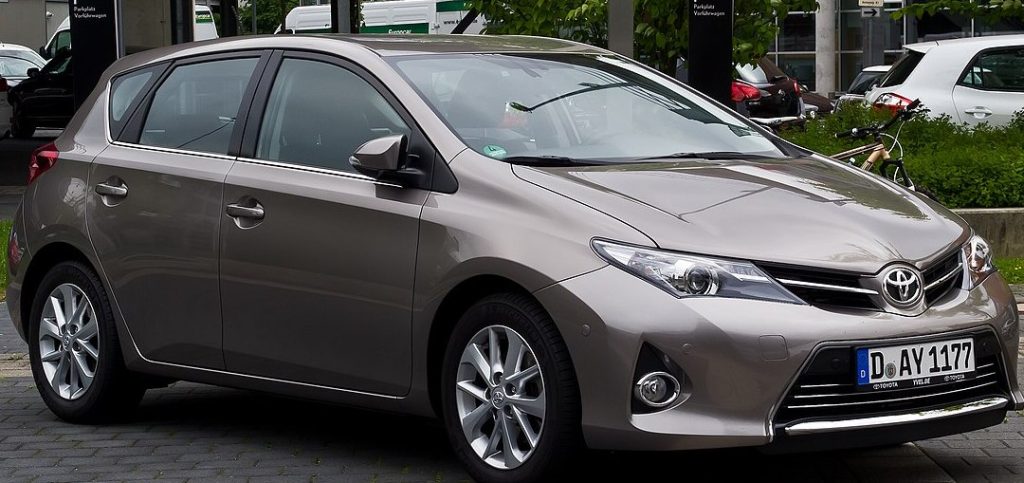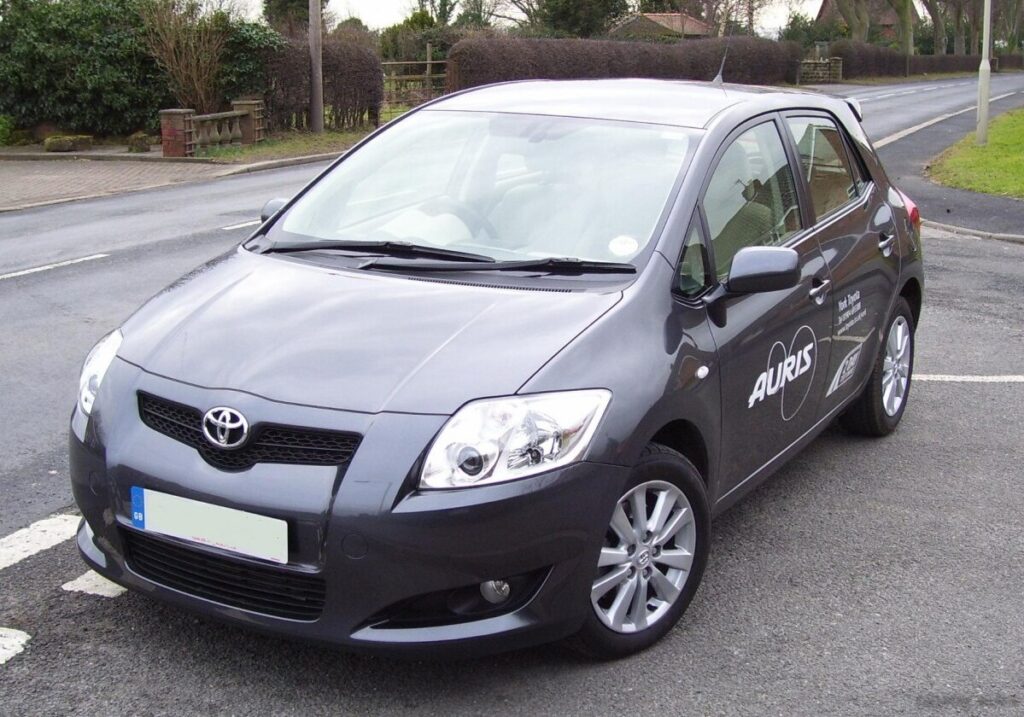
The Toyota Auris I 1.4 D-4D (90 hp) was a European-market compact hatchback produced between 2009 and 2010. Positioned as an entry-level offering within the first generation Auris (E150 series), it aimed to provide fuel-efficient transportation for buyers prioritizing economy over outright performance. This variant played a key role in establishing the Auris as a competitor to established rivals like the Volkswagen Golf, Ford Focus, and Opel/Vauxhall Astra in the crucial C-segment. It was part of the broader Toyota strategy to offer a more modern and refined alternative to the Corolla, which was phased out in Europe in favor of the Auris.
Technical Specifications
| Brand | Toyota |
| Model | Auris |
| Generation | Auris I |
| Type (Engine) | 1.4 D-4D (90 Hp) |
| Start of production | 2009 |
| End of production | 2010 |
| Powertrain Architecture | Internal Combustion engine |
| Body type | Hatchback |
| Seats | 5 |
| Doors | 5 |
| Fuel consumption (urban) | 5.7 l/100 km (41.3 US mpg, 49.6 UK mpg) |
| Fuel consumption (extra urban) | 4.3 l/100 km (54.7 US mpg, 65.7 UK mpg) |
| Fuel consumption (combined) | 4.8 l/100 km (49 US mpg, 58.9 UK mpg) |
| CO2 emissions | 128 g/km |
| Fuel Type | Diesel |
| Acceleration 0 – 100 km/h | 11.9 sec |
| Acceleration 0 – 62 mph | 11.9 sec |
| Acceleration 0 – 60 mph | 11.3 sec |
| Maximum speed | 175 km/h (108.74 mph) |
| Emission standard | Euro 4 |
| Weight-to-power ratio | 14.1 kg/Hp |
| Weight-to-torque ratio | 6.2 kg/Nm |
| Power | 90 Hp @ 3800 rpm |
| Torque | 205 Nm @ 1800-2800 rpm (151.2 lb.-ft. @ 1800-2800 rpm) |
| Engine layout | Front, Transverse |
| Engine Model/Code | 1ND-TV |
| Engine displacement | 1364 cm3 (83.24 cu. in.) |
| Number of cylinders | 4 |
| Engine configuration | Inline |
| Cylinder Bore | 73 mm (2.87 in.) |
| Piston Stroke | 81.5 mm (3.21 in.) |
| Compression ratio | 17.9:1 |
| Number of valves per cylinder | 2 |
| Fuel injection system | Diesel Commonrail |
| Engine aspiration | Turbocharger, Intercooler |
| Valvetrain | SOHC |
| Engine oil capacity | 3.9 l (4.12 US qt | 3.43 UK qt) |
| Coolant capacity | 5.6 l (5.92 US qt | 4.93 UK qt) |
| Kerb Weight | 1265-1320 kg (2788.85 – 2910.1 lbs.) |
| Max. weight | 1760 kg (3880.14 lbs.) |
| Max load | 440-495 kg (970.03 – 1091.29 lbs.) |
| Trunk (boot) space – minimum | 354 l (12.5 cu. ft.) |
| Trunk (boot) space – maximum | 1355 l (47.85 cu. ft.) |
| Fuel tank capacity | 55 l (14.53 US gal | 12.1 UK gal) |
| Max. roof load | 75 kg (165.35 lbs.) |
| Permitted trailer load with brakes (12%) | 1000 kg (2204.62 lbs.) |
| Permitted trailer load without brakes | 450 kg (992.08 lbs.) |
| Permitted towbar download | 55 kg (121.25 lbs.) |
| Length | 4220 mm (166.14 in.) |
| Width | 1760 mm (69.29 in.) |
| Height | 1515 mm (59.65 in.) |
| Wheelbase | 2600 mm (102.36 in.) |
| Front track | 1525 mm (60.04 in.) |
| Rear track | 1525 mm (60.04 in.) |
| Minimum turning circle | 11 m (36.09 ft.) |
| Drivetrain | Front wheel drive |
| Number of gears | 6 |
| Gearbox type | Manual transmission |
| Front suspension | Independent type McPherson |
| Rear suspension | Torsion |
| Front brakes | Ventilated discs, 273×26 mm |
| Rear brakes | Disc, 270×10 mm |
| Assisting systems | ABS (Anti-lock braking system) |
| Steering type | Steering rack and pinion |
| Power steering | Electric Steering |
| Tires size | 195/65 R15; 205/55 R16 |
| Wheel rims size | 6J x 15; 6.5J x 16 |
Powertrain & Engine Architecture
The heart of the Auris 1.4 D-4D was the 1ND-TV engine, a 1.4-liter inline-four cylinder diesel. This engine was a member of Toyota’s ‘ND’ family of diesel engines, known for their durability and fuel efficiency. It featured a turbocharger with an intercooler to boost power output, and a common-rail direct fuel injection system for precise fuel delivery. The 1ND-TV utilized a Single Overhead Camshaft (SOHC) valvetrain with two valves per cylinder. The engine produced 90 horsepower at 3800 rpm and 205 Nm (151.2 lb-ft) of torque between 1800 and 2800 rpm. The engine’s relatively high compression ratio of 17.9:1 contributed to its efficiency. The engine was paired with a six-speed manual transmission, which was the standard offering for this variant. While an automatic transmission was available on other Auris models, it wasn’t offered with the 1.4 D-4D engine.
Driving Characteristics
The 1.4 D-4D with the manual transmission offered a practical, if not particularly exciting, driving experience. Acceleration from 0-60 mph took around 11.3 seconds, and top speed was 175 km/h (108.74 mph). The engine’s torque was readily available from low revs, making it suitable for everyday driving and overtaking maneuvers. However, it lacked the punch of higher-powered Auris variants like the 1.6L petrol or the 2.0L D-4D. The six-speed gearbox was well-matched to the engine, allowing for efficient cruising on motorways. The gear ratios were optimized for fuel economy rather than outright performance. Compared to the petrol versions, the 1.4 D-4D offered significantly better fuel economy, but at the cost of responsiveness.
Equipment & Trim Levels
The 1.4 D-4D typically represented the entry-level trim in the Auris range. Standard equipment generally included air conditioning, power steering, electric front windows, a CD player, and ABS brakes. Safety features like driver and passenger airbags were also standard. Interior upholstery was typically cloth, and the dashboard featured a functional, if somewhat basic, design. Optional extras included alloy wheels, a multi-function steering wheel, and a trip computer. Higher trim levels, such as the SR and T2, added features like climate control, rear electric windows, and upgraded audio systems.
Chassis & Braking
The Auris I utilized a McPherson strut independent suspension at the front and a torsion beam suspension at the rear. This setup provided a comfortable ride quality, although it wasn’t particularly sporty. The front brakes were ventilated discs, while the rear brakes were solid discs. ABS (Anti-lock Braking System) was standard. The suspension was tuned for comfort and stability, prioritizing ride quality over handling precision. The relatively lightweight nature of the 1.4 D-4D model, with a kerb weight between 1265-1320 kg, helped to mitigate the effects of the less powerful engine.
Market Reception & Comparison
The Auris 1.4 D-4D was generally well-received by critics for its fuel efficiency and low running costs. It was seen as a sensible choice for buyers who prioritized economy over performance. However, some reviewers criticized its lack of power and somewhat uninspiring driving experience. Compared to the 1.6L petrol version, the 1.4 D-4D offered significantly better fuel economy (around 49 mpg combined vs. 41 mpg) but slower acceleration. The 2.0L D-4D provided a more powerful and refined driving experience, but at a higher price point and with slightly lower fuel economy. The Auris 1.4 D-4D competed directly with models like the Volkswagen Golf 1.6 TDI and the Ford Focus 1.6 TDCi.
Legacy
The 1ND-TV engine, found in the Auris 1.4 D-4D, has proven to be a reliable and durable unit. While diesel engines, in general, have faced increased scrutiny in recent years, the 1ND-TV has a reputation for longevity, provided it has been properly maintained. On the used car market, the Auris 1.4 D-4D remains an affordable and economical option. However, potential buyers should be aware of the potential for diesel particulate filter (DPF) issues, particularly on vehicles that have primarily been used for short journeys. Overall, the Auris 1.4 D-4D represents a practical and fuel-efficient choice for those seeking a reliable and affordable compact hatchback.