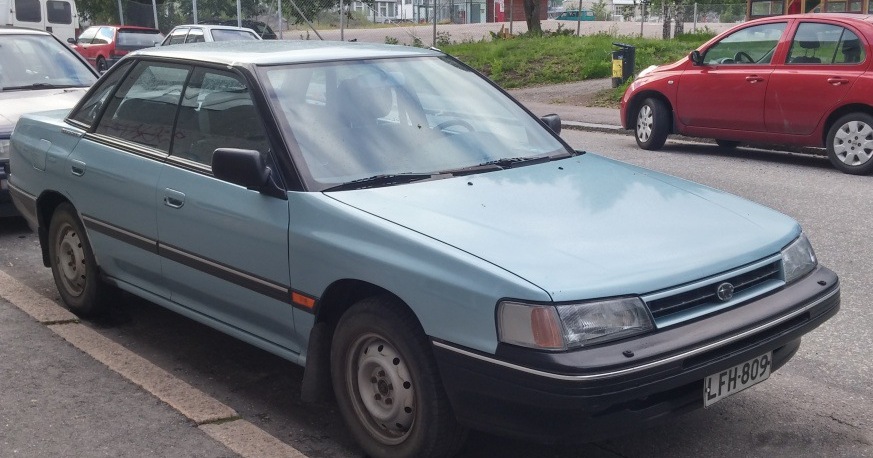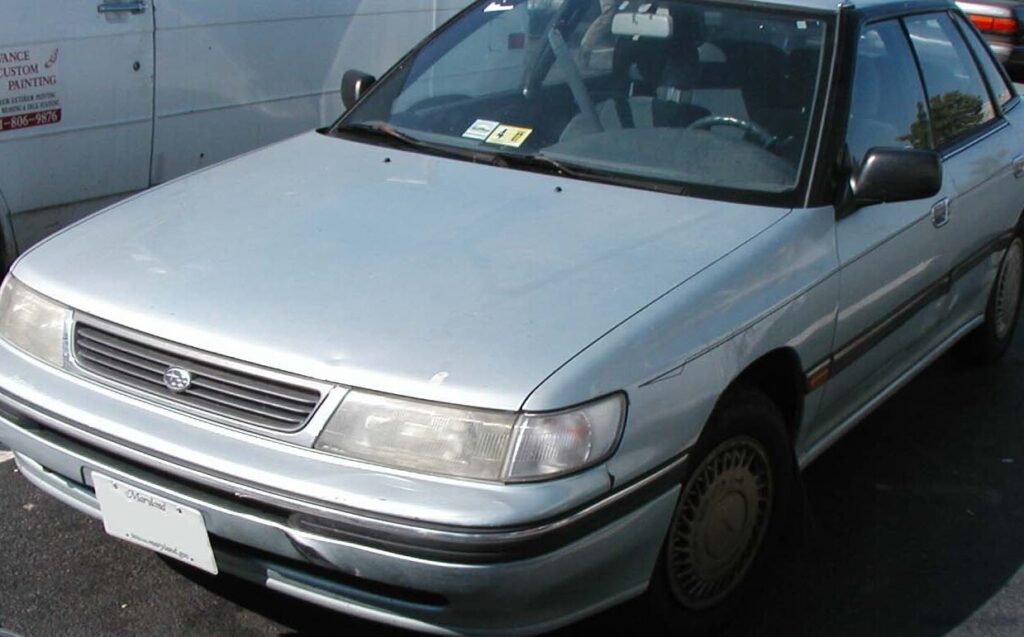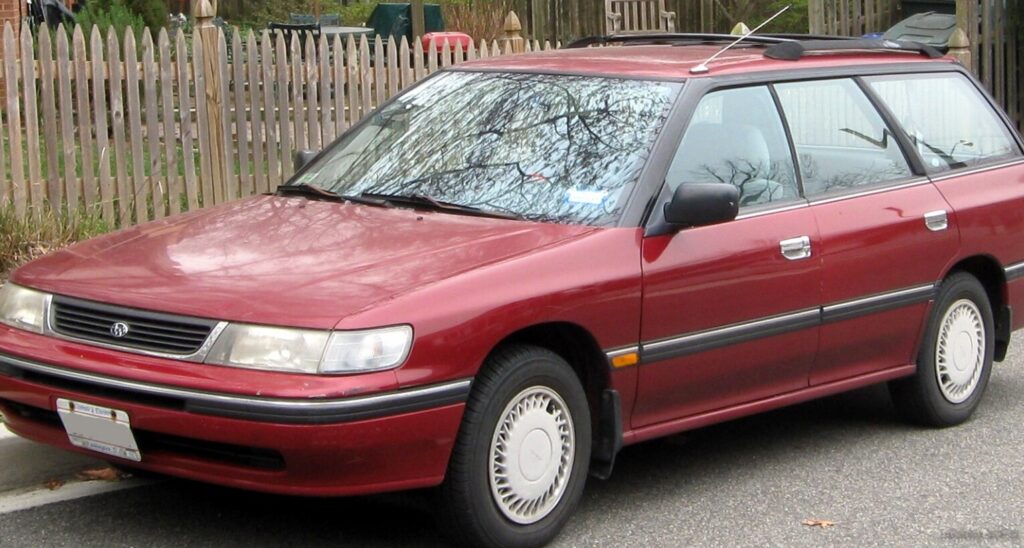
The Subaru Legacy I Station Wagon, specifically the BJF facelift model produced from 1991 to 1994, represented Subaru’s entry into the competitive mid-size wagon segment. This variant, equipped with the 2.0-liter EJ20E engine producing 116 horsepower and paired with a five-speed manual transmission, offered a practical and capable all-wheel-drive option for families and those needing versatile cargo space. The BJF facelift brought subtle styling updates and refinements to the original Legacy wagon, solidifying its position as a reliable and well-rounded vehicle. It was a key model for Subaru in markets where wagons were popular, offering a compelling alternative to sedans and SUVs.
Technical Specifications
| Brand | Subaru |
| Model | Legacy |
| Generation | Legacy I Station Wagon (BJF, facelift 1991) |
| Type (Engine) | 2000 (116 Hp) AWD |
| Start of production | 1991 |
| End of production | 1994 |
| Powertrain Architecture | Internal Combustion engine |
| Body type | Station wagon (estate) |
| Seats | 5 |
| Doors | 5 |
| Fuel consumption (urban) | 12 l/100 km (19.6 US mpg, 23.5 UK mpg, 8.3 km/l) |
| Fuel consumption (extra urban) | 7.7 l/100 km (30.5 US mpg, 36.7 UK mpg, 13 km/l) |
| Fuel consumption (combined) | 9.7 l/100 km (24.2 US mpg, 29.1 UK mpg, 10.3 km/l) |
| Fuel Type | Petrol (Gasoline) |
| Acceleration 0 – 100 km/h | 10.4 sec |
| Acceleration 0 – 62 mph | 10.4 sec |
| Acceleration 0 – 60 mph | 9.9 sec |
| Maximum speed | 181 km/h (112.47 mph) |
| Weight-to-power ratio | 11.6 kg/Hp, 86.2 Hp/tonne |
| Weight-to-torque ratio | 8.2 kg/Nm, 121.9 Nm/tonne |
| Power | 116 Hp @ 5600 rpm |
| Power per litre | 58.2 Hp/l |
| Torque | 164 Nm @ 4400 rpm (120.96 lb.-ft. @ 4400 rpm) |
| Engine layout | Front, Longitudinal |
| Engine Model/Code | EJ20E |
| Engine displacement | 1994 cm3 (121.68 cu. in.) |
| Number of cylinders | 4 |
| Engine configuration | Boxer |
| Cylinder Bore | 92 mm (3.62 in.) |
| Piston Stroke | 75 mm (2.95 in.) |
| Compression ratio | 9.5:1 |
| Number of valves per cylinder | 4 |
| Fuel injection system | Multi-port manifold injection |
| Engine aspiration | Naturally aspirated engine |
| Valvetrain | SOHC |
| Engine oil capacity | 4.5 l (4.76 US qt | 3.96 UK qt) |
| Coolant | 6.1 l (6.45 US qt | 5.37 UK qt) |
| Kerb Weight | 1345 kg (2965.22 lbs.) |
| Max. weight | 1950 kg (4299.01 lbs.) |
| Max load | 605 kg (1333.8 lbs.) |
| Trunk (boot) space – minimum | 420 l (14.83 cu. ft.) |
| Trunk (boot) space – maximum | 1550 l (54.74 cu. ft.) |
| Fuel tank capacity | 60 l (15.85 US gal | 13.2 UK gal) |
| Max. roof load | 100 kg (220.46 lbs.) |
| Permitted trailer load with brakes (12%) | 950 kg (2094.39 lbs.) |
| Permitted trailer load without brakes | 605 kg (1333.8 lbs.) |
| Permitted towbar download | 75 kg (165.35 lbs.) |
| Length | 4620 mm (181.89 in.) |
| Width | 1690 mm (66.54 in.) |
| Height | 1430 mm (56.3 in.) |
| Wheelbase | 2580 mm (101.57 in.) |
| Front track | 1460 mm (57.48 in.) |
| Rear (Back) track | 1450 mm (57.09 in.) |
| Ride height (ground clearance) | 165 mm (6.5 in.) |
| Minimum turning circle (turning diameter) | 10.1 m (33.14 ft.) |
| Drive wheel | All wheel drive (4×4) |
| Number of gears and type of gearbox | 5 gears, manual transmission |
| Front suspension | Independent type McPherson |
| Rear suspension | Several levers and rods |
| Front brakes | Ventilated discs |
| Rear brakes | Disc |
| Assisting systems | ABS (Anti-lock braking system) |
| Steering type | Steering rack and pinion |
| Power steering | Hydraulic Steering |
| Tires size | 185/70 R14 |
| Wheel rims size | 14 |
Powertrain & Engine Architecture
The heart of this Legacy wagon is the EJ20E, a 2.0-liter naturally aspirated, horizontally-opposed (boxer) four-cylinder engine. This engine design, a Subaru hallmark, provides a low center of gravity, contributing to improved handling and stability. The EJ20E features a single overhead camshaft (SOHC) valvetrain operating four valves per cylinder. Fuel delivery is managed by a multi-port fuel injection system, providing precise fuel metering for efficient combustion. The engine produces 116 horsepower at 5600 rpm and 164 Nm (120.96 lb-ft) of torque at 4400 rpm. The five-speed manual transmission provides a direct connection to the drivetrain, allowing for precise control and efficient power delivery. The transmission’s gear ratios were tuned for a balance of acceleration and fuel economy, prioritizing usability over outright performance.
Driving Characteristics
The 116 hp EJ20E-powered Legacy wagon offered respectable, though not exhilarating, performance. Acceleration from 0-60 mph took approximately 9.9 seconds, and the top speed was around 112 mph. The all-wheel-drive system provided excellent traction in various weather conditions, making it a confident handler on both dry and slippery surfaces. Compared to higher-output versions of the Legacy, such as those with the turbocharged EJ20G engine, this variant felt less powerful, particularly during overtaking maneuvers. However, the manual transmission allowed drivers to make the most of the available power, and the predictable torque curve made it easy to drive in everyday situations. The wagon’s suspension provided a comfortable ride, absorbing bumps and imperfections in the road effectively.
Equipment & Trim Levels
The BJF facelift Legacy wagon typically came with a reasonable level of standard equipment. This included power steering, a basic audio system, and cloth upholstery. Depending on the specific market and optional packages, features like air conditioning, power windows, and central locking could be added. The interior design was functional and straightforward, prioritizing practicality over luxury. The wagon’s spacious interior and large cargo area were key selling points, making it ideal for families and those with active lifestyles. The rear seats could be folded down to create a larger cargo space, further enhancing its versatility.
Chassis & Braking
The Legacy wagon featured an independent McPherson strut suspension in the front and a multi-link suspension in the rear, providing a comfortable ride and good handling characteristics. The braking system consisted of ventilated discs in the front and solid discs in the rear. Anti-lock brakes (ABS) were often included as standard equipment, enhancing safety by preventing wheel lockup during hard braking. The chassis was designed to provide a stable and predictable driving experience, even when fully loaded. The all-wheel-drive system distributed power to all four wheels, maximizing traction and stability.
Market Reception & Comparison
The Subaru Legacy I Station Wagon, particularly the 2.0-liter AWD variant, was well-received in markets where wagons were popular. Critics praised its practicality, reliability, and all-weather capability. Compared to other mid-size wagons of the time, the Legacy offered a unique combination of features, including standard all-wheel drive and a horizontally-opposed engine. Fuel economy was reasonable for its class, averaging around 24.2 US mpg in combined driving. While not the fastest or most luxurious wagon available, it offered a compelling value proposition for buyers seeking a versatile and dependable vehicle.
Legacy
The EJ20E engine, found in this Legacy wagon, is known for its durability and reliability when properly maintained. While age and mileage can lead to common issues such as oil leaks and head gasket failures, the engine is generally considered to be robust. Today, these Legacy wagons are becoming increasingly sought after by enthusiasts and collectors. Their combination of practicality, all-wheel-drive capability, and unique engine design makes them appealing to those looking for a classic Subaru. Parts availability is generally good, and the relatively simple mechanical design makes them relatively easy to maintain and repair.