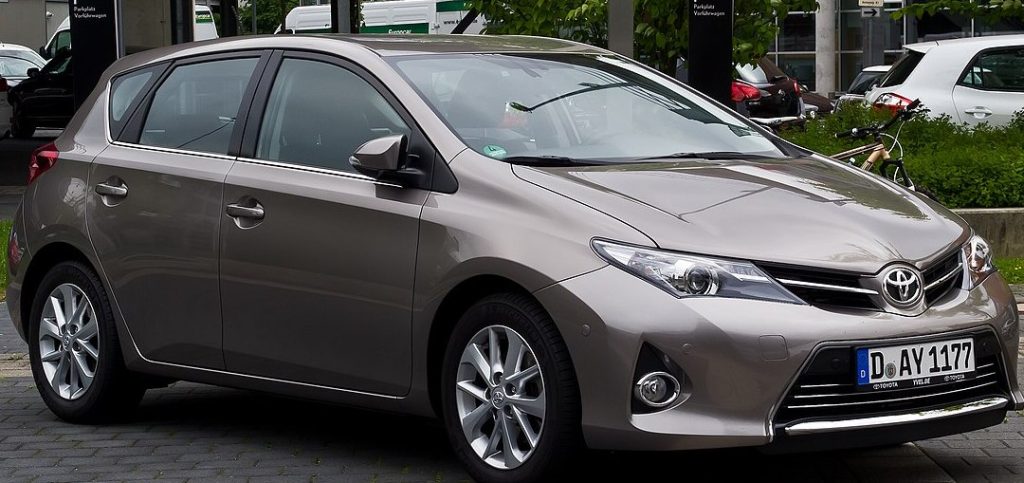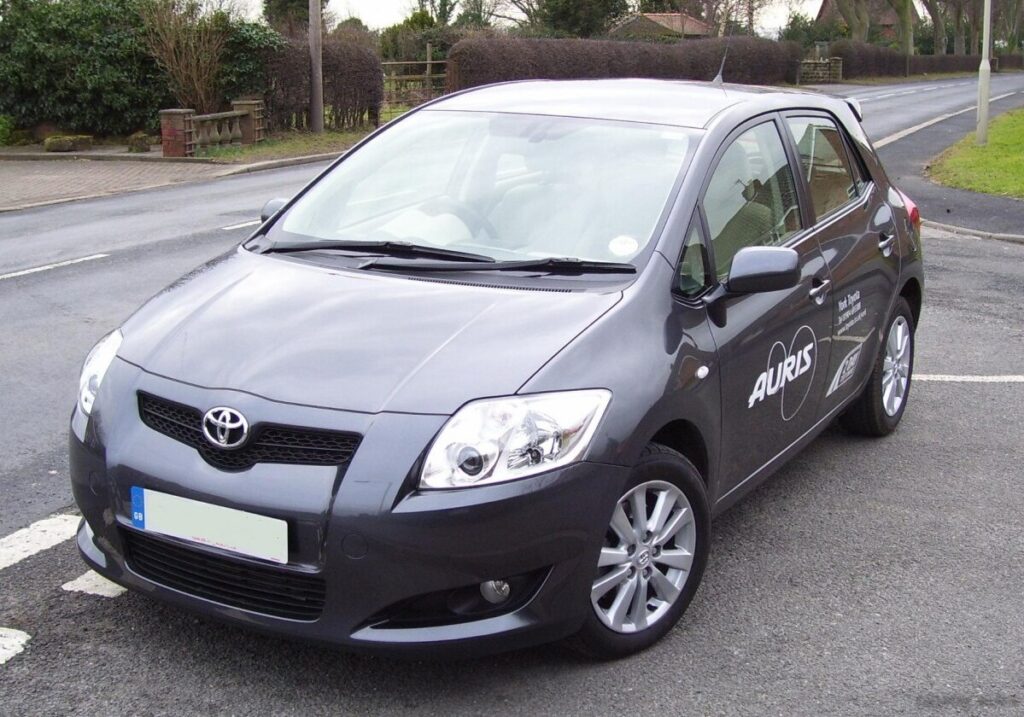
The Toyota Auris I 1.6 16V Valvematic, produced from 2009 to 2010, represented a key offering in Toyota’s European C-segment hatchback lineup. Positioned as a mainstream choice, it aimed to provide a balance of fuel efficiency, practicality, and reasonable performance. This variant was part of the first generation Auris (E150/E180 series), designed as a replacement for the Corolla hatchback in the European market. The Auris sought to appeal to a broader audience with a more contemporary design and improved driving dynamics compared to its predecessor. This specific 1.6L engine and 6-speed manual transmission combination was a popular choice, offering a good compromise for drivers prioritizing economy and usability over outright speed.
Technical Specifications
| Brand | Toyota |
| Model | Auris |
| Generation | Auris I |
| Type (Engine) | 1.6 16V Valvematic (132 Hp) |
| Start of production | 2009 |
| End of production | 2010 |
| Powertrain Architecture | Internal Combustion engine |
| Body type | Hatchback |
| Seats | 5 |
| Doors | 5 |
| Fuel consumption (urban) | 8.4 l/100 km (28 US mpg, 33.6 UK mpg, 11.9 km/l) |
| Fuel consumption (extra urban) | 5.4 l/100 km (43.6 US mpg, 52.3 UK mpg, 18.5 km/l) |
| Fuel consumption (combined) | 6.5 l/100 km (36.2 US mpg, 43.5 UK mpg, 15.4 km/l) |
| Fuel Type | Petrol (Gasoline) |
| Acceleration 0 – 100 km/h | 10 sec |
| Acceleration 0 – 62 mph | 10 sec |
| Acceleration 0 – 60 mph | 9.5 sec |
| Maximum speed | 195 km/h (121.17 mph) |
| Power | 132 Hp @ 6400 rpm |
| Power per litre | 82.6 Hp/l |
| Torque | 160 Nm @ 4400 rpm (118.01 lb.-ft. @ 4400 rpm) |
| Engine layout | Front, Transverse |
| Engine Model/Code | 1ZR-FAE |
| Engine displacement | 1598 cm3 (97.52 cu. in.) |
| Number of cylinders | 4 |
| Engine configuration | Inline |
| Cylinder Bore | 80.5 mm (3.17 in.) |
| Piston Stroke | 78.5 mm (3.09 in.) |
| Compression ratio | 10.7:1 |
| Number of valves per cylinder | 4 |
| Fuel injection system | Multi-port manifold injection |
| Engine aspiration | Naturally aspirated engine |
| Valvetrain | DOHC |
| Engine oil capacity | 4.2 l (4.44 US qt | 3.7 UK qt) |
| Coolant | 5.6 l (5.92 US qt | 4.93 UK qt) |
| Trunk (boot) space – minimum | 350 l (12.36 cu. ft.) |
| Trunk (boot) space – maximum | 750 l (26.49 cu. ft.) |
| Fuel tank capacity | 55 l (14.53 US gal | 12.1 UK gal) |
| Length | 4220 mm (166.14 in.) |
| Width | 1760 mm (69.29 in.) |
| Height | 1515 mm (59.65 in.) |
| Wheelbase | 2600 mm (102.36 in.) |
| Front track | 1525 mm (60.04 in.) |
| Rear track | 1525 mm (60.04 in.) |
| Drivetrain Architecture | The Internal combustion engine (ICE) drives the front wheels of the vehicle. |
| Drive wheel | Front wheel drive |
| Number of gears and type of gearbox | 6 gears, manual transmission |
| Front suspension | Spring Strut |
| Rear suspension | Torsion |
| Front brakes | Ventilated discs |
| Rear brakes | Disc |
| Assisting systems | ABS (Anti-lock braking system) |
| Steering type | Steering rack and pinion |
INTRODUCTION
The Toyota Auris I 1.6 16V Valvematic, launched in 2009, was a crucial model for Toyota in Europe. It was designed to replace the Corolla hatchback, offering a more modern and appealing package for European buyers. The Auris aimed to blend Toyota’s renowned reliability with a more engaging driving experience and contemporary styling. This 1.6-liter variant, producing 132 horsepower, served as a core model within the range, appealing to customers seeking a practical and economical daily driver. It sat in the middle of the lineup, offering a step up from the base 1.33-liter engine while remaining more affordable than the higher-performance 1.8-liter Valvematic or diesel options.
Powertrain & Engine Architecture
The heart of this Auris variant is the 1ZR-FAE 1.6-liter inline-four engine. This engine utilizes Toyota’s Valvematic technology, a variable valve lift system that continuously adjusts the intake valve lift and timing to optimize engine performance and fuel efficiency. Unlike traditional variable valve timing systems that only adjust valve timing, Valvematic directly alters the lift amount, providing greater control over the air-fuel mixture. The engine employs multi-port fuel injection and a double overhead camshaft (DOHC) configuration. The 1ZR-FAE is a naturally aspirated engine, meaning it doesn’t rely on a turbocharger or supercharger for forced induction. The engine is transversely mounted in the front of the vehicle. Paired with the engine is a six-speed manual transmission, offering precise gear changes and contributing to the car’s overall fuel efficiency. The transmission’s gear ratios are tuned for a balance of acceleration and cruising comfort.
Driving Characteristics
The 1.6 16V Valvematic Auris delivers a respectable, if not exhilarating, driving experience. With 132 horsepower and 160 Nm (118 lb-ft) of torque, acceleration from 0 to 60 mph takes around 9.5 seconds, and it reaches a top speed of 195 km/h (121 mph). The Valvematic system helps to provide a relatively flat torque curve, making the engine feel responsive in everyday driving situations. Compared to the more powerful 1.8L variant, the 1.6L feels less strained during acceleration, but it lacks the same level of outright performance. The six-speed manual transmission allows drivers to keep the engine in its optimal power band, enhancing responsiveness. The steering is light and precise, making the Auris easy to maneuver in urban environments. The suspension provides a comfortable ride, absorbing bumps and imperfections in the road surface effectively.
Equipment & Trim Levels
The Auris I 1.6 16V Valvematic typically came equipped with a reasonable level of standard features. These included air conditioning, power windows, power door locks, a CD player with auxiliary input, and ABS brakes. Higher trim levels, such as the ‘TR’ or ‘SR’ variants, added features like alloy wheels, fog lights, a multi-function steering wheel, and upgraded interior trim. Interior upholstery was typically cloth, with options for different color schemes. Optional extras included a sunroof, satellite navigation, and parking sensors. The dashboard layout was functional and user-friendly, with clearly labeled controls and a straightforward instrument cluster.
Chassis & Braking
The Auris I utilizes a front-wheel-drive layout with a MacPherson strut suspension system at the front and a torsion beam suspension at the rear. This setup provides a good balance of ride comfort and handling. The front brakes are ventilated discs, offering strong stopping power, while the rear brakes are solid discs. ABS (Anti-lock Braking System) is standard, enhancing safety by preventing wheel lockup during hard braking. The chassis is relatively lightweight, contributing to the car’s agility and fuel efficiency. Stabilizer bars are fitted to both the front and rear axles to reduce body roll during cornering.
Market Reception & Comparison
The Toyota Auris I 1.6 16V Valvematic was generally well-received by automotive critics. It was praised for its fuel efficiency, reliability, and comfortable ride. However, some reviewers found the engine to be somewhat underpowered, particularly when fully loaded or driving on steep inclines. Compared to the 1.8L Valvematic, the 1.6L offered better fuel economy but less performance. The 1.6L also provided a more affordable entry point into the Auris range. In terms of reliability, the 1ZR-FAE engine proved to be very dependable, with few reported issues. Fuel economy figures of around 36.2 US mpg combined were competitive for its class.
Legacy
The Toyota Auris I 1.6 16V Valvematic has proven to be a durable and reliable vehicle in the used car market. The 1ZR-FAE engine is known for its longevity and relatively low maintenance costs. While not a particularly exciting car to drive, it offers a practical and economical transportation solution. Parts availability is generally good, and the Auris benefits from Toyota’s reputation for build quality. Today, these models represent a good value proposition for buyers seeking a dependable and affordable hatchback. The Valvematic technology, while not groundbreaking, contributed to the engine’s efficiency and smooth operation, solidifying its place as a sensible choice in the early 2010s.