
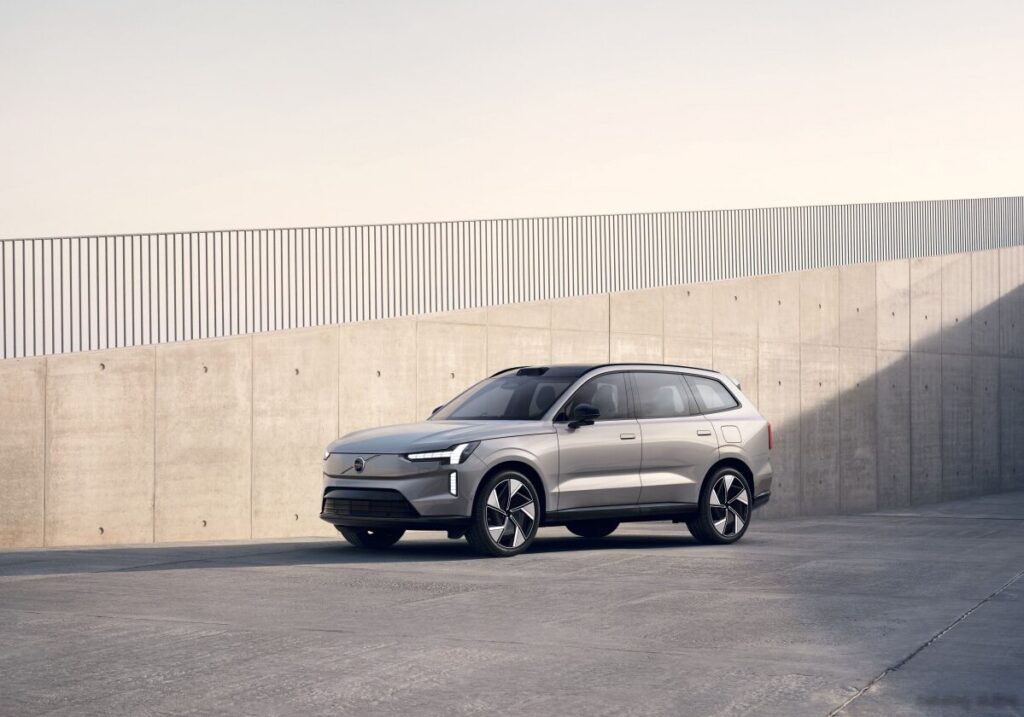
The Volvo EX90 111 kWh (517 Hp) Twin Motor Performance AWD represents Volvo’s flagship entry into the all-electric, three-row SUV segment. Introduced for the 2024 model year, with production anticipated through September 2025, the EX90 is built upon Volvo’s dedicated electric vehicle platform. It aims to combine Scandinavian design, advanced safety features, and substantial electric range into a premium family vehicle. This particular variant, the Performance AWD, sits at the top of the EX90 lineup, offering the highest power output and quickest acceleration within the range.
Technical Specifications
| Brand | Volvo |
| Model | EX90 |
| Generation | EX90 |
| Type (Engine) | 111 kWh (517 Hp) Twin Motor Performance AWD |
| Start of production | 2023 |
| End of production | September, 2025 |
| Powertrain Architecture | BEV (Electric Vehicle) |
| Body type | SUV |
| Seats | 7 |
| Doors | 5 |
| Fuel Type | Electricity |
| Acceleration 0 – 100 km/h | 4.9 sec |
| Acceleration 0 – 62 mph | 4.9 sec |
| Acceleration 0 – 60 mph | 4.7 sec |
| Maximum speed | 180 km/h (111.85 mph) |
| Weight-to-power ratio | 5.5 kg/Hp, 183.5 Hp/tonne |
| Weight-to-torque ratio | 3.1 kg/Nm, 322.9 Nm/tonne |
| Gross battery capacity | 111 kWh |
| Net (usable) battery capacity | 107 kWh |
| Battery technology | Lithium-ion (Li-Ion) |
| Battery location | Below the floor |
| All-electric range (WLTP) | 590 km (366.61 mi) |
| All-electric range (CLTC) | 650 km (403.89 mi) |
| Electric motor 1 power | 241 Hp |
| Electric motor 1 Torque | 420 Nm (309.78 lb.-ft.) |
| Electric motor 1 Maximum revolutions | 14,000 rpm |
| Electric motor 1 location | Front axle, Transverse |
| Electric motor 1 type | Synchronous |
| Electric motor 2 power | 268 Hp |
| Electric motor 2 Torque | 490 Nm (361.41 lb.-ft.) |
| Electric motor 2 Maximum revolutions | 14,000 rpm |
| Electric motor 2 location | Rear axle, Transverse |
| Electric motor 2 type | Synchronous |
| System power | 517 Hp |
| System torque | 910 Nm (671.18 lb.-ft.) |
| Kerb Weight | 2818 kg (6212.63 lbs.) |
| Trunk (boot) space – minimum | 310 l (10.95 cu. ft.) |
| Trunk (boot) space – maximum | 1915 l (67.63 cu. ft.) |
| Max. roof load | 100 kg (220.46 lbs.) |
| Permitted trailer load with brakes (12%) | 2200 kg (4850.17 lbs.) |
| Length | 5037 mm (198.31 in.) |
| Width | 1964 mm (77.32 in.) |
| Width with mirrors folded | 2039 mm (80.28 in.) |
| Width including mirrors | 2113 mm (83.19 in.) |
| Height | 1744 mm (68.66 in.) |
| Wheelbase | 2985 mm (117.52 in.) |
| Front track | 1673-1678 mm (65.87 – 66.06 in.) |
| Rear (Back) track | 1667-1678 mm (65.63 – 66.06 in.) |
| Front overhang | 920 mm (36.22 in.) |
| Rear overhang | 1132 mm (44.57 in.) |
| Ride height (ground clearance) | 208-212 mm (8.19 – 8.35 in.) |
| Drag coefficient (Cd) | 0.29 |
| Minimum turning circle (turning diameter) | 11.8-12.2 m (38.71 – 40.03 ft.) |
| Approach angle | 19.3° |
| Departure angle | 18.2° |
| Ramp-over (brakeover) angle | 21.0° |
| Wading depth | 450 mm (17.72 in.) |
| Drivetrain Architecture | One electric motor drives the front wheels, one electric motor drives the rear wheels. |
| Drive wheel | All wheel drive (4×4) |
| Number of gears and type of gearbox | 1 gears, automatic transmission |
| Front suspension | Spring Strut, Double wishbone, Transverse stabilizer, Air suspension |
| Rear suspension | Spring Strut, Independent multi-link suspension, Air suspension |
| Front brakes | Ventilated discs, 400×38 mm |
| Rear brakes | Ventilated discs, 390×25 mm |
| Assisting systems | ABS (Anti-lock braking system) |
| Steering type | Steering rack and pinion |
| Power steering | Electric Steering |
INTRODUCTION
The Volvo EX90 represents a significant departure for the Swedish automaker, marking its full commitment to an all-electric future. Launched in late 2023, the EX90 is positioned as a direct competitor to vehicles like the Tesla Model X, BMW iX, and Mercedes-Benz EQS SUV. The 111 kWh (517 Hp) Twin Motor Performance AWD variant is the range-topping model, offering the quickest acceleration and longest range within the EX90 family. It builds upon Volvo’s established reputation for safety, incorporating a suite of advanced driver-assistance systems (ADAS) and a focus on sustainable materials.
Powertrain & Engine Architecture
The EX90 utilizes a dual-motor, all-wheel-drive (AWD) powertrain. Each axle is powered by a permanent magnet synchronous motor. The front motor produces 241 horsepower and 420 Nm (309.78 lb.-ft.) of torque, while the rear motor delivers 268 horsepower and 490 Nm (361.41 lb.-ft.) of torque. Combined, the system generates 517 horsepower and a substantial 910 Nm (671.18 lb.-ft.) of torque. The powertrain is powered by a 111 kWh lithium-ion battery pack, providing a usable capacity of 107 kWh. Volvo employs a 400V architecture for the EX90, enabling relatively fast DC fast-charging capabilities. The battery pack is integrated into the vehicle’s floor, contributing to a low center of gravity and improved handling. The single-speed automatic transmission is inherent to the electric motor design, providing seamless acceleration.
Driving Characteristics
The EX90 Performance AWD delivers brisk acceleration, achieving 0-60 mph in approximately 4.7 seconds. The instant torque characteristic of electric motors provides strong off-the-line performance. The dual-motor setup allows for precise torque vectoring, enhancing stability and agility in corners. The air suspension, standard on this trim, contributes to a comfortable ride quality, absorbing bumps and irregularities in the road surface effectively. While the EX90 is a large SUV, the low center of gravity and responsive steering make it feel surprisingly nimble. Regenerative braking is adjustable, allowing drivers to customize the level of deceleration when lifting off the accelerator.
Equipment & Trim Levels
The Performance AWD trim comes standard with a comprehensive suite of features, including a large 14.5-inch central touchscreen infotainment system powered by Google Automotive Services. Premium interior materials, such as wool blend upholstery and sustainably sourced wood trim, are standard. Other standard features include a panoramic sunroof, premium Harman Kardon audio system, and a full suite of advanced driver-assistance systems (ADAS), including Pilot Assist, lane keeping assist, and adaptive cruise control. Optional extras include a LiDAR-based driver assistance system for enhanced safety and autonomous driving capabilities, as well as various interior and exterior customization options.
Chassis & Braking
The EX90 features a double-wishbone front suspension and an independent multi-link rear suspension, both incorporating air suspension for adjustable ride height and improved comfort. The air suspension also allows for automatic leveling, ensuring consistent ride height regardless of load. Braking duties are handled by ventilated disc brakes on all four wheels, with 400mm rotors up front and 390mm rotors at the rear. The EX90 is equipped with an anti-lock braking system (ABS) and electronic stability control (ESC) as standard safety features.
Market Reception & Comparison
Initial reviews of the EX90 have been largely positive, with critics praising its spacious interior, advanced technology, and strong performance. The EX90’s focus on safety and sustainability has also been well-received. Compared to other electric SUVs in its class, the EX90 offers a compelling combination of luxury, performance, and practicality. Its range of 590 km (366.61 mi) WLTP is competitive, although some rivals offer slightly longer ranges. The EX90’s pricing places it in line with other premium electric SUVs.
Legacy
The Volvo EX90 represents a pivotal moment for the brand, signaling its transition to a fully electric future. Its advanced technology, sustainable materials, and focus on safety are expected to set a new benchmark in the electric SUV segment. The long-term reliability of the EX90’s powertrain remains to be seen, but Volvo’s reputation for building durable and reliable vehicles suggests a positive outlook. As the electric vehicle market continues to evolve, the EX90 is poised to become a significant player, offering a compelling alternative to established competitors.
