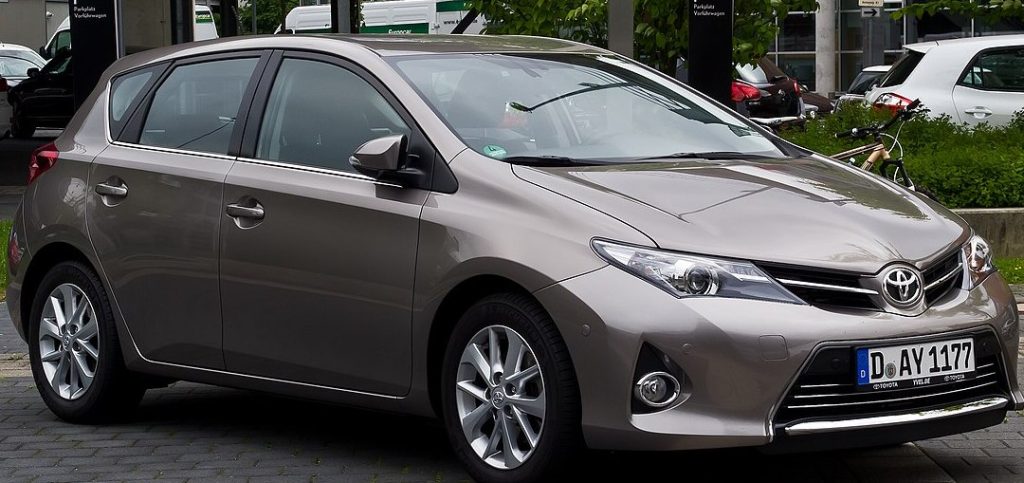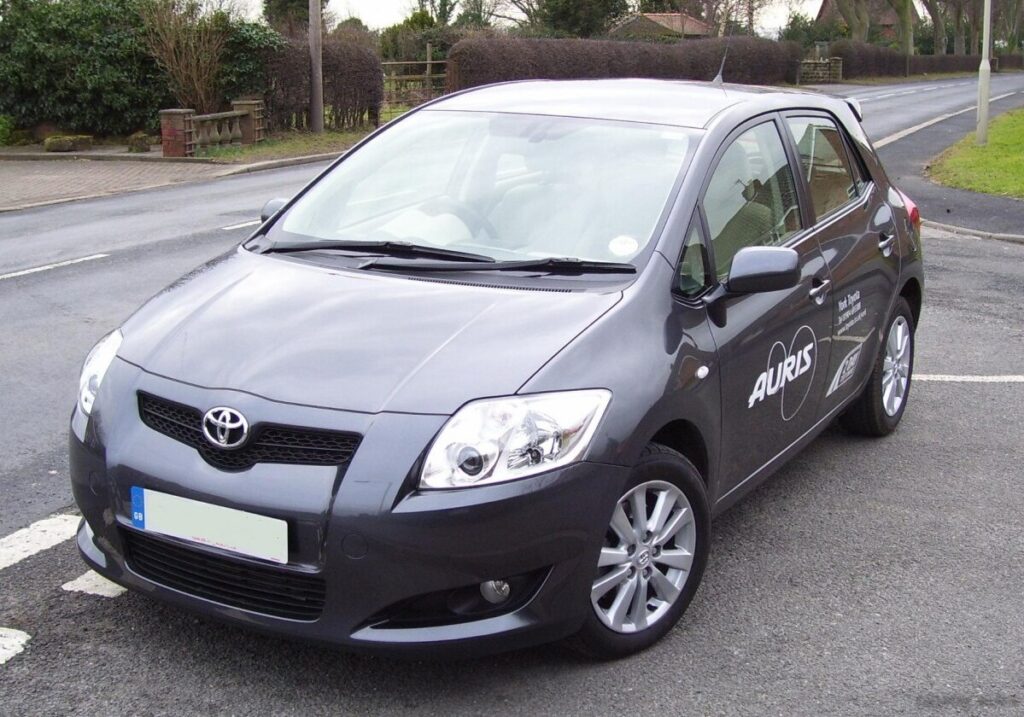
The Toyota Auris I 1.6 i 16V VVT-i, produced between 2006 and 2010, marked Toyota’s initial foray into the European compact hatchback segment, directly challenging established competitors like the Volkswagen Golf and Ford Focus. This specific variant, powered by a 1.6-liter gasoline engine generating 124 horsepower and coupled with a MultiMode transmission (MMT), served as a significant volume seller within the Auris range. It was strategically positioned as a pragmatic and affordable choice, appealing to buyers who prioritized fuel efficiency and ease of operation over outright performance. The Auris I was built upon the Toyota New Global Architecture (TNGA) platform, although this predated the comprehensive implementation of the TNGA philosophy seen in later Toyota models. This model represented a shift for Toyota in Europe, moving away from the Corolla nameplate for this particular body style.
Technical Specifications
| Brand | Toyota |
| Model | Auris |
| Generation | Auris I |
| Type (Engine) | 1.6 i 16V VVT-i (124 Hp) MMT |
| Start of production | 2006 |
| End of production | 2010 |
| Powertrain Architecture | Internal Combustion engine |
| Body type | Hatchback |
| Seats | 5 |
| Doors | 5 |
| Fuel consumption (urban) | 8.5 l/100 km (27.7 US mpg) |
| Fuel consumption (extra urban) | 5.9 l/100 km (39.9 US mpg) |
| Fuel consumption (combined) | 6.9 l/100 km (34.1 US mpg) |
| Fuel Type | Petrol (Gasoline) |
| Acceleration 0 – 100 km/h | 12.1 sec |
| Acceleration 0 – 62 mph | 12.1 sec |
| Acceleration 0 – 60 mph | 11.5 sec |
| Maximum speed | 190 km/h (118.06 mph) |
| Emission standard | Euro 4 |
| Weight-to-power ratio | 9.9 kg/Hp |
| Weight-to-torque ratio | 7.8 kg/Nm |
| Power | 124 Hp @ 6000 rpm |
| Torque | 157 Nm @ 5200 rpm (115.8 lb.-ft. @ 5200 rpm) |
| Engine layout | Front, Transverse |
| Engine Model/Code | 1ZR-FE |
| Engine displacement | 1598 cm3 (97.52 cu. in.) |
| Number of cylinders | 4 |
| Engine configuration | Inline |
| Cylinder Bore | 80.5 mm (3.17 in.) |
| Piston Stroke | 78.5 mm (3.09 in.) |
| Compression ratio | 10.2:1 |
| Number of valves per cylinder | 4 |
| Fuel injection system | Multi-port manifold injection |
| Engine aspiration | Naturally aspirated |
| Valvetrain | DOHC |
| Engine oil capacity | 4.2 l (4.44 US qt | 3.7 UK qt) |
| Coolant capacity | 5.5 l (5.81 US qt | 4.84 UK qt) |
| Kerb Weight | 1230 kg (2711.69 lbs.) |
| Max. weight | 1750 kg (3858.09 lbs.) |
| Max load | 520 kg (1146.4 lbs.) |
| Trunk (boot) space – minimum | 354 l (12.5 cu. ft.) |
| Trunk (boot) space – maximum | 761 l (26.87 cu. ft.) |
| Fuel tank capacity | 55 l (14.53 US gal | 12.1 UK gal) |
| Length | 4220 mm (166.14 in.) |
| Width | 1760 mm (69.29 in.) |
| Height | 1515 mm (59.65 in.) |
| Wheelbase | 2600 mm (102.36 in.) |
| Front track | 1524 mm (60 in.) |
| Rear track | 1522 mm (59.92 in.) |
| Minimum turning circle | 10.2 m (33.46 ft.) |
| Drivetrain | Front wheel drive |
| Number of gears | 5 |
| Gearbox type | Automatic transmission |
| Front suspension | Spring Strut |
| Rear suspension | Torsion |
| Front brakes | Ventilated discs |
| Rear brakes | Disc |
| Assisting systems | ABS (Anti-lock braking system) |
| Steering type | Steering rack and pinion |
| Tires size | 205/55 R16 |
Powertrain & Engine Architecture
The core of the Auris 1.6 i 16V VVT-i is the 1ZR-FE engine, a 1.6-liter inline-four cylinder gasoline engine. This engine incorporates Toyota’s Variable Valve Timing-intelligent (VVT-i) system, which dynamically adjusts valve timing based on engine speed and load, enhancing both performance and fuel economy. The 1ZR-FE features multi-point fuel injection and a compression ratio of 10.2:1. The engine is mounted transversely in the front of the vehicle. The MMT transmission, also known as a sequential manual transmission, is a five-speed automated manual gearbox. It functions similarly to a traditional manual transmission, but gear changes are executed automatically by actuators controlled by the vehicle’s computer. While offering some of the fuel efficiency advantages of a manual transmission, it lacked the smoothness of a conventional automatic transmission and was frequently criticized for its slow and somewhat jerky shifts.
Driving Characteristics
The combination of the 1.6-liter engine and the MMT transmission delivered adequate, though not particularly spirited, performance. Acceleration from 0 to 60 mph required approximately 11.5 to 12.1 seconds, with a top speed around 118 mph. The MMT transmission’s gear ratios were optimized for fuel economy rather than rapid acceleration. Compared to the more powerful 1.8-liter engine options or the diesel variants, the 1.6L felt noticeably slower, especially during overtaking maneuvers or when ascending hills. The MMT transmission also contributed to a less refined driving experience, with perceptible pauses during gear changes. However, for typical daily commuting and urban driving, the 1.6L/MMT pairing proved perfectly adequate.
Equipment & Trim Levels
The Auris 1.6 i 16V VVT-i generally came equipped with a reasonable array of standard features. These included air conditioning, power steering, electric front windows, central locking, and an audio system with a CD player. Higher trim levels, such as the SR, added features like alloy wheels, fog lights, and upgraded interior trim. Optional extras encompassed a sunroof, rear parking sensors, and a more sophisticated audio system. Interior upholstery was typically cloth, featuring a functional and durable design. The dashboard layout was straightforward and user-friendly.
Chassis & Braking
The Auris I utilized a MacPherson strut front suspension and a torsion beam rear suspension. This configuration provided a comfortable ride quality, although it wasn’t particularly focused on sporty handling. The front brakes were ventilated discs, while the rear brakes were solid discs. An Anti-lock Braking System (ABS) was standard equipment. The steering system was a rack and pinion design, offering reasonable precision. The 1.6L variant, being lighter than some of its counterparts, generally handled well enough for everyday driving, though it lacked the dynamic finesse of more performance-oriented models.
Market Reception & Comparison
The Auris 1.6 i 16V VVT-i was generally well-received as a practical and economical hatchback. Reviewers commended its fuel efficiency and comfortable ride, but frequently criticized the MMT transmission for its sluggishness and lack of refinement. In comparison to the 1.8-liter versions, the 1.6L offered lower running costs but sacrificed performance. The diesel variants provided even better fuel economy but came with a higher initial purchase price. Regarding reliability, the 1ZR-FE engine proved to be generally robust, although the MMT transmission was identified as a potential weak point, with some owners reporting issues with actuator failures.
Legacy
The Toyota Auris I 1.6 i 16V VVT-i remains a relatively common vehicle on the used car market today. The 1ZR-FE engine is known for its durability, and with consistent maintenance, it can deliver many years of dependable service. However, prospective buyers should be aware of the potential issues associated with the MMT transmission and factor in the possibility of repair costs. While not an exceptionally exciting vehicle to drive, the Auris 1.6L offered a sensible and affordable option for buyers seeking a practical and fuel-efficient compact hatchback. It established a foundation for subsequent generations of the Auris, which would address many of the criticisms directed at the original model.