
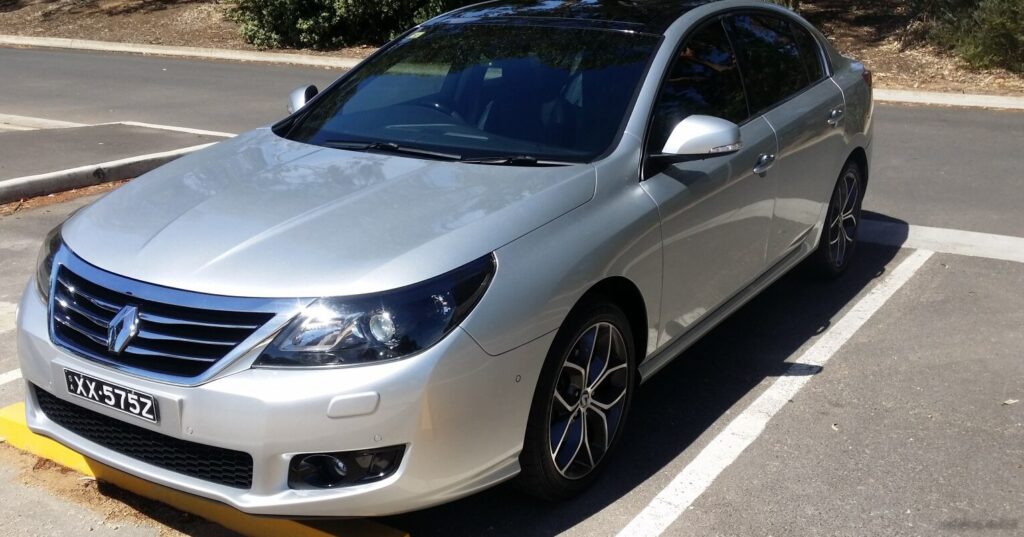
The Renault Latitude 2.0 dCi (150 hp) FAP was a mid-size sedan produced by the French manufacturer Renault from 2010 to 2013. Positioned as a more upscale offering within Renault’s lineup, the Latitude aimed to compete with established players like the Ford Mondeo and Opel/Vauxhall Insignia, particularly in European markets. This specific 2.0 dCi variant, equipped with a diesel particulate filter (FAP), represented a balance between performance, fuel efficiency, and emissions compliance. It served as a popular choice for both private buyers and fleet customers seeking a comfortable and refined sedan.
Technical Specifications
| Brand | Renault |
| Model | Latitude |
| Generation | Latitude |
| Type (Engine) | 2.0 dCi (150 Hp) FAP |
| Start of production | 2010 |
| End of production | 2013 |
| Powertrain Architecture | Internal Combustion engine |
| Body type | Sedan |
| Seats | 5 |
| Doors | 4 |
| Fuel consumption (urban) | 7 l/100 km (33.6 US mpg, 40.4 UK mpg, 14.3 km/l) |
| Fuel consumption (extra urban) | 4.6 l/100 km (51.1 US mpg, 61.4 UK mpg, 21.7 km/l) |
| Fuel consumption (combined) | 5.3 l/100 km (44.4 US mpg, 53.3 UK mpg, 18.9 km/l) |
| Fuel Type | Diesel |
| Acceleration 0 – 100 km/h | 10.3 sec |
| Acceleration 0 – 62 mph | 10.3 sec |
| Acceleration 0 – 60 mph | 9.8 sec |
| Maximum speed | 210 km/h (130.49 mph) |
| Emission standard | Euro 5 |
| Weight-to-power ratio | 10.2 kg/Hp, 97.7 Hp/tonne |
| Weight-to-torque ratio | 4.5 kg/Nm, 221.5 Nm/tonne |
| Power | 150 Hp @ 4000 rpm |
| Power per litre | 75.2 Hp/l |
| Torque | 340 Nm @ 2000 rpm (250.77 lb.-ft. @ 2000 rpm) |
| Engine layout | Front, Transverse |
| Engine Model/Code | M9R |
| Engine displacement | 1995 cm3 (121.74 cu. in.) |
| Number of cylinders | 4 |
| Engine configuration | Inline |
| Cylinder Bore | 84 mm (3.31 in.) |
| Piston Stroke | 90 mm (3.54 in.) |
| Number of valves per cylinder | 4 |
| Fuel injection system | Diesel Commonrail |
| Engine aspiration | Turbocharger, Intercooler |
| Engine oil capacity | 7.4 l (7.82 US qt | 6.51 UK qt) |
| Coolant | 7.8 l (8.24 US qt | 6.86 UK qt) |
| Kerb Weight | 1535 kg (3384.1 lbs.) |
| Max. weight | 2140 kg (4717.89 lbs.) |
| Max load | 605 kg (1333.8 lbs.) |
| Trunk (boot) space – minimum | 477 l (16.85 cu. ft.) |
| Fuel tank capacity | 70 l (18.49 US gal | 15.4 UK gal) |
| Length | 4897 mm (192.8 in.) |
| Width | 1832 mm (72.13 in.) |
| Height | 1483 mm (58.39 in.) |
| Wheelbase | 2762 mm (108.74 in.) |
| Front track | 1565 mm (61.61 in.) |
| Rear (Back) track | 1565 mm (61.61 in.) |
| Drivetrain Architecture | The Internal combustion engine (ICE) drives the front wheels of the vehicle. |
| Drive wheel | Front wheel drive |
| Number of gears and type of gearbox | 6 gears, manual transmission |
| Front suspension | Independent type McPherson |
| Rear suspension | Independent multi-link suspension |
| Front brakes | Ventilated discs |
| Rear brakes | Disc |
| Assisting systems | ABS (Anti-lock braking system) |
| Tires size | 225/50 R17 |
| Wheel rims size | 17 |
INTRODUCTION
The Renault Latitude 2.0 dCi (150 hp) FAP, launched in 2010, was Renault’s attempt to establish a stronger presence in the competitive D-segment sedan market. Built on the CMF-C/D platform (shared with the Nissan Teana), the Latitude offered a more premium experience than Renault’s previous offerings in this class. The 2.0 dCi variant, powered by the M9R engine, was a key component of the Latitude’s appeal, providing a good balance of performance and fuel economy. The FAP (Filtre à Particules) or diesel particulate filter, was standard equipment to meet increasingly stringent European emission regulations. This trim level positioned itself as a mid-range option, offering a step up from the base models while remaining more accessible than the fully-loaded versions.
Powertrain & Engine Architecture
At the heart of the Latitude 2.0 dCi was Renault’s M9R engine, a 1.995-liter inline-four cylinder diesel. This engine was a common sight in Renault and Nissan vehicles of the era, known for its robust construction and relatively good refinement. The M9R featured a common rail direct injection system, delivering fuel at extremely high pressures for optimized combustion. A turbocharger with an intercooler further enhanced performance, boosting power and torque. The engine produced 150 horsepower at 4000 rpm and a substantial 340 Nm (250.77 lb-ft) of torque at just 2000 rpm. This torque output provided strong low-end and mid-range acceleration, making it well-suited for everyday driving and highway cruising. The 6-speed manual transmission was the standard gearbox for this variant, offering precise shifts and contributing to the car’s overall efficiency.
Driving Characteristics
The Renault Latitude 2.0 dCi with the manual transmission offered a comfortable and composed driving experience. The engine’s strong torque meant that spirited acceleration was readily available without needing to rev the engine excessively. The 6-speed gearbox was well-matched to the engine’s characteristics, providing a good spread of ratios for both fuel efficiency and performance. Compared to higher-output versions of the Latitude (which were available in some markets), the 150 hp variant felt less overtly sporty, but it offered a more relaxed and refined driving experience. The gear ratios were tuned for efficiency, prioritizing fuel economy over outright acceleration. While not as quick as some of its rivals, the Latitude 2.0 dCi provided ample power for most driving situations. The suspension setup, tuned for comfort, absorbed bumps and imperfections in the road effectively, contributing to a smooth and quiet ride.
Equipment & Trim Levels
The Latitude 2.0 dCi typically came equipped with a respectable level of standard features. These included air conditioning, power windows and mirrors, a CD/MP3 stereo system, and ABS brakes. Higher trim levels added features such as leather upholstery, a navigation system, automatic climate control, and parking sensors. The interior design was generally considered to be modern and well-appointed, with a focus on comfort and practicality. The Latitude aimed to provide a more luxurious feel than some of its competitors, with attention paid to material quality and cabin refinement. Optional extras included a panoramic sunroof, upgraded audio systems, and various driver assistance technologies.
Chassis & Braking
The Renault Latitude featured a McPherson strut front suspension and a multi-link rear suspension, providing a good balance of ride comfort and handling. The suspension was tuned to prioritize comfort, resulting in a smooth and controlled ride. The Latitude 2.0 dCi was equipped with ventilated disc brakes at the front and solid disc brakes at the rear. ABS (Anti-lock Braking System) was standard, enhancing safety and stability during braking. The steering was power-assisted, providing light and precise control. The Latitude’s chassis was designed to provide a stable and predictable driving experience, even when fully loaded.
Market Reception & Comparison
The Renault Latitude 2.0 dCi received generally positive reviews from automotive critics. It was praised for its comfortable ride, spacious interior, and refined engine. However, some critics noted that it lacked the dynamic flair of some of its rivals, such as the Ford Mondeo. Fuel economy was a strong point, with the 2.0 dCi achieving respectable figures in real-world driving. Compared to the petrol-powered versions of the Latitude, the 2.0 dCi offered significantly better fuel economy and torque. The 1.5 dCi engine, available in some markets, provided even better fuel economy but lacked the performance of the 2.0 dCi. Reliability was generally considered to be good, although some owners reported issues with the diesel particulate filter (FAP) requiring periodic maintenance or replacement.
Legacy
The Renault Latitude, while not a massive sales success, remains a reasonably well-regarded mid-size sedan. The 2.0 dCi engine, in particular, has proven to be a durable and reliable unit when properly maintained. On the used car market, the Latitude 2.0 dCi represents a good value proposition for buyers seeking a comfortable, spacious, and fuel-efficient sedan. The M9R engine is known for its longevity, but potential buyers should be aware of the potential for FAP-related issues and ensure that the vehicle has been regularly serviced. The Latitude’s relatively understated styling and focus on comfort have given it a loyal following among those who prioritize a relaxed and refined driving experience.
