
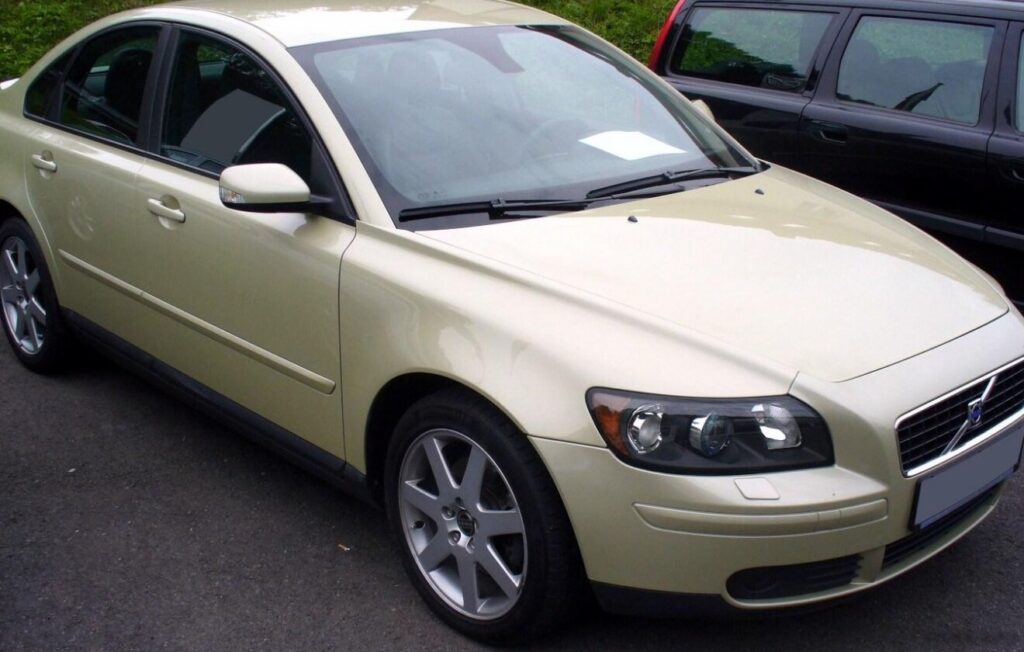
The Volvo S40 II 1.8i, produced between 2004 and 2007, represented a key entry point into Volvo’s compact executive sedan lineup. Part of the second generation S40 (designated as the 1HX0 chassis code), this variant aimed to balance affordability with Volvo’s renowned safety and Scandinavian design. Positioned as the base model, the 1.8i offered a more accessible price point compared to the higher-trim 2.4i and T5 models, targeting buyers prioritizing fuel efficiency and comfortable daily driving over outright performance. It was a significant model for Volvo in Europe and North America, competing with vehicles like the Audi A3, BMW 1 Series, and Acura TSX.
Technical Specifications
| Brand | Volvo |
| Model | S40 |
| Generation | S40 II |
| Type (Engine) | 1.8 i (125 Hp) |
| Start of production | 2004 |
| End of production | 2007 |
| Powertrain Architecture | Internal Combustion engine |
| Body type | Sedan |
| Seats | 5 |
| Doors | 4 |
| Fuel consumption (urban) | 9.8 l/100 km (24 US mpg) |
| Fuel consumption (extra urban) | 5.7 l/100 km (41.3 US mpg) |
| Fuel consumption (combined) | 7.2 l/100 km (32.7 US mpg) |
| CO2 emissions | 172 g/km |
| Fuel Type | Petrol (Gasoline) |
| Acceleration 0 – 100 km/h | 10.9 sec |
| Acceleration 0 – 62 mph | 10.9 sec |
| Acceleration 0 – 60 mph | 10.4 sec |
| Maximum speed | 200 km/h (124.27 mph) |
| Emission standard | Euro 4 |
| Weight-to-power ratio | 10.2 kg/Hp |
| Weight-to-torque ratio | 7.8 kg/Nm |
| Power | 125 Hp @ 6000 rpm |
| Torque | 165 Nm @ 4000 rpm (121.7 lb.-ft. @ 4000 rpm) |
| Engine layout | Front, Transverse |
| Engine Model/Code | B4184S11 |
| Engine displacement | 1798 cm3 (109.72 cu. in.) |
| Number of cylinders | 4 |
| Engine configuration | Inline |
| Cylinder Bore | 83 mm (3.27 in.) |
| Piston Stroke | 83.1 mm (3.27 in.) |
| Compression ratio | 10.8:1 |
| Number of valves per cylinder | 4 |
| Fuel injection system | Multi-port manifold injection |
| Engine aspiration | Naturally aspirated engine |
| Valvetrain | DOHC |
| Engine oil capacity | 4.3 l (4.54 US qt | 3.78 UK qt) |
| Coolant | 7.5 l (7.93 US qt | 6.6 UK qt) |
| Kerb Weight | 1280 kg (2821.92 lbs.) |
| Trunk (boot) space – minimum | 404 l (14.27 cu. ft.) |
| Trunk (boot) space – maximum | 883 l (31.18 cu. ft.) |
| Fuel tank capacity | 55 l (14.53 US gal | 12.1 UK gal) |
| Length | 4468 mm (175.91 in.) |
| Width | 1770 mm (69.69 in.) |
| Height | 1452 mm (57.17 in.) |
| Wheelbase | 2640 mm (103.94 in.) |
| Front track | 1531 mm (60.28 in.) |
| Rear (Back) track | 1535 mm (60.43 in.) |
| Minimum turning circle | 10.6 m (34.78 ft.) |
| Drivetrain Architecture | The Internal combustion engine (ICE) drives the front wheels of the vehicle. |
| Drive wheel | Front wheel drive |
| Number of gears and type of gearbox | 5 gears, manual transmission |
| Assisting systems | ABS (Anti-lock braking system) |
INTRODUCTION
The Volvo S40 II 1.8i, launched in 2004, was a crucial model in Volvo’s efforts to attract a younger and more diverse customer base. Built on the shared Ford/Volvo C1 platform (also known as the 1HX0), it represented a significant departure from the more boxy designs of previous Volvo generations. The S40 II aimed for a more contemporary and dynamic aesthetic, while retaining the brand’s core values of safety, durability, and comfort. This 1.8-liter variant served as the entry-level option, offering a balance between affordability and the Volvo experience. Production continued until 2007, when it was superseded by a revised model.
Powertrain & Engine Architecture
The heart of the S40 II 1.8i is the Volvo B4184S11 engine, a 1.8-liter inline-four cylinder gasoline engine. This engine, part of Volvo’s modular engine family, utilizes a naturally aspirated configuration with multi-port fuel injection. The engine’s design emphasizes smooth operation and reasonable fuel economy rather than outright power. It features a double overhead camshaft (DOHC) valvetrain with four valves per cylinder, contributing to improved breathing and efficiency. The compression ratio is set at 10.8:1. The engine produced 125 horsepower at 6000 rpm and 165 Nm (121.7 lb-ft) of torque at 4000 rpm. The engine was typically paired with a 5-speed manual transmission, although a 4-speed automatic transmission was also available, though less common. The automatic transmission, while providing convenience, did impact acceleration and fuel economy compared to the manual.
Driving Characteristics
The S40 II 1.8i, particularly with the manual transmission, offered a reasonably engaging driving experience for its class. Acceleration from 0-60 mph took around 10.4 seconds, which was adequate for everyday driving but not particularly sporty. The 1.8-liter engine provided sufficient power for merging onto highways and overtaking, but required downshifting for quicker responses. The automatic transmission, while smooth, noticeably dulled acceleration and made the engine feel more strained. The steering was light and precise, making the car easy to maneuver in urban environments. The suspension, tuned for comfort, absorbed bumps and imperfections in the road well, providing a smooth ride. Compared to the more powerful 2.4i and T5 models, the 1.8i felt less responsive and lacked the same level of dynamic capability.
Equipment & Trim Levels
The S40 II 1.8i typically came standard with a respectable level of equipment. Standard features included air conditioning, power windows and locks, a CD player, and ABS brakes. Safety was a key focus, with standard features like front and side airbags. Interior upholstery was typically cloth, with options for leather available at an extra cost. Higher trim levels offered features like alloy wheels, a sunroof, and upgraded audio systems. Optional extras included a navigation system, heated front seats, and automatic climate control. The dashboard layout was clean and functional, with a focus on ergonomics and ease of use.
Chassis & Braking
The S40 II utilized a MacPherson strut front suspension and a multi-link rear suspension, providing a good balance between ride comfort and handling. The front suspension featured a stabilizer bar to reduce body roll during cornering. Braking systems varied depending on the specific configuration. Base models typically featured disc brakes on the front wheels and drum brakes on the rear. Higher trim levels often included disc brakes on all four wheels. ABS (Anti-lock Braking System) was standard across all models, enhancing braking performance and stability, especially in adverse conditions.
Market Reception & Comparison
The S40 II 1.8i was generally well-received by automotive critics as a practical and comfortable compact sedan. However, its performance was often criticized as being somewhat underwhelming compared to its rivals. Fuel economy was considered a strong point, with the 1.8-liter engine offering competitive figures. Compared to the 2.4i and T5 models within the S40 II lineup, the 1.8i offered a more affordable entry point but sacrificed performance. The 2.4i provided a noticeable power increase, while the T5, with its turbocharged engine, offered significantly more performance. In terms of reliability, the B4184S11 engine proved to be generally robust, although regular maintenance was essential to prevent issues.
Legacy
The Volvo S40 II 1.8i remains a relatively common sight on used car markets today. Its reputation for reliability and affordability makes it an attractive option for budget-conscious buyers. The B4184S11 engine, while not known for its high performance, is generally considered to be durable and relatively easy to maintain. Common issues include oil leaks and occasional sensor failures, but these are typically not major concerns. The S40 II 1.8i represents a transitional period for Volvo, showcasing the brand’s move towards more contemporary designs while retaining its commitment to safety and quality. It continues to be appreciated by owners for its comfortable ride, practical interior, and overall value.
