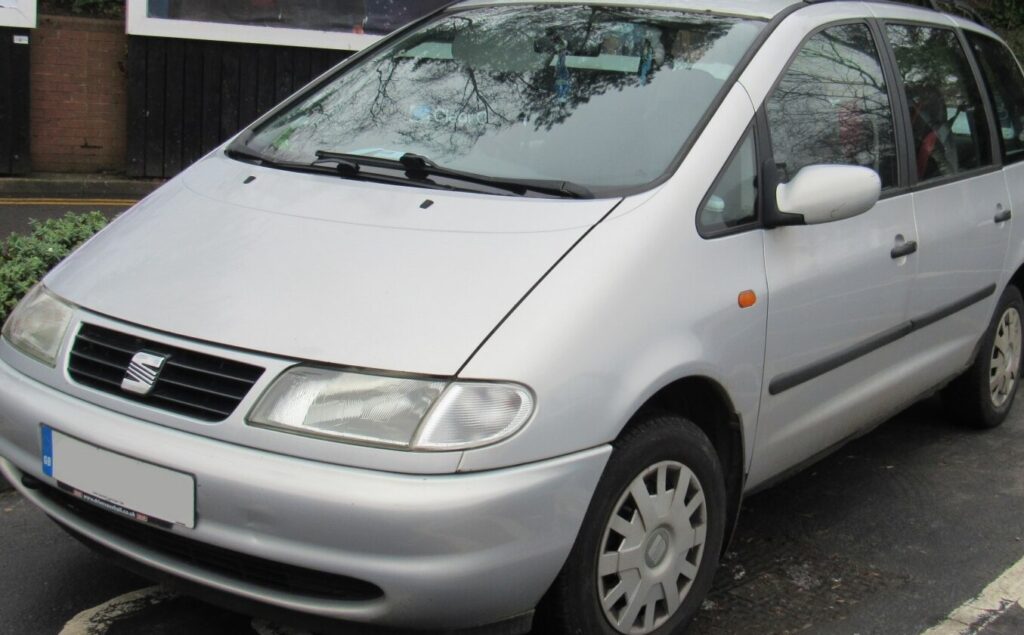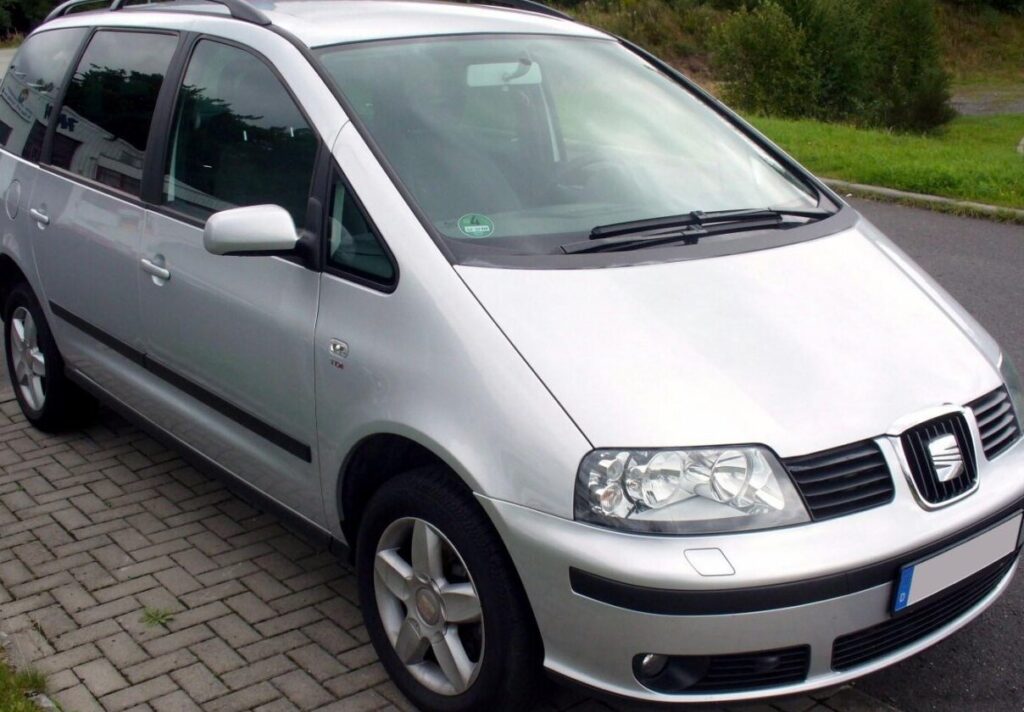
The Seat Alhambra I (7M), particularly the facelifted version introduced in 2000, represented Seat’s entry into the large MPV (Multi-Purpose Vehicle) segment. Produced from 1996 to 2010 (with the facelift spanning 2000-2010), the Alhambra was developed in collaboration with Ford, resulting in the mechanically similar Ford Galaxy. The 1.9 TDI 115 hp Tiptronic variant, manufactured from 2006 to 2010, occupied a middle ground in the Alhambra lineup, offering a balance between fuel efficiency, practicality, and ease of driving. It was aimed at families needing space and versatility, but who preferred the convenience of an automatic transmission over a manual.
Technical Specifications
| Brand | Seat |
| Model | Alhambra |
| Generation | Alhambra I (7M, facelift 2000) |
| Type (Engine) | 1.9 TDI (115 Hp) Tiptronic |
| Start of production | 2006 |
| End of production | 2010 |
| Powertrain Architecture | Internal Combustion engine |
| Body type | Minivan, MPV |
| Seats | 7 |
| Doors | 5 |
| Fuel consumption (urban) | 10 l/100 km (23.5 US mpg, 28.2 UK mpg, 10 km/l) |
| Fuel consumption (extra urban) | 5.9 l/100 km (39.9 US mpg, 47.9 UK mpg, 16.9 km/l) |
| Fuel consumption (combined) | 7.4 l/100 km (31.8 US mpg, 38.2 UK mpg, 13.5 km/l) |
| CO2 emissions | 196 g/km |
| Fuel Type | Diesel |
| Acceleration 0 – 100 km/h | 15.1 sec |
| Acceleration 0 – 62 mph | 15.1 sec |
| Acceleration 0 – 60 mph | 14.3 sec |
| Maximum speed | 177 km/h (109.98 mph) |
| Emission standard | Euro 4 |
| Weight-to-power ratio | 14.6 kg/Hp, 68.4 Hp/tonne |
| Weight-to-torque ratio | 5.4 kg/Nm, 184.3 Nm/tonne |
| Power | 115 Hp @ 4000 rpm |
| Power per litre | 60.7 Hp/l |
| Torque | 310 Nm @ 1900 rpm (228.64 lb.-ft. @ 1900 rpm) |
| Engine layout | Front, Transverse |
| Engine Model/Code | AUY, BVK |
| Engine displacement | 1896 cm3 (115.7 cu. in.) |
| Number of cylinders | 4 |
| Engine configuration | Inline |
| Cylinder Bore | 79.5 mm (3.13 in.) |
| Piston Stroke | 95.5 mm (3.76 in.) |
| Compression ratio | 18:1 |
| Number of valves per cylinder | 2 |
| Fuel injection system | Pump-nozzle (Unit Injector) |
| Engine aspiration | Turbocharger, Intercooler |
| Valvetrain | SOHC |
| Engine oil capacity | 4.3 l (4.54 US qt, 3.78 UK qt) |
| Coolant capacity | 6.8 l (7.19 US qt, 5.98 UK qt) |
| Kerb Weight | 1682 kg (3708.18 lbs) |
| Max. weight | 2510 kg (5533.6 lbs) |
| Max load | 828 kg (1825.43 lbs) |
| Trunk (boot) space – minimum | 256 l (9.04 cu. ft.) |
| Trunk (boot) space – maximum | 2610 l (92.17 cu. ft.) |
| Fuel tank capacity | 70 l (18.49 US gal, 15.4 UK gal) |
| Max. roof load | 75 kg (165.35 lbs) |
| Permitted trailer load (braked) | 2000 kg (4409.25 lbs) |
| Permitted trailer load (unbraked) | 700 kg (1543.24 lbs) |
| Permitted towbar download | 85 kg (187.39 lbs) |
| Length | 4634 mm (182.44 in.) |
| Width | 1810 mm (71.26 in.) |
| Height | 1762 mm (69.37 in.) |
| Wheelbase | 2835 mm (111.61 in.) |
| Front track | 1520-1532 mm (59.84 – 60.31 in.) |
| Rear track | 1506-1518 mm (59.29 – 59.76 in.) |
| Front overhang | 892 mm (35.12 in.) |
| Rear overhang | 907 mm (35.71 in.) |
| Drag coefficient (Cd) | 0.31 |
| Minimum turning circle | 10.9 m (35.76 ft.) |
| Drivetrain | Front wheel drive |
| Gearbox | 5 gears, automatic transmission Tiptronic |
| Front suspension | Independent type McPherson, Transverse stabilizer |
| Rear suspension | Transverse stabilizer, Trailing arm, Coil spring |
| Front brakes | Ventilated discs |
| Rear brakes | Disc |
| Assisting systems | ABS (Anti-lock braking system) |
| Steering type | Steering rack and pinion |
| Power steering | Hydraulic |
| Tires size | 215/55 R16; 225/45 R17 |
| Wheel rims size | 6J x 16; 7J x 17 |
INTRODUCTION
The Seat Alhambra I, particularly the facelifted model from 2000 onwards, was Seat’s contribution to the growing European MPV market. Built alongside the Ford Galaxy, the Alhambra offered seven-seat capacity, a spacious interior, and practical features aimed at families. The 1.9 TDI 115 hp Tiptronic variant, available from 2006 to 2010, provided a compromise between the more economical lower-powered diesels and the more potent, but also more expensive, higher-output versions. This trim level was positioned as a comfortable and convenient option for those prioritizing ease of use and fuel efficiency over outright performance.
Powertrain & Engine Architecture
The heart of the Alhambra 1.9 TDI Tiptronic is the 1.9-liter, four-cylinder diesel engine, typically identified by engine codes AUY or BVK. This engine is a member of the Volkswagen Group’s well-regarded TDI (Turbocharged Direct Injection) family. It utilizes a pump-nozzle (unit injector) fuel injection system, known for its precision and efficiency. The engine features a single overhead camshaft (SOHC) valvetrain operating two valves per cylinder. A turbocharger with an intercooler is employed to boost power and torque. The Tiptronic transmission is a five-speed automatic gearbox offering both fully automatic operation and a manual shift mode, allowing the driver some control over gear selection. This transmission was known for its smoothness, but could be prone to issues with the mechatronic unit over time.
Driving Characteristics
The 115 hp output and 310 Nm (228.64 lb-ft) of torque delivered by the 1.9 TDI engine, coupled with the Tiptronic transmission, resulted in a driving experience focused on usability rather than sportiness. Acceleration was adequate for everyday driving, with a 0-60 mph time of around 14.3 seconds, but it wasn’t particularly brisk. The Tiptronic transmission provided smooth gear changes, making it ideal for urban driving and long journeys. However, compared to the manual transmission versions, the automatic resulted in a slight reduction in fuel economy and a less engaging driving experience. The gear ratios were optimized for fuel efficiency and comfortable cruising, rather than rapid acceleration. The Alhambra, being a relatively heavy MPV, felt its weight during spirited driving, and the engine could feel strained when fully loaded.
Equipment & Trim Levels
The 1.9 TDI Tiptronic variant of the Alhambra typically came with a reasonable level of standard equipment. This included air conditioning, central locking, electric front windows, power steering, and an ABS anti-lock braking system. Interior upholstery was usually cloth, with options for upgraded materials. Higher trim levels offered features such as alloy wheels, rear parking sensors, a CD stereo system, and climate control. Optional extras included a sunroof, leather upholstery, and a navigation system. The dashboard layout was functional and straightforward, prioritizing practicality over aesthetic flair.
Chassis & Braking
The Alhambra’s chassis was designed to provide a comfortable ride and stable handling. The front suspension utilized independent McPherson struts with a transverse stabilizer bar, while the rear suspension employed a trailing arm setup with coil springs and a transverse stabilizer bar. Braking was handled by ventilated discs on the front wheels and solid discs on the rear. The braking system was generally effective, but the Alhambra’s weight meant that stopping distances were longer than those of lighter vehicles. The hydraulic power steering provided light and easy steering, making maneuvering in tight spaces relatively effortless.
Market Reception & Comparison
The Seat Alhambra 1.9 TDI Tiptronic was generally well-received by critics as a practical and comfortable MPV. It was praised for its spacious interior, versatility, and fuel efficiency. However, some reviewers noted that the automatic transmission could feel sluggish at times, and the engine lacked the punch of the higher-powered TDI variants. Compared to the 1.8-liter petrol versions, the 1.9 TDI offered significantly better fuel economy and torque, making it a more sensible choice for long-distance driving. Against the Ford Galaxy 1.9 TDI Tiptronic, which was mechanically very similar, the Alhambra often offered a slightly more competitive price point.
Legacy
The Seat Alhambra 1.9 TDI Tiptronic has proven to be a relatively reliable vehicle, although the Tiptronic transmission can be a potential weak point, requiring careful maintenance and occasional repairs. The 1.9 TDI engine itself is known for its durability and longevity, provided it is properly serviced. In the used car market, these Alhambras represent a good value proposition for families needing a spacious and practical MPV. However, potential buyers should be aware of the potential transmission issues and ensure that the vehicle has been well-maintained. The Alhambra, and its Ford Galaxy sibling, helped establish Seat as a credible player in the MPV segment and paved the way for future models.