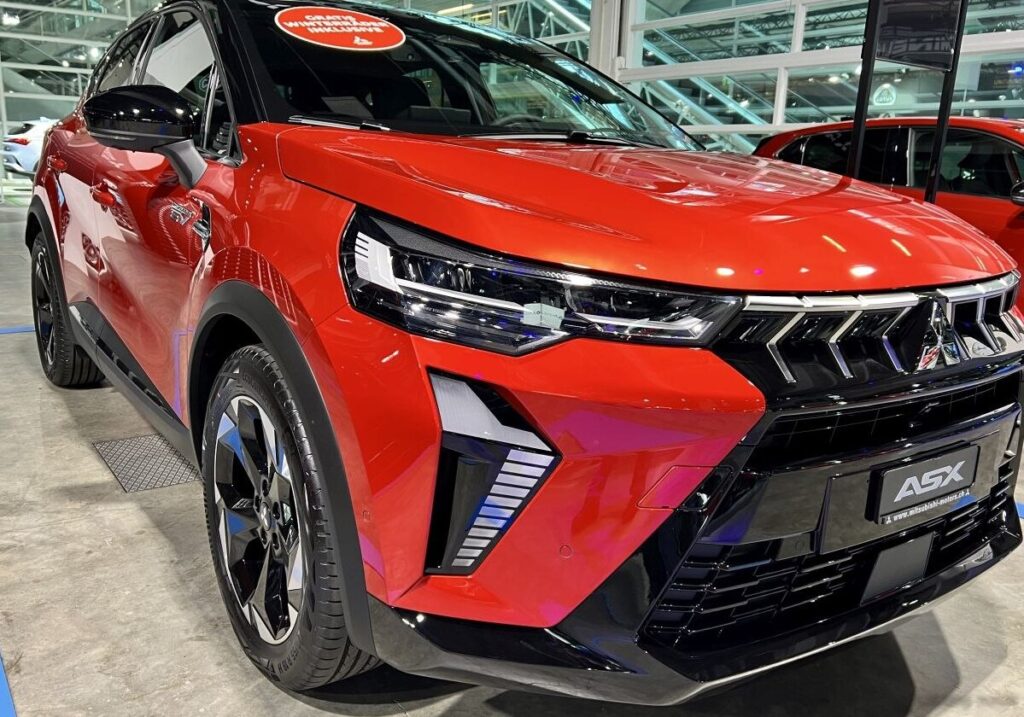
The Mitsubishi ASX II (facelift 2024) 1.3 Turbo (140 Hp) Mild Hybrid represents a significant update to Mitsubishi’s popular compact crossover SUV. Introduced in June 2024, this variant is positioned as a fuel-efficient and technologically advanced option within the ASX II range, slated for production through December 2025. It builds upon the foundation of the broader ASX II generation, which itself is based on the Renault-Nissan-Mitsubishi Alliance’s CMF-B platform. This facelift brings styling revisions and powertrain enhancements, aiming to bolster the ASX’s competitiveness in the European and other international markets where it’s primarily sold. The 1.3 Turbo Mild Hybrid trim is designed to appeal to buyers seeking a balance between performance, economy, and modern features.
Technical Specifications
| Brand | Mitsubishi |
| Model | ASX |
| Generation | ASX II (facelift 2024) |
| Type (Engine) | 1.3 Turbo (140 Hp) Mild Hybrid |
| Start of production | June, 2024 |
| End of production | December, 2025 |
| Powertrain Architecture | MHEV (Mild Hybrid Electric Vehicle) |
| Body type | SUV, Crossover |
| Seats | 5 |
| Doors | 5 |
| Fuel consumption at Low speed (WLTP) | 7.4 l/100 km (31.8 US mpg) |
| Fuel consumption at Medium speed (WLTP) | 5.5 l/100 km (42.8 US mpg) |
| Fuel consumption at high speed (WLTP) | 5.1 l/100 km (46.1 US mpg) |
| Fuel consumption at very high speed (WLTP) | 6.5 l/100 km (36.2 US mpg) |
| Combined fuel consumption (WLTP) | 6.0 l/100 km (39.2 US mpg) |
| CO2 emissions (WLTP) | 135 g/km |
| Fuel Type | Petrol (Gasoline) |
| Acceleration 0 – 100 km/h | 10.3 sec |
| Acceleration 0 – 62 mph | 10.3 sec |
| Acceleration 0 – 60 mph | 9.8 sec |
| Maximum speed | 180 km/h (111.85 mph) |
| Emission standard | Euro 6d |
| Weight-to-power ratio | 9.1 kg/Hp |
| Weight-to-torque ratio | 4.9 kg/Nm |
| Battery voltage | 12 V |
| Power | 140 Hp @ 4500-6000 rpm |
| Torque | 260 Nm @ 3500 rpm (191.77 lb.-ft. @ 3500 rpm) |
| Engine layout | Front, Transverse |
| Engine Model/Code | H5H |
| Engine displacement | 1332 cm3 (81.28 cu. in.) |
| Number of cylinders | 4 |
| Engine configuration | Inline |
| Cylinder Bore | 72.2 mm (2.84 in.) |
| Piston Stroke | 81.34 mm (3.2 in.) |
| Compression ratio | 10.5:1 |
| Number of valves per cylinder | 4 |
| Fuel injection system | Direct injection |
| Engine aspiration | Turbocharger, Intercooler |
| Valvetrain | DOHC |
| Engine oil capacity | 5.4 l (5.71 US qt | 4.75 UK qt) |
| Coolant | 7.5 l (7.93 US qt | 6.6 UK qt) |
| Kerb Weight | 1273 kg (2806.48 lbs.) |
| Max. weight | 1780 kg (3924.23 lbs.) |
| Max load | 507 kg (1117.74 lbs.) |
| Trunk (boot) space – minimum | 484 l (17.09 cu. ft.) |
| Trunk (boot) space – maximum | 1596 l (56.36 cu. ft.) |
| Fuel tank capacity | 48 l (12.68 US gal | 10.56 UK gal) |
| Max. roof load | 80 kg (176.37 lbs.) |
| Permitted trailer load with brakes (12%) | 1200 kg (2645.55 lbs.) |
| Permitted trailer load without brakes | 670 kg (1477.1 lbs.) |
| Permitted towbar download | 75 kg (165.35 lbs.) |
| Length | 4239 mm (166.89 in.) |
| Width | 1797 mm (70.75 in.) |
| Width including mirrors | 2003 mm (78.86 in.) |
| Height | 1584 mm (62.36 in.) |
| Wheelbase | 2639 mm (103.9 in.) |
| Front track | 1562 mm (61.5 in.) |
| Rear (Back) track | 1547 mm (60.91 in.) |
| Front overhang | 883 mm (34.76 in.) |
| Rear overhang | 717 mm (28.23 in.) |
| Ride height (ground clearance) | 169 mm (6.65 in.) |
| Minimum turning circle (turning diameter) | 11.1 m (36.42 ft.) |
| Drivetrain Architecture | Front wheel drive, MHEV |
| Number of gears and type of gearbox | 6 gears, manual transmission |
| Front suspension | Independent type McPherson |
| Rear suspension | Torsion |
| Front brakes | Ventilated discs |
| Rear brakes | Drum |
| Tires size | 215/60 R17 |
| Wheel rims size | 7J x 17 |
Powertrain & Engine Architecture
At the heart of the ASX II 1.3 Turbo Mild Hybrid lies the H5H engine, a 1.3-liter turbocharged inline-four cylinder gasoline engine. This engine produces 140 horsepower at 4500-6000 rpm and 260 Nm (191.77 lb.-ft.) of torque at 3500 rpm. The engine utilizes direct fuel injection and a turbocharger with an intercooler to enhance efficiency and power output. The mild hybrid system incorporates a 48-volt starter-generator, which assists the engine during acceleration and enables start-stop functionality for improved fuel economy. The engine’s architecture is relatively compact, allowing for efficient packaging within the engine bay. The 6-speed manual transmission is standard, providing drivers with direct control over gear selection. The engine’s design prioritizes a balance between performance and fuel efficiency, making it suitable for everyday driving conditions.
Driving Characteristics
The 1.3 Turbo Mild Hybrid powertrain delivers adequate performance for typical driving scenarios. Acceleration from 0-100 km/h (0-62 mph) takes approximately 10.3 seconds. While not a particularly sporty setup, the turbocharger provides a noticeable boost in power during acceleration, making overtaking maneuvers manageable. The mild hybrid system contributes to smoother starts and improved responsiveness at lower speeds. Compared to higher-output versions of the ASX II, this variant offers a more relaxed driving experience, prioritizing fuel economy over outright performance. The 6-speed manual transmission allows for precise gear changes, but the gear ratios are tuned for efficiency rather than aggressive acceleration. The overall driving experience is comfortable and predictable, making it well-suited for urban commuting and long-distance highway driving.
Equipment & Trim Levels
The ASX II 1.3 Turbo Mild Hybrid typically comes equipped with a range of standard features, including air conditioning, a touchscreen infotainment system with smartphone integration (Apple CarPlay and Android Auto), Bluetooth connectivity, and a suite of safety features such as automatic emergency braking, lane departure warning, and traffic sign recognition. Interior upholstery is generally cloth, with options for upgraded materials available on higher trim levels. Optional extras may include a panoramic sunroof, heated seats, a premium sound system, and advanced driver-assistance systems like adaptive cruise control and blind-spot monitoring. The dashboard layout is modern and functional, with a focus on ease of use.
Chassis & Braking
The ASX II utilizes a front-wheel-drive configuration with an independent McPherson strut suspension at the front and a torsion beam suspension at the rear. This setup provides a comfortable ride quality and predictable handling characteristics. The front brakes are ventilated discs, while the rear brakes are drums. ABS (Anti-lock Braking System) is standard, enhancing braking performance and stability. The suspension is tuned to prioritize comfort over sporty handling, making it well-suited for everyday driving conditions. The vehicle’s weight-to-power ratio of 9.1 kg/Hp contributes to its manageable handling characteristics.
Market Reception & Comparison
The Mitsubishi ASX II 1.3 Turbo Mild Hybrid has been generally well-received by critics for its fuel efficiency and value proposition. It offers a competitive fuel economy of 6.0 l/100 km (39.2 US mpg) combined, making it an attractive option for budget-conscious buyers. Compared to other trims in the ASX II lineup, this variant offers a balance between performance and economy. The manual transmission may not appeal to all buyers, but it contributes to the vehicle’s affordability. Reliability is expected to be good, based on Mitsubishi’s reputation for building durable vehicles.
Legacy
The 1.3 Turbo Mild Hybrid powertrain is expected to offer good long-term reliability, benefiting from Mitsubishi’s engineering expertise and the relatively simple design of the mild hybrid system. In the used car market, this variant is likely to be sought after by buyers looking for a fuel-efficient and affordable compact crossover SUV. The combination of a turbocharged engine, mild hybrid technology, and a manual transmission provides a practical and economical driving experience that should appeal to a wide range of buyers for years to come.