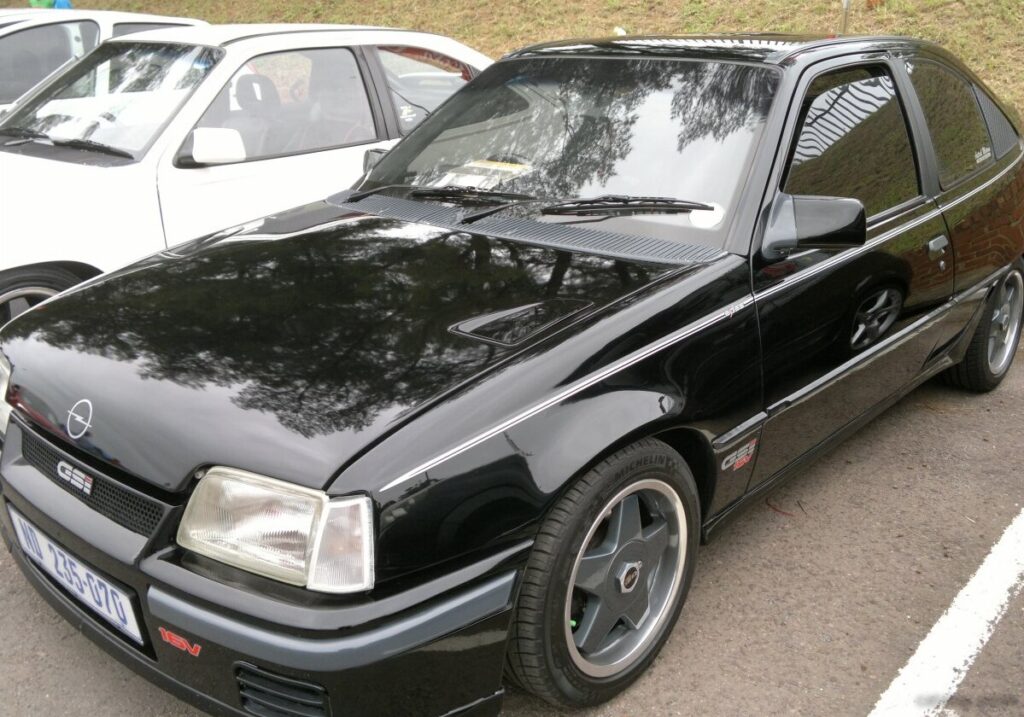
The Opel Kadett E CC 1.8i, produced from 1985 to 1986, represented a significant step forward for Opel’s compact offering. Positioned as a mid-range trim within the Kadett E lineup – which spanned from the base 1.0L models to the more performance-oriented GSi variants – the 1.8i aimed to provide a balance of practicality, comfort, and reasonable performance for the European market. It was a key component of the Kadett E (CC denoting the coupe/notchback body style, though hatchbacks were also available) which was based on the GM T-platform, shared with other vehicles like the Vauxhall Astra, Isuzu Gemini, and Holden Nova. The Kadett E was a crucial model for Opel, aiming to recapture market share in the competitive European small family car segment.
Technical Specifications
| Brand | Opel |
| Model | Kadett |
| Generation | Kadett E CC |
| Type (Engine) | 1.8i (100 Hp) |
| Start of production | 1985 |
| End of production | 1986 |
| Powertrain Architecture | Internal Combustion engine |
| Body type | Hatchback |
| Seats | 5 |
| Doors | 3-5 |
| Fuel Type | Petrol (Gasoline) |
| Acceleration 0 – 100 km/h | 10.5 sec |
| Acceleration 0 – 62 mph | 10.5 sec |
| Acceleration 0 – 60 mph | 10 sec |
| Maximum speed | 188 km/h (116.82 mph) |
| Weight-to-power ratio | 9.6 kg/Hp, 104.2 Hp/tonne |
| Weight-to-torque ratio | 6.9 kg/Nm, 145.8 Nm/tonne |
| Power | 100 Hp @ 5800 rpm |
| Power per litre | 55.7 Hp/l |
| Torque | 140 Nm @ 3000 rpm (103.26 lb.-ft. @ 3000 rpm) |
| Engine layout | Front, Transverse |
| Engine Model/Code | C18NE |
| Engine displacement | 1796 cm3 (109.6 cu. in.) |
| Number of cylinders | 4 |
| Engine configuration | Inline |
| Cylinder Bore | 84.8 mm (3.34 in.) |
| Piston Stroke | 79.5 mm (3.13 in.) |
| Compression ratio | 8.9:1 |
| Number of valves per cylinder | 2 |
| Fuel injection system | Multi-port manifold injection |
| Engine aspiration | Naturally aspirated engine |
| Engine oil capacity | 4 l (4.23 US qt | 3.52 UK qt) |
| Coolant | 6.5 l (6.87 US qt | 5.72 UK qt) |
| Kerb Weight | 960 kg (2116.44 lbs.) |
| Max. weight | 1425 kg (3141.59 lbs.) |
| Max load | 465 kg (1025.15 lbs.) |
| Trunk (boot) space – minimum | 485 l (17.13 cu. ft.) |
| Trunk (boot) space – maximum | 1385 l (48.91 cu. ft.) |
| Fuel tank capacity | 52 l (13.74 US gal | 11.44 UK gal) |
| Length | 3998 mm (157.4 in.) |
| Width | 1666 mm (65.59 in.) |
| Height | 1395 mm (54.92 in.) |
| Wheelbase | 2520 mm (99.21 in.) |
| Front track | 1406 mm (55.35 in.) |
| Rear (Back) track | 1406 mm (55.35 in.) |
| Minimum turning circle | 10.5 m (34.45 ft.) |
| Drivetrain Architecture | The Internal combustion engine (ICE) drives the front wheels of the vehicle. |
| Drive wheel | Front wheel drive |
| Number of gears and type of gearbox | 5 gears, manual transmission |
| Front brakes | Disc |
| Rear brakes | Drum |
Powertrain & Engine Architecture
The heart of the Kadett E 1.8i was the C18NE engine, an 1796cc inline-four cylinder unit. This engine was a naturally aspirated design, utilizing a two-valve per cylinder configuration and a Bosch multi-port fuel injection system. The C18NE was known for its relative simplicity and durability, characteristics valued in the European market. The engine produced 100 horsepower at 5800 rpm and 140 Nm (103 lb-ft) of torque at 3000 rpm. While not a high-performance engine, it provided adequate power for everyday driving. The engine’s transverse mounting and front-wheel drive configuration were typical for cars of this era and class. The five-speed manual transmission was the standard offering, providing a reasonable spread of gears for both fuel efficiency and acceleration. An optional three-speed automatic transmission was available, though it impacted performance and fuel economy.
Driving Characteristics
The Kadett E 1.8i with the manual transmission offered a reasonably engaging driving experience. Acceleration to 60 mph took around 10.5 seconds, and the top speed was approximately 117 mph. The 1.8-liter engine provided sufficient power for overtaking maneuvers and maintaining comfortable cruising speeds on the Autobahn. The automatic transmission version, while offering convenience, noticeably dulled performance. The gear ratios were optimized for fuel economy rather than outright acceleration. The Kadett E’s suspension, featuring MacPherson struts at the front and a twist-beam rear axle, provided a comfortable ride, though it wasn’t particularly sporty. Steering was light and precise, making the car easy to maneuver in urban environments.
Equipment & Trim Levels
The 1.8i trim generally included features such as cloth upholstery, a basic stereo system, and central locking. Power windows were often an optional extra. The dashboard layout was functional and straightforward, typical of European cars of the 1980s. Higher-spec versions of the 1.8i could be equipped with features like alloy wheels, a sunroof, and upgraded interior trim. The Kadett E offered a range of optional extras, allowing buyers to customize their vehicles to their preferences and budget.
Chassis & Braking
The Kadett E utilized a front disc/rear drum braking system. The front discs provided adequate stopping power, while the rear drums were less effective, particularly under heavy braking. The suspension setup, as mentioned previously, consisted of MacPherson struts at the front and a twist-beam rear axle. Stabilizer bars were fitted to both the front and rear axles to reduce body roll during cornering. The Kadett E’s chassis was relatively lightweight, contributing to its nimble handling characteristics.
Market Reception & Comparison
The Kadett E 1.8i was generally well-received by automotive critics. It was praised for its practicality, fuel efficiency, and comfortable ride. However, some critics noted that the engine lacked outright power compared to some of its rivals, such as the Volkswagen Golf GTI. Compared to the Kadett E 1.6, the 1.8i offered a noticeable performance improvement, but at a slightly higher price point. The 1.6 was often seen as the more sensible choice for budget-conscious buyers, while the 1.8i appealed to those who wanted a bit more performance. The GSi models, with their more powerful engines and sportier suspension, were aimed at a different segment of the market altogether.
Legacy
The Opel Kadett E 1.8i, while not a particularly rare or collectible car today, remains a popular choice among classic car enthusiasts. The C18NE engine is known for its reliability and relative ease of maintenance. Parts availability is generally good, making it a relatively affordable classic to own and restore. The Kadett E played a significant role in Opel’s history, helping to establish the brand as a major player in the European compact car market. Today, well-maintained examples of the Kadett E 1.8i are increasingly sought after by those who appreciate the styling and simplicity of 1980s European automobiles.