
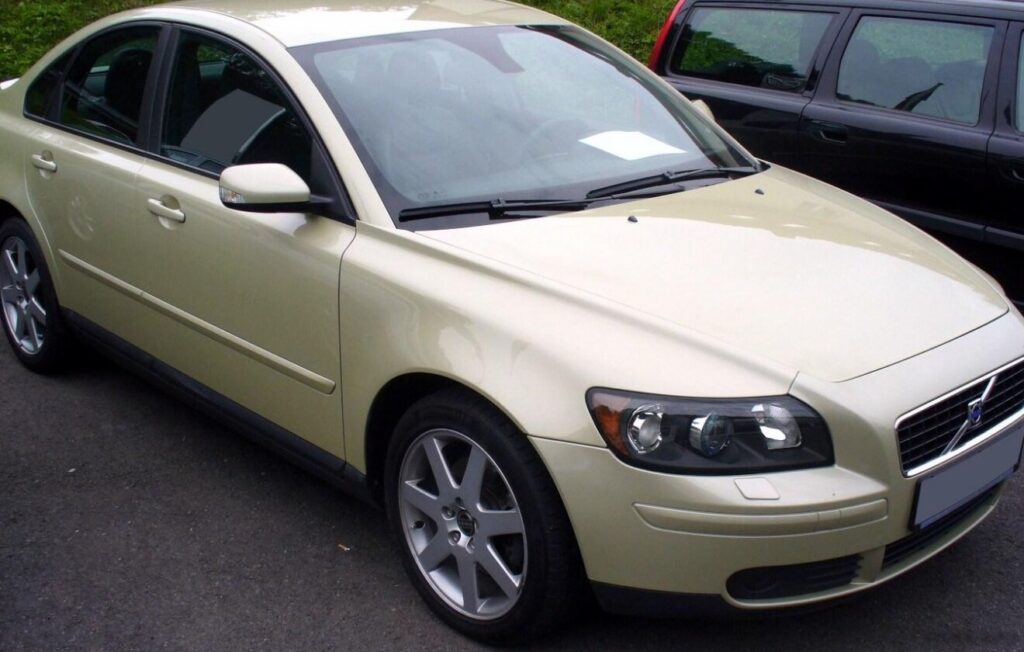
The Volvo S40 II 2.4 20V, equipped with the Geartronic automatic transmission, was a key component of Volvo’s compact executive car lineup from 2004 to 2007. Positioned as a comfortable and refined option within the S40 range, this variant offered a balance between performance and convenience, appealing to buyers seeking a smooth driving experience. It was built on the Volvo P24 platform, shared with the Mazda 3, and represented Volvo’s attempt to broaden its appeal in the increasingly competitive entry-level luxury segment. This model year marked a significant redesign for the S40, moving away from the more angular styling of the first generation.
Technical Specifications
| Brand | Volvo |
| Model | S40 |
| Generation | S40 II |
| Type (Engine) | 2.4 20V (140 Hp) Geartronic |
| Start of production | 2004 |
| End of production | 2007 |
| Powertrain Architecture | Internal Combustion engine |
| Body type | Sedan |
| Seats | 5 |
| Doors | 4 |
| Fuel consumption (urban) | 13.2 l/100 km (17.8 US mpg, 21.4 UK mpg, 7.6 km/l) |
| Fuel consumption (extra urban) | 6.7 l/100 km (35.1 US mpg, 42.2 UK mpg, 14.9 km/l) |
| Fuel consumption (combined) | 9.1 l/100 km (25.8 US mpg, 31 UK mpg, 11 km/l) |
| CO2 emissions | 217 g/km |
| Fuel Type | Petrol (Gasoline) |
| Acceleration 0 – 100 km/h | 10.6 sec |
| Acceleration 0 – 62 mph | 10.6 sec |
| Acceleration 0 – 60 mph | 10.1 sec |
| Maximum speed | 200 km/h (124.27 mph) |
| Emission standard | Euro 4 |
| Weight-to-power ratio | 10 kg/Hp, 100 Hp/tonne |
| Weight-to-torque ratio | 6.4 kg/Nm, 157.1 Nm/tonne |
| Power | 140 Hp @ 5000 rpm |
| Power per litre | 57.5 Hp/l |
| Torque | 220 Nm @ 4000 rpm (162.26 lb.-ft. @ 4000 rpm) |
| Engine layout | Front, Transverse |
| Engine Model/Code | B5244S5 |
| Engine displacement | 2435 cm3 (148.59 cu. in.) |
| Number of cylinders | 5 |
| Engine configuration | Inline |
| Cylinder Bore | 83 mm (3.27 in.) |
| Piston Stroke | 90 mm (3.54 in.) |
| Compression ratio | 10.3:1 |
| Number of valves per cylinder | 4 |
| Fuel injection system | Multi-port manifold injection |
| Engine aspiration | Naturally aspirated engine |
| Valvetrain | DOHC |
| Engine oil capacity | 5.8 l (6.13 US qt | 5.1 UK qt) |
| Coolant | 8.5 l (8.98 US qt | 7.48 UK qt) |
| Kerb Weight | 1400 kg (3086.47 lbs.) |
| Max. weight | 1940 kg (4276.97 lbs.) |
| Max load | 540 kg (1190.5 lbs.) |
| Trunk (boot) space – minimum | 404 l (14.27 cu. ft.) |
| Trunk (boot) space – maximum | 883 l (31.18 cu. ft.) |
| Fuel tank capacity | 62 l (16.38 US gal | 13.64 UK gal) |
| Length | 4476 mm (176.22 in.) |
| Width | 1770 mm (69.69 in.) |
| Height | 1454 mm (57.24 in.) |
| Wheelbase | 2640 mm (103.94 in.) |
| Front track | 1535 mm (60.43 in.) |
| Rear (Back) track | 1531 mm (60.28 in.) |
| Minimum turning circle | 11.1 m (36.42 ft.) |
| Drivetrain Architecture | ICE, Front wheel drive |
| Drive wheel | Front wheel drive |
| Number of gears | 5 |
| Gearbox type | automatic transmission |
| Front suspension | Transverse stabilizer |
| Rear suspension | Transverse stabilizer |
| Front brakes | Ventilated discs |
| Rear brakes | Disc |
| Assisting systems | ABS (Anti-lock braking system) |
| Steering type | Steering rack and pinion |
| Power steering | Hydraulic Steering |
| Tires size | 205/55 R16 V |
| Wheel rims size | 16 |
Powertrain & Engine Architecture
The heart of the S40 II 2.4 was the B5244S5 engine, a naturally aspirated 2.4-liter inline-five cylinder powerplant. This engine was part of Volvo’s modular engine family, known for its robustness and relatively simple design. The “20V” designation indicates the engine’s 20 valves (four valves per cylinder). Fuel delivery was handled by a multi-port fuel injection system, providing precise fuel metering for optimal combustion. The engine utilized a double overhead camshaft (DOHC) valvetrain, contributing to improved breathing and power output. Paired with this engine was a five-speed Geartronic automatic transmission. This transmission offered a conventional torque converter setup with the ability for manual gear selection, providing drivers with some control over the gear changes. The Geartronic system wasn’t known for its particularly quick shifts, but prioritized smoothness and comfort.
Driving Characteristics
The 140 horsepower and 220 Nm (162 lb-ft) of torque produced by the 2.4L engine, when coupled with the automatic transmission, resulted in a comfortable, but not particularly sporty, driving experience. Acceleration from 0-60 mph took around 10.1 seconds, and top speed was limited to 124 mph. The automatic transmission’s gear ratios were tuned for fuel efficiency and smooth cruising, rather than aggressive acceleration. Compared to the available manual transmission or the higher-output 2.5L turbocharged variants, the 2.4 Geartronic felt noticeably slower. However, it offered a more relaxed driving experience, particularly in urban environments. The transmission’s shift points were generally well-chosen, but could sometimes feel hesitant during quick overtaking maneuvers.
Equipment & Trim Levels
The S40 II 2.4 Geartronic typically came standard with features such as air conditioning, power windows and locks, a CD player, and ABS brakes. Higher trim levels added features like leather upholstery, a sunroof, automatic climate control, and upgraded audio systems. Safety was a Volvo hallmark, and even base models included features like side airbags and whiplash protection system (WHIPS). Optional extras included navigation systems, premium sound systems, and various cosmetic enhancements.
Chassis & Braking
The S40 II featured a MacPherson strut front suspension and a multi-link rear suspension, providing a comfortable ride and decent handling. Stabilizer bars were fitted to both the front and rear axles to reduce body roll. Braking duties were handled by ventilated discs at the front and solid discs at the rear. ABS was standard, providing enhanced braking performance in emergency situations. The suspension tuning was geared towards comfort, resulting in a softer ride quality compared to more performance-oriented rivals.
Market Reception & Comparison
The S40 II 2.4 Geartronic was generally well-received by critics as a comfortable and practical compact executive car. However, its performance was often criticized as being underwhelming, especially when compared to competitors like the BMW 3 Series or Audi A4. Fuel economy was average for its class, and the automatic transmission wasn’t as responsive as some of its rivals. The 1.8L engine variants were more fuel efficient, but offered significantly less power. The turbocharged 2.5L models provided a much more engaging driving experience, but came at a higher price point. The 2.4 Geartronic appealed to buyers who prioritized comfort and convenience over outright performance.
Legacy
The B5244S5 engine, in general, proved to be a reliable powerplant, and the S40 II 2.4 Geartronic is generally considered a dependable used car. However, like all vehicles, it’s susceptible to age-related issues. Common problems include oil leaks, worn suspension components, and occasional issues with the automatic transmission. The Geartronic transmission, while generally reliable, can sometimes exhibit harsh shifting or slipping if not properly maintained. Today, the S40 II 2.4 Geartronic represents an affordable entry point into the Volvo brand, offering a comfortable and safe driving experience for those seeking a practical and reliable compact sedan.
