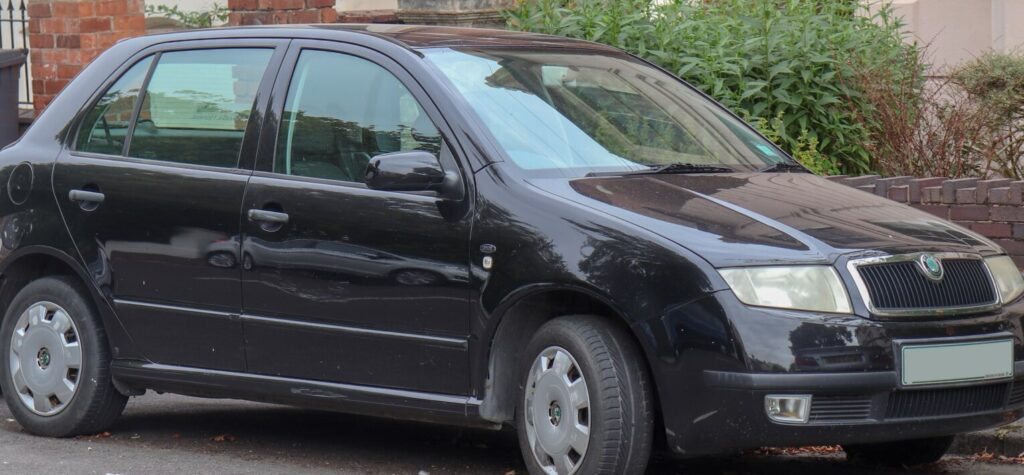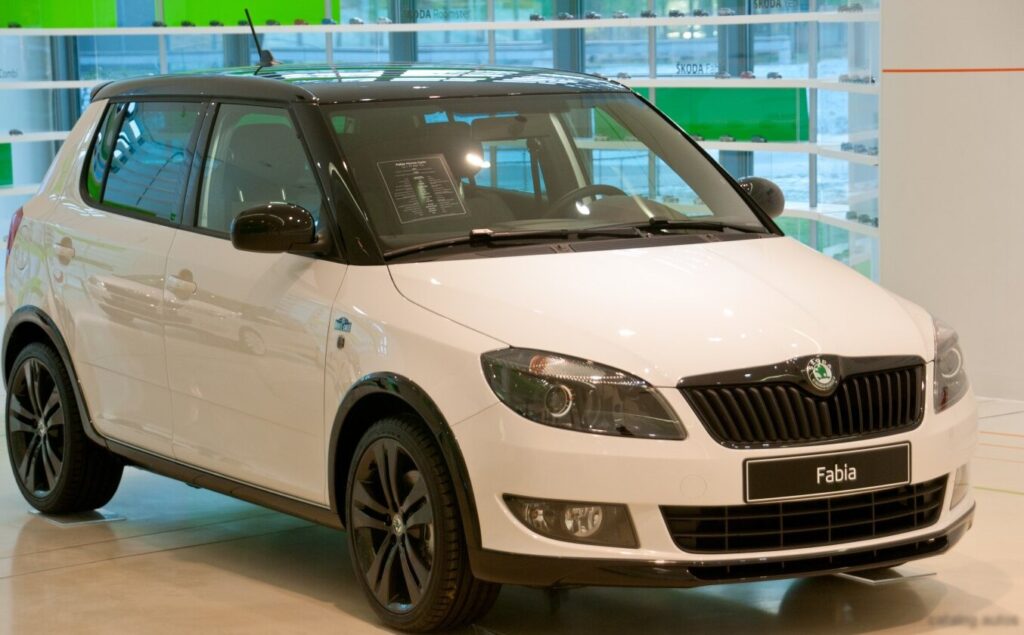
The Skoda Fabia II (facelift, produced from March 2010 to 2014) 1.2 TSI 105 horsepower variant represented a significant step forward in the compact hatchback segment, offering a blend of fuel efficiency and respectable performance. Positioned as a mid-range offering within the Fabia II lineup, it aimed to bridge the gap between the more basic entry-level models and the higher-performance variants. This model was a key part of Skoda’s strategy to offer technologically advanced vehicles at a competitive price point, particularly within the European market. The Fabia II itself was based on the Volkswagen Group’s A05 (PQ25) platform, shared with the Volkswagen Polo and SEAT Ibiza.
Technical Specifications
| Brand | Skoda |
| Model | Fabia |
| Generation | Fabia II (facelift 2010) |
| Type (Engine) | 1.2 TSI (105 Hp) |
| Start of production | March, 2010 |
| End of production | 2014 |
| Powertrain Architecture | Internal Combustion engine |
| Body type | Hatchback |
| Seats | 5 |
| Doors | 5 |
| Fuel consumption (urban) | 6.8 l/100 km (34.6 US mpg, 41.5 UK mpg, 14.7 km/l) |
| Fuel consumption (extra urban) | 4.5 l/100 km (52.3 US mpg, 62.8 UK mpg, 22.2 km/l) |
| Fuel consumption (combined) | 5.3 l/100 km (44.4 US mpg, 53.3 UK mpg, 18.9 km/l) |
| CO2 emissions | 124 g/km |
| Fuel Type | Petrol (Gasoline) |
| Acceleration 0 – 100 km/h | 10.1 sec |
| Acceleration 0 – 62 mph | 10.1 sec |
| Acceleration 0 – 60 mph | 9.6 sec |
| Maximum speed | 191 km/h (118.68 mph) |
| Emission standard | Euro 5 |
| Weight-to-power ratio | 10 kg/Hp |
| Weight-to-torque ratio | 6 kg/Nm |
| Power | 105 Hp @ 5000 rpm |
| Power per litre | 87.7 Hp/l |
| Torque | 175 Nm @ 1550-4100 rpm (129.07 lb.-ft. @ 1550-4100 rpm) |
| Engine layout | Front, Transverse |
| Engine Model/Code | EA111 / CBZB |
| Engine displacement | 1197 cm3 (73.05 cu. in.) |
| Number of cylinders | 4 |
| Engine configuration | Inline |
| Cylinder Bore | 71 mm (2.8 in.) |
| Piston Stroke | 75.6 mm (2.98 in.) |
| Compression ratio | 10:1 |
| Number of valves per cylinder | 4 |
| Fuel injection system | Direct injection |
| Engine aspiration | Turbocharger, Intercooler |
| Valvetrain | DOHC |
| Engine oil capacity | 3.6 l (3.8 US qt | 3.17 UK qt) |
| Coolant capacity | 7.7 l (8.14 US qt | 6.78 UK qt) |
| Kerb Weight | 1055 kg (2325.88 lbs.) |
| Max. weight | 1585 kg (3494.33 lbs.) |
| Max load | 530 kg (1168.45 lbs.) |
| Trunk (boot) space – minimum | 315 l (11.12 cu. ft.) |
| Trunk (boot) space – maximum | 1180 l (41.67 cu. ft.) |
| Fuel tank capacity | 45 l (11.89 US gal | 9.9 UK gal) |
| Max. roof load | 75 kg (165.35 lbs.) |
| Permitted trailer load with brakes (12%) | 1200 kg (2645.55 lbs.) |
| Permitted trailer load without brakes | 500 kg (1102.31 lbs.) |
| Permitted towbar download | 50 kg (110.23 lbs.) |
| Length | 4000 mm (157.48 in.) |
| Width | 1642 mm (64.65 in.) |
| Width including mirrors | 1886 mm (74.25 in.) |
| Height | 1498 mm (58.98 in.) |
| Wheelbase | 2465 mm (97.05 in.) |
| Front track | 1433 mm (56.42 in.) |
| Rear track | 1426 mm (56.14 in.) |
| Front overhang | 860 mm (33.86 in.) |
| Rear overhang | 675 mm (26.57 in.) |
| Ride height (ground clearance) | 134 mm (5.28 in.) |
| Drag coefficient (Cd) | 0.33 |
| Minimum turning circle | 10 m (32.81 ft.) |
| Approach angle | 14° |
| Departure angle | 16.2° |
| Drivetrain Architecture | ICE, Front wheel drive |
| Drive wheel | Front wheel drive |
| Number of gears | 5 |
| Gearbox type | Manual transmission |
| Front suspension | Independent, McPherson with coil spring and anti-roll bar |
| Rear suspension | Coil spring, Torsion |
| Front brakes | Ventilated discs |
| Rear brakes | Disc |
| Assisting systems | ABS (Anti-lock braking system) |
| Steering type | Steering rack and pinion |
| Power steering | Electric |
| Tires size | 195/55 R15 |
| Wheel rims size | 6J x 15 |
INTRODUCTION
The Skoda Fabia II facelift, launched in 2010, represented a significant refresh of the already popular second-generation Fabia. The 1.2 TSI 105 horsepower variant was a key component of this update, offering a modern, turbocharged engine in a practical and affordable package. This engine, part of the Volkswagen Group’s EA111 family, was designed to deliver improved fuel economy and reduced emissions compared to older naturally aspirated engines. The Fabia II competed directly with other supermini hatchbacks like the Ford Fiesta, Volkswagen Polo, and SEAT Ibiza, offering a compelling value proposition with its spacious interior and robust build quality.
Powertrain & Engine Architecture
The heart of this Fabia variant is the 1.2-liter TSI (Turbocharged Stratified Injection) engine, specifically the CBZB engine code. This engine is a four-cylinder, inline configuration with a displacement of 1197cc. It features direct fuel injection, a turbocharger with an intercooler, and a double overhead camshaft (DOHC) valvetrain with four valves per cylinder. The direct injection system allows for precise fuel delivery, optimizing combustion efficiency and reducing emissions. The turbocharger provides a significant boost in power output compared to naturally aspirated engines of similar size. The engine’s control unit carefully manages the turbocharger’s boost pressure and fuel injection timing to deliver a balance of performance and economy. The 1.2 TSI engine was paired with a five-speed manual transmission, providing a relatively direct and engaging driving experience.
Driving Characteristics
The 1.2 TSI 105 hp Fabia offered a noticeable improvement in performance over the older 1.4-liter engines previously offered. While not a particularly sporty vehicle, it provided sufficient power for everyday driving, including highway cruising and overtaking maneuvers. Acceleration from 0-60 mph took around 9.6 seconds, and the top speed was approximately 118.68 mph. The turbocharger provides a noticeable surge of power in the mid-range, making it easy to maintain speed on inclines. The five-speed manual transmission is well-matched to the engine’s characteristics, with gear ratios that prioritize fuel efficiency without sacrificing drivability. Compared to the more powerful variants, such as those with larger engines, this version felt less strained during acceleration, but also lacked the same level of outright performance.
Equipment & Trim Levels
The 1.2 TSI 105 hp Fabia typically came equipped with a reasonable level of standard features. These included power windows, central locking, air conditioning, and an audio system with MP3 compatibility. Higher trim levels offered additional features such as alloy wheels, fog lights, a multi-function steering wheel, and upgraded interior trim. Safety features included ABS brakes, driver and passenger airbags, and seatbelt pretensioners. Optional extras included a sunroof, parking sensors, and a navigation system. Interior upholstery was typically cloth, with a focus on durability and practicality. The dashboard layout was functional and straightforward, with easy-to-read instruments.
Chassis & Braking
The Fabia II utilized a McPherson strut front suspension and a torsion beam rear suspension. This setup provided a good balance of ride comfort and handling. The front brakes were ventilated discs, while the rear brakes were solid discs. ABS (Anti-lock Braking System) was standard, enhancing braking performance and stability. The steering was a rack and pinion system with electric power assistance, providing light and precise steering feel. The suspension was tuned to prioritize comfort, but it also offered reasonable body control during cornering. Stabilizer bars were fitted to both the front and rear axles to reduce body roll.
Market Reception & Comparison
The Skoda Fabia II 1.2 TSI 105 hp received generally positive reviews from automotive critics. It was praised for its fuel efficiency, comfortable ride, and spacious interior. However, some critics noted that the engine could feel a little strained when fully loaded or driving uphill. Compared to the 1.4-liter engine, the 1.2 TSI offered better fuel economy and more responsive performance. The 1.6-liter TDI diesel variant offered even better fuel economy but at the expense of refinement and performance. The 1.2 TSI struck a good balance between these two extremes, making it a popular choice for drivers who prioritized both economy and drivability.
Legacy
The 1.2 TSI engine proved to be a reliable and durable powertrain when properly maintained. While some early examples experienced issues with carbon buildup on the intake valves (a common issue with direct injection engines), these problems were often addressed through regular servicing and the use of fuel system cleaners. Today, the Fabia II 1.2 TSI 105 hp remains a popular choice in the used car market, offering a practical and affordable option for those seeking a reliable and fuel-efficient hatchback. Its combination of practicality, economy, and reasonable performance ensures its continued relevance in the compact car segment.