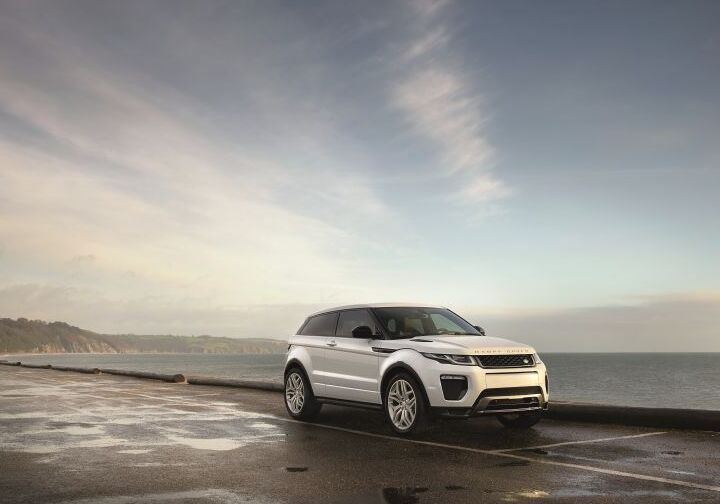
The Land Rover Range Rover Evoque I coupe (facelift 2015) 2.0 TD4, producing 180 horsepower, represents a significant iteration within the first generation Evoque lineup, produced from 2015 to 2018. Positioned as a mid-range offering, this variant aimed to balance fuel efficiency with respectable performance, appealing to buyers seeking a stylish and capable compact SUV. It was a key model in Land Rover’s strategy to broaden the Range Rover brand’s appeal, offering a more accessible entry point into the luxury SUV segment. The facelift brought styling updates and, crucially, the introduction of Land Rover’s new Ingenium engine family, of which the 2.0 TD4 was a prominent member. This model competed directly with premium compact SUVs like the BMW X3, Audi Q5, and Porsche Macan, though typically at a slightly lower price point.
Technical Specifications
| Brand | Land Rover |
| Model | Range Rover Evoque |
| Generation | Range Rover Evoque I coupe (facelift 2015) |
| Type (Engine) | 2.0 TD4 (180 Hp) AWD Automatic |
| Start of production | 2015 |
| End of production | 2018 |
| Powertrain Architecture | Internal Combustion engine |
| Body type | Coupe, SUV |
| Seats | 5 |
| Doors | 3 |
| Fuel consumption (combined) | 4.9 l/100 km (48 US mpg, 57.6 UK mpg, 20.4 km/l) |
| CO2 emissions | 129 g/km |
| Fuel Type | Diesel |
| Acceleration 0 – 100 km/h | 9 sec |
| Acceleration 0 – 62 mph | 9 sec |
| Acceleration 0 – 60 mph | 8.6 sec |
| Maximum speed | 195 km/h (121.17 mph) |
| Emission standard | Euro 6 |
| Weight-to-power ratio | 9.4 kg/Hp, 106.5 Hp/tonne |
| Weight-to-torque ratio | 3.9 kg/Nm, 254.4 Nm/tonne |
| Power | 180 Hp @ 4000 rpm |
| Power per litre | 90 Hp/l |
| Torque | 430 Nm @ 1500 rpm (317.15 lb.-ft. @ 1500 rpm) |
| Engine layout | Front, Transverse |
| Engine Model/Code | Ingenium / 204DTD |
| Engine displacement | 1999 cm3 (121.99 cu. in.) |
| Number of cylinders | 4 |
| Engine configuration | Inline |
| Cylinder Bore | 83 mm (3.27 in.) |
| Piston Stroke | 92.35 mm (3.64 in.) |
| Compression ratio | 15.5:1 |
| Number of valves per cylinder | 4 |
| Fuel injection system | Diesel Commonrail |
| Engine aspiration | Turbocharger, Intercooler |
| Engine oil capacity | 6.5 l (6.87 US qt | 5.72 UK qt) |
| Coolant | 11 l (11.62 US qt | 9.68 UK qt) |
| Kerb Weight | 1690 kg (3725.81 lbs.) |
| Fuel tank capacity | 54 l (14.27 US gal | 11.88 UK gal) |
| Length | 4371 mm (172.09 in.) |
| Width | 1980 mm (77.95 in.) |
| Width including mirrors | 2085 mm (82.09 in.) |
| Height | 1625 mm (63.98 in.) |
| Wheelbase | 2660 mm (104.72 in.) |
| Front track | 1625 mm (63.98 in.) |
| Rear track | 1629 mm (64.13 in.) |
| Ride height (ground clearance) | 215 mm (8.46 in.) |
| Drag coefficient (Cd) | 0.37 |
| Minimum turning circle | 11.3 m (37.07 ft.) |
| Approach angle | 25° |
| Departure angle | 33° |
| Drive wheel | All wheel drive (4×4) |
| Number of gears | 9 |
| Gearbox type | Automatic transmission |
| Front suspension | Independent, type McPherson with coil spring and anti-roll bar |
| Rear suspension | Independent multi-link suspension |
| Front brakes | Ventilated discs |
| Rear brakes | Disc |
Powertrain & Engine Architecture
The heart of the 2.0 TD4 is Land Rover’s Ingenium engine family, specifically the 204DTD code. This engine represents a departure from Land Rover’s previous reliance on Ford-sourced engines, offering improved efficiency and refinement. The 2.0-liter inline-four diesel utilizes a sophisticated common-rail direct injection system, delivering fuel at pressures up to 2,000 bar for optimized combustion. A single turbocharger, coupled with an intercooler, provides boost, contributing to the engine’s 430 Nm (317 lb-ft) of torque available from a low 1500 rpm. The Ingenium engine also features a variable geometry turbocharger (VGT) to enhance responsiveness across the rev range. Paired with this engine is a ZF 9-speed automatic transmission, known for its smooth shifts and wide gear ratio spread. This transmission contributes to both fuel economy and performance, allowing the engine to operate efficiently at highway speeds while providing quick acceleration when needed.
Driving Characteristics
The 180 hp 2.0 TD4 automatic offers a comfortable and capable driving experience. While not overtly sporty, the engine provides sufficient power for everyday driving and overtaking maneuvers. The nine-speed automatic transmission is generally smooth and responsive, although some drivers have noted occasional hesitancy during downshifts. The all-wheel-drive system provides excellent traction in various conditions, making it a confident performer on both paved and unpaved surfaces. Compared to the higher-output 240 hp version of the 2.0 Ingenium, the 180 hp variant feels noticeably less urgent in acceleration. However, the lower power output also contributes to improved fuel economy. The gear ratios are tuned for efficiency, with higher gears prioritizing fuel savings during cruising. The Evoque’s suspension provides a good balance between comfort and handling, absorbing bumps effectively while maintaining reasonable body control.
Equipment & Trim Levels
The 2.0 TD4 Automatic typically came equipped with a respectable level of standard features. These included leather upholstery, automatic climate control, a touchscreen infotainment system with navigation, and parking sensors. Optional extras included a panoramic sunroof, premium audio system, adaptive cruise control, and various styling enhancements. Trim levels varied depending on the market, but generally included SE, HSE, and Landmark editions. The HSE trim added features like heated seats, upgraded interior trim, and larger alloy wheels. The Landmark edition offered a more distinctive appearance with unique exterior styling cues and additional equipment.
Chassis & Braking
The Evoque’s chassis utilizes a monocoque construction, providing a good balance of rigidity and weight. The front suspension employs McPherson struts with coil springs and an anti-roll bar, while the rear features an independent multi-link setup. This suspension configuration delivers a comfortable ride and predictable handling. Braking duties are handled by ventilated discs at the front and solid discs at the rear. Anti-lock braking system (ABS) and electronic stability control (ESC) are standard features, enhancing safety and control. The steering is electrically assisted, providing a light and precise feel.
Market Reception & Comparison
The Range Rover Evoque, including the 2.0 TD4 Automatic variant, was generally well-received by critics and consumers alike. It was praised for its stylish design, luxurious interior, and capable all-wheel-drive system. The 2.0 TD4 offered a compelling blend of fuel efficiency and performance, making it an attractive option for buyers seeking a practical and refined compact SUV. Compared to the more powerful 240 hp version, the 180 hp model offered better fuel economy but lacked the same level of outright performance. Reliability reports have been mixed, with some owners reporting issues with the Ingenium engine’s fuel injection system and the ZF transmission. However, these issues appear to be relatively infrequent.
Legacy
The 2.0 TD4 Automatic variant of the Range Rover Evoque I played a crucial role in establishing the Evoque as a successful model within the Range Rover lineup. The Ingenium engine family, introduced with this model, has become a cornerstone of Land Rover’s powertrain strategy. While early examples of the Ingenium engine experienced some teething issues, subsequent revisions have improved reliability. Today, the facelifted Evoque I 2.0 TD4 Automatic remains a popular choice in the used car market, offering a stylish and capable SUV at a relatively affordable price point. Its blend of luxury, practicality, and fuel efficiency continues to appeal to a wide range of buyers.