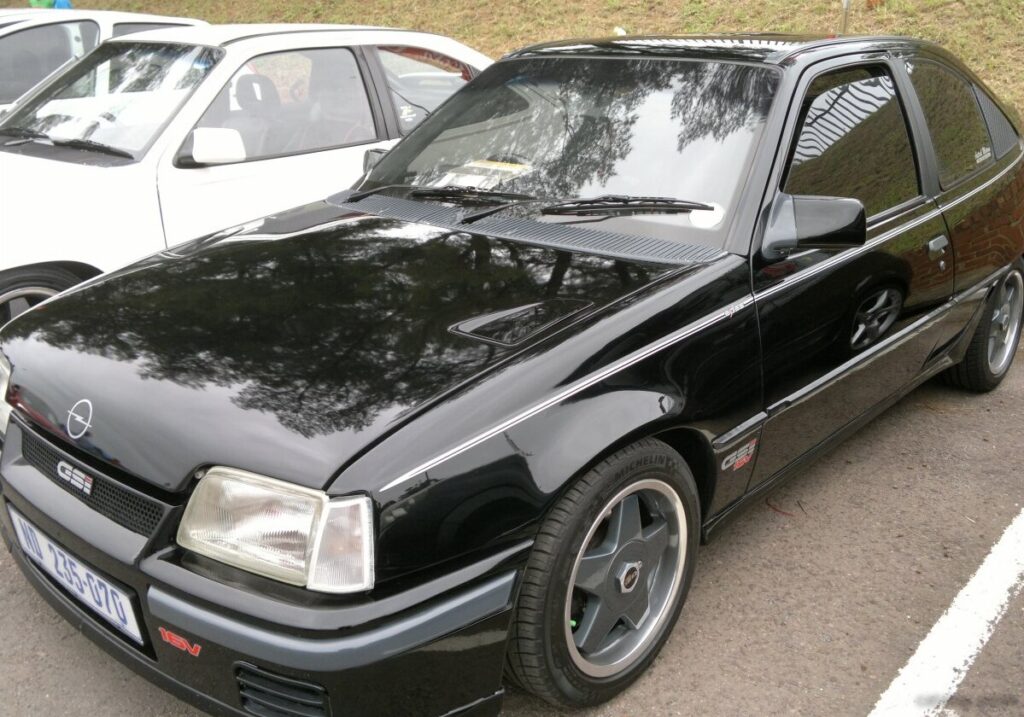
The Opel Kadett E CC 2.0 GSI, produced between 1986 and 1991, represented the performance pinnacle of the Kadett E range. Positioned as the sporty variant, the GSI (Gran Sport Injection) offered a significant upgrade over the standard Kadett models, both in terms of engine output and handling. It was a key competitor in the European compact car market, appealing to drivers seeking a blend of practicality and driving enjoyment. The Kadett E, internally designated the T85 project, was a significant redesign of the Kadett line, moving to a more modern, aerodynamic design and offering improved interior space and refinement. The “CC” designation denotes the coupe-like hatchback body style, offering a sportier profile than the traditional four-door saloon.
Technical Specifications
| Brand | Opel |
| Model | Kadett |
| Generation | Kadett E CC |
| Type (Engine) | 2.0 GSI (129 Hp) |
| Start of production | 1986 |
| End of production | 1991 |
| Powertrain Architecture | Internal Combustion engine |
| Body type | Hatchback |
| Seats | 5 |
| Doors | 3-5 |
| Fuel Type | Petrol (Gasoline) |
| Acceleration 0 – 100 km/h | 8.5 sec |
| Acceleration 0 – 62 mph | 8.5 sec |
| Acceleration 0 – 60 mph | 8.1 sec |
| Maximum speed | 206 km/h (128 mph) |
| Weight-to-power ratio | 7.6 kg/Hp, 131 Hp/tonne |
| Weight-to-torque ratio | 5.5 kg/Nm, 182.7 Nm/tonne |
| Power | 129 Hp @ 5600 rpm |
| Power per litre | 64.6 Hp/l |
| Torque | 180 Nm @ 4600 rpm (132.76 lb.-ft. @ 4600 rpm) |
| Engine layout | Front, Transverse |
| Engine Model/Code | 20SEH |
| Engine displacement | 1998 cm3 (121.93 cu. in.) |
| Number of cylinders | 4 |
| Engine configuration | Inline |
| Cylinder Bore | 86 mm (3.39 in.) |
| Piston Stroke | 86 mm (3.39 in.) |
| Compression ratio | 10:1 |
| Number of valves per cylinder | 2 |
| Fuel injection system | Multi-port manifold injection |
| Engine aspiration | Naturally aspirated engine |
| Valvetrain | SOHC |
| Engine oil capacity | 4 l (4.23 US qt | 3.52 UK qt) |
| Coolant | 6.9 l (7.29 US qt | 6.07 UK qt) |
| Kerb Weight | 985 kg (2171.55 lbs) |
| Max. weight | 1385 kg (3053.4 lbs) |
| Max load | 400 kg (881.85 lbs) |
| Trunk (boot) space – minimum | 485 l (17.13 cu. ft.) |
| Trunk (boot) space – maximum | 1385 l (48.91 cu. ft.) |
| Fuel tank capacity | 52 l (13.74 US gal | 11.44 UK gal) |
| Length | 3998 mm (157.4 in.) |
| Width | 1666 mm (65.59 in.) |
| Height | 1395 mm (54.92 in.) |
| Wheelbase | 2520 mm (99.21 in.) |
| Front track | 1406 mm (55.35 in.) |
| Rear (Back) track | 1406 mm (55.35 in.) |
| Minimum turning circle | 10.5 m (34.45 ft.) |
| Drivetrain Architecture | The Internal combustion engine (ICE) drives the front wheels of the vehicle. |
| Drive wheel | Front wheel drive |
| Number of gears and type of gearbox | 5 gears, manual transmission |
| Front brakes | Ventilated discs |
| Rear brakes | Drum |
Powertrain & Engine Architecture
The heart of the Kadett E 2.0 GSI was the 20SEH engine, a 1998cc inline-four cylinder unit. This engine featured a single overhead camshaft (SOHC) valvetrain operating two valves per cylinder. Crucially, it employed Bosch Motronic multi-port fuel injection, a significant advancement over the carbureted engines found in earlier Kadett models. This system allowed for precise fuel metering, contributing to improved performance and fuel efficiency. The 20SEH produced 129 horsepower at 5600 rpm and 180 Nm (132.76 lb-ft) of torque at 4600 rpm. The engine’s robust bottom end and relatively free-flowing exhaust system allowed it to rev freely and deliver a satisfying driving experience. The transmission was a five-speed manual gearbox, chosen for its sporty feel and direct connection to the engine. An automatic transmission was offered as an option, but it was less common and generally considered to detract from the GSI’s performance character.
Driving Characteristics
The 2.0 GSI offered a noticeable step up in performance compared to the lower-spec Kadett E models. Acceleration to 60 mph took approximately 8.1 seconds, and it could achieve a top speed of around 128 mph. While not a sports car in the modern sense, the GSI provided brisk acceleration and confident highway cruising. The five-speed manual gearbox was well-matched to the engine’s powerband, allowing drivers to keep the engine in its sweet spot. The automatic transmission, while offering convenience, resulted in a slight performance decrease due to torque converter losses and less aggressive gear ratios. The GSI’s suspension was also upgraded compared to standard Kadett models, with stiffer springs and dampers, providing improved handling and reduced body roll. However, the ride quality was firmer, making it less comfortable for everyday commuting.
Equipment & Trim Levels
The Kadett E 2.0 GSI came reasonably well-equipped for its time. Standard features typically included a sports steering wheel, upgraded interior trim, a rev counter, and tinted glass. Exterior features included a distinctive front spoiler, side skirts, and a rear spoiler, all designed to enhance the car’s sporty appearance. Optional extras included power windows, central locking, and an upgraded sound system. Interior upholstery was typically cloth, with a sporty pattern. The dashboard layout was functional and driver-focused, with clear instrumentation and easy-to-reach controls.
Chassis & Braking
The Kadett E utilized a MacPherson strut front suspension and a torsion beam rear suspension. The GSI variant benefited from stiffer springs and dampers, as well as a thicker front stabilizer bar, to improve handling. Braking was accomplished via ventilated discs on the front wheels and drum brakes on the rear. While adequate for most driving situations, the rear drum brakes were a point of criticism, as they lacked the stopping power of disc brakes. The steering was a rack-and-pinion system, providing precise and responsive steering feel.
Market Reception & Comparison
The Kadett E 2.0 GSI was generally well-received by automotive critics. It was praised for its performance, handling, and sporty styling. However, some critics noted the firm ride quality and the limitations of the rear drum brakes. Compared to other hot hatches of the era, such as the Volkswagen Golf GTI, the Kadett GSI offered a similar level of performance at a slightly lower price point. The 1.6 and 1.8 liter Kadett models were significantly less powerful and targeted a more budget-conscious buyer. The 1.6 offered better fuel economy, while the 1.8 provided a compromise between performance and economy. The GSI, with its 2.0-liter engine, was clearly aimed at enthusiasts seeking a more engaging driving experience.
Legacy
The Opel Kadett E 2.0 GSI has become a popular classic car among enthusiasts. The 20SEH engine is known for its reliability and durability, provided it is properly maintained. Parts availability is generally good, although some specific GSI-specific components can be difficult to find. Today, well-maintained examples of the Kadett E 2.0 GSI are sought after by collectors and enthusiasts, representing a nostalgic reminder of a bygone era of affordable, sporty hatchbacks. The car’s simple mechanical design makes it relatively easy to work on for DIY mechanics, further contributing to its enduring appeal. While not as iconic as some of its rivals, the Kadett E GSI remains a fondly remembered and appreciated vehicle within the classic car community.