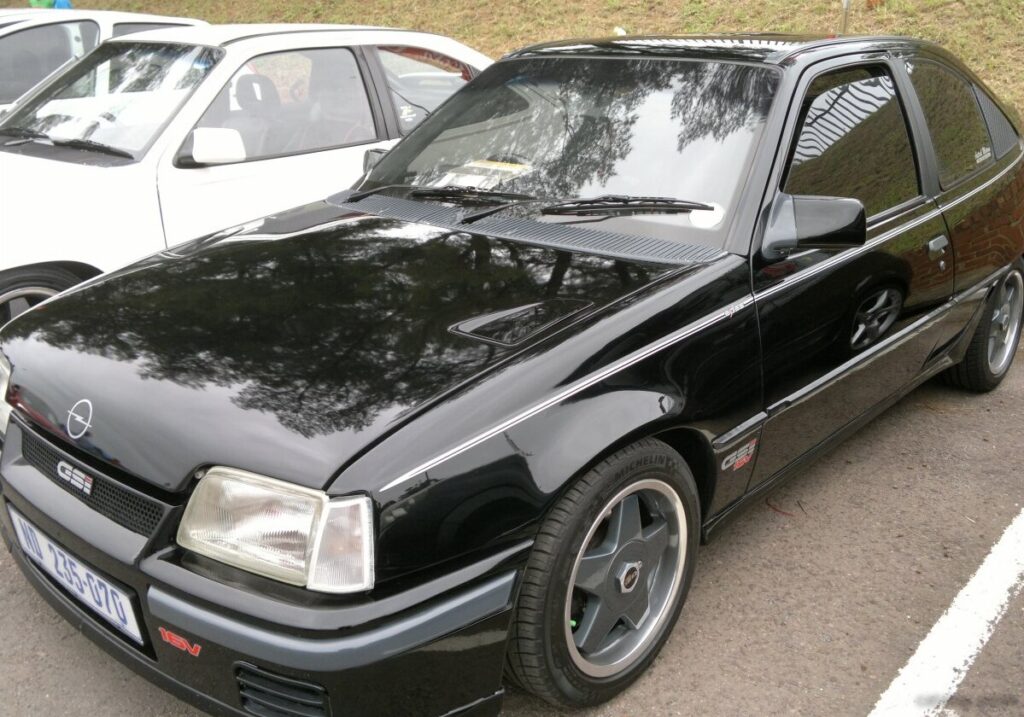
The Opel Kadett E CC 2.0 GSI 16V, produced between 1988 and 1991, represented the performance pinnacle of the Kadett E range. Positioned as the hot hatch variant, the GSI 16V offered a significant step up in power and handling compared to lower-spec Kadett models. It was a key player in the competitive European market for affordable, sporty hatchbacks, appealing to drivers seeking a blend of practicality and driving enjoyment. The Kadett E itself was a significant model for Opel, representing a move towards more modern design and engineering, and the GSI 16V was its flagship.
Technical Specifications
| Brand | Opel |
| Model | Kadett |
| Generation | Kadett E CC |
| Type (Engine) | 2.0 GSI 16V (150 Hp) |
| Start of production | 1988 |
| End of production | 1991 |
| Powertrain Architecture | Internal Combustion engine |
| Body type | Hatchback |
| Seats | 5 |
| Doors | 3 |
| Fuel consumption (urban) | 9.9 l/100 km (23.8 US mpg) |
| Fuel consumption (extra urban) | 5.5 l/100 km (42.8 US mpg) |
| Fuel consumption (combined) | 7 l/100 km (33.6 US mpg) |
| Fuel Type | Petrol (Gasoline) |
| Acceleration 0 – 100 km/h | 7.7 sec |
| Acceleration 0 – 62 mph | 7.7 sec |
| Acceleration 0 – 60 mph | 7.3 sec |
| Maximum speed | 220 km/h (136.7 mph) |
| Weight-to-power ratio | 6.9 kg/Hp |
| Weight-to-torque ratio | 5.3 kg/Nm |
| Power | 150 Hp @ 6000 rpm |
| Torque | 196 Nm (144.56 lb.-ft.) |
| Engine layout | Front, Transverse |
| Engine Model/Code | C20XE |
| Engine displacement | 1998 cm3 (121.93 cu. in.) |
| Number of cylinders | 4 |
| Engine configuration | Inline |
| Cylinder Bore | 86 mm (3.39 in.) |
| Piston Stroke | 86 mm (3.39 in.) |
| Compression ratio | 10.5:1 |
| Number of valves per cylinder | 4 |
| Fuel injection system | Multi-port manifold injection |
| Engine aspiration | Naturally aspirated |
| Engine oil capacity | 4.5 l (4.76 US qt | 3.96 UK qt) |
| Coolant capacity | 6.9 l (7.29 US qt | 6.07 UK qt) |
| Kerb Weight | 1030 kg (2270.76 lbs.) |
| Trunk (boot) space – minimum | 485 l (17.13 cu. ft.) |
| Trunk (boot) space – maximum | 1385 l (48.91 cu. ft.) |
| Fuel tank capacity | 52 l (13.74 US gal | 11.44 UK gal) |
| Length | 3998 mm (157.4 in.) |
| Width | 1666 mm (65.59 in.) |
| Height | 1395 mm (54.92 in.) |
| Wheelbase | 2520 mm (99.21 in.) |
| Front track | 1406 mm (55.35 in.) |
| Rear track | 1406 mm (55.35 in.) |
| Minimum turning circle | 10.5 m (34.45 ft.) |
| Drivetrain Architecture | Front wheel drive |
| Number of gears | 5 |
| Gearbox type | Manual transmission |
| Front brakes | Ventilated discs |
| Rear brakes | Disc |
| Assisting systems | ABS (Anti-lock braking system) |
| Steering type | Steering rack and pinion |
| Power steering | Hydraulic |
| Tires size | 185/60 R14 |
| Wheel rims size | 14 |
Powertrain & Engine Architecture
The heart of the Kadett E GSI 16V was the C20XE engine, a 2.0-liter inline-four cylinder powerplant. This engine was a key component of Opel’s ‘Ecotec’ family, known for its efficiency and performance. The ‘XE’ designation signified a dual overhead camshaft (DOHC) design with four valves per cylinder, a significant upgrade from the single overhead cam engines found in lower Kadett trims. Fuel delivery was handled by Bosch Motronic multi-port fuel injection, optimizing the air-fuel mixture for improved power and reduced emissions. The engine produced 150 horsepower at 6000 rpm and 196 Nm (144.56 lb-ft) of torque. The engine’s robust bottom end and well-designed cylinder head allowed it to rev freely and deliver a responsive driving experience. The transmission was a five-speed manual gearbox, chosen for its sporty feel and direct connection to the engine. This transmission featured relatively short gear ratios, contributing to the car’s brisk acceleration.
Driving Characteristics
The Kadett E GSI 16V offered a noticeably more engaging driving experience than its less powerful siblings. The 150 hp engine, combined with the lightweight chassis, resulted in a 0-60 mph time of around 7.3 seconds and a top speed of 136.7 mph. While not blistering by modern standards, these figures were competitive for a front-wheel-drive hatchback in the late 1980s and early 1990s. The short gear ratios of the five-speed manual transmission kept the engine in its powerband, providing strong acceleration in each gear. The steering was precise and well-weighted, offering good feedback to the driver. The suspension, while relatively simple, was tuned for a balance between comfort and handling. Compared to the 1.6-liter Kadett models, the GSI 16V felt significantly more powerful and responsive, making it a more rewarding car to drive on winding roads. The manual transmission also provided a more direct and engaging driving experience than the optional automatic transmission available on some Kadett models.
Equipment & Trim Levels
The GSI 16V trim level was well-equipped for its time. Standard features included sports seats with distinctive upholstery, a leather-wrapped steering wheel, and a comprehensive instrument cluster with a tachometer. Exterior features included a body-colored front spoiler, side skirts, and a rear spoiler, giving the GSI 16V a more aggressive appearance. Optional extras included power windows, central locking, and an upgraded sound system. The interior was generally functional and well-built, although the materials were not as luxurious as those found in more expensive cars. The focus was on providing a sporty and driver-focused environment.
Chassis & Braking
The Kadett E GSI 16V utilized a MacPherson strut front suspension and a torsion beam rear suspension. The front suspension featured stiffer springs and dampers compared to lower-spec Kadett models, improving handling and reducing body roll. The braking system consisted of ventilated disc brakes at the front and solid disc brakes at the rear. Anti-lock braking system (ABS) was standard, enhancing safety and control during hard braking. The chassis was relatively lightweight, contributing to the car’s agility. The steering was a rack-and-pinion system with hydraulic power assistance, providing precise and responsive steering feel.
Market Reception & Comparison
The Kadett E GSI 16V was generally well-received by automotive critics. It was praised for its performance, handling, and value for money. Compared to rivals such as the Volkswagen Golf GTI and the Ford Escort RS Turbo, the Kadett GSI 16V offered a similar level of performance at a competitive price. Fuel economy was reasonable for a performance car of its era, averaging around 33.6 US mpg on the combined cycle. Reliability was generally good, although the C20XE engine required regular maintenance to ensure optimal performance. Some critics noted that the interior was somewhat basic compared to its rivals, but this was often overlooked given the car’s sporty driving characteristics and affordable price.
Legacy
The Opel Kadett E GSI 16V has become a popular classic car among enthusiasts. The C20XE engine is known for its durability and tunability, making it a favorite among those who enjoy modifying and upgrading their cars. Well-maintained examples of the GSI 16V are becoming increasingly collectible. The car’s combination of performance, affordability, and practicality has ensured its enduring appeal. Today, the Kadett E GSI 16V is remembered as a significant hot hatch of the late 1980s and early 1990s, representing a high point in Opel’s engineering and design.