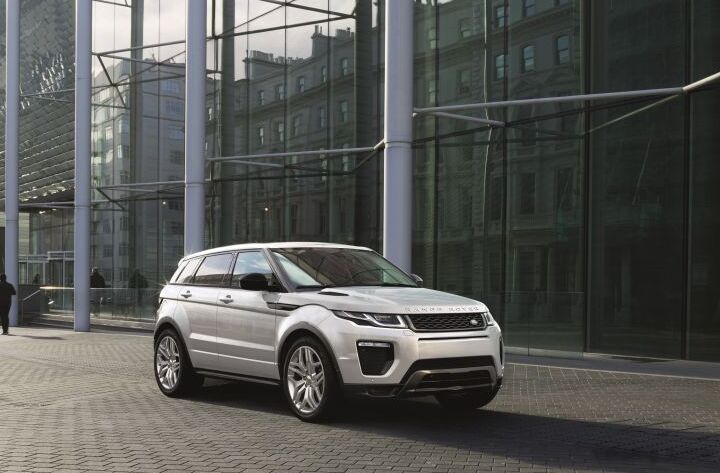
The Land Rover Range Rover Evoque I (facelift 2015) 2.0 TD4, producing 150 horsepower, represents a key variant within the first generation of the Evoque model line. Introduced as part of a mid-cycle refresh in 2015 and continuing through the 2018 model year, this version aimed to balance fuel efficiency with acceptable performance for the burgeoning compact luxury crossover segment. Positioned as a more economical option within the Evoque range, it sat below the higher-output petrol and diesel variants, targeting buyers prioritizing running costs over outright speed. The facelift brought subtle styling updates and improvements to the infotainment system, solidifying the Evoque’s position as a style-conscious and capable vehicle.
Technical Specifications
| Brand | Land Rover |
| Model | Range Rover Evoque |
| Generation | Range Rover Evoque I (facelift 2015) |
| Type (Engine) | 2.0 TD4 (150 Hp) |
| Start of production | 2015 |
| End of production | 2018 |
| Powertrain Architecture | Internal Combustion engine |
| Body type | SUV, Crossover |
| Seats | 5 |
| Doors | 5 |
| Fuel consumption (combined) | 4.3 l/100 km (54.7 US mpg, 65.7 UK mpg, 23.3 km/l) |
| CO2 emissions | 109 g/km |
| Fuel Type | Diesel |
| Acceleration 0 – 100 km/h | 11.2 sec |
| Acceleration 0 – 62 mph | 11.2 sec |
| Acceleration 0 – 60 mph | 10.6 sec |
| Maximum speed | 182 km/h (113.09 mph) |
| Emission standard | Euro 6 |
| Weight-to-power ratio | 10.7 kg/Hp, 93.3 Hp/tonne |
| Weight-to-torque ratio | 4.2 kg/Nm, 236.3 Nm/tonne |
| Power | 150 Hp @ 4000 rpm |
| Power per litre | 75 Hp/l |
| Torque | 380 Nm @ 1500 rpm (280.27 lb.-ft. @ 1500 rpm) |
| Engine layout | Front, Transverse |
| Engine Model/Code | Ingenium / 204DTD |
| Engine displacement | 1999 cm3 (121.99 cu. in.) |
| Number of cylinders | 4 |
| Engine configuration | Inline |
| Cylinder Bore | 83 mm (3.27 in.) |
| Piston Stroke | 92.35 mm (3.64 in.) |
| Compression ratio | 15.5:1 |
| Number of valves per cylinder | 4 |
| Fuel injection system | Diesel Commonrail |
| Engine aspiration | Turbocharger, Intercooler |
| Engine oil capacity | 6.5 l (6.87 US qt | 5.72 UK qt) |
| Coolant | 11 l (11.62 US qt | 9.68 UK qt) |
| Kerb Weight | 1608 kg (3545.03 lbs.) |
| Fuel tank capacity | 54 l (14.27 US gal | 11.88 UK gal) |
| Length | 4371 mm (172.09 in.) |
| Width | 1985 mm (78.15 in.) |
| Width including mirrors | 2090 mm (82.28 in.) |
| Height | 1660 mm (65.35 in.) |
| Wheelbase | 2660 mm (104.72 in.) |
| Front track | 1625 mm (63.98 in.) |
| Rear track | 1629 mm (64.13 in.) |
| Ride height (ground clearance) | 215 mm (8.46 in.) |
| Drag coefficient (Cd) | 0.37 |
| Minimum turning circle | 11.3 m (37.07 ft.) |
| Approach angle | 25° |
| Departure angle | 33° |
| Drivetrain Architecture | The Internal combustion engine (ICE) drives the front wheels of the vehicle. |
| Drive wheel | Front wheel drive |
| Number of gears | 6 |
| Gearbox type | Manual transmission |
| Front suspension | Independent, type McPherson with coil spring and anti-roll bar |
| Rear suspension | Independent multi-link suspension |
| Front brakes | Ventilated discs |
| Rear brakes | Disc |
| Assisting systems | ABS (Anti-lock braking system) |
| Steering type | Steering rack and pinion |
| Power steering | Electric Steering |
INTRODUCTION
The 2015-2018 Range Rover Evoque 2.0 TD4 150 hp model represents Land Rover’s attempt to broaden the appeal of its stylish compact SUV. Built on the Land Rover-Ford jointly developed 1HX0/A3 platform, the Evoque aimed to attract a younger, more fashion-conscious demographic than traditional Land Rover buyers. The TD4 150 variant, with its front-wheel-drive configuration and relatively modest power output, was specifically tailored for European markets and buyers prioritizing fuel economy and lower running costs. While the Evoque was initially offered with both two-wheel and four-wheel drive, the TD4 150 was primarily sold as a front-wheel-drive model, further emphasizing its efficiency focus.
Powertrain & Engine Architecture
At the heart of the Evoque 2.0 TD4 150 lies the Ingenium engine family, specifically the 204DTD code. This 2.0-liter inline-four diesel engine utilizes a sophisticated common-rail direct injection system, delivering fuel at extremely high pressures for optimized combustion. The engine features a single turbocharger with an intercooler, boosting power and torque. The 15.5:1 compression ratio is typical for modern diesel engines, contributing to thermal efficiency. The engine produces 150 horsepower at 4000 rpm and a respectable 380 Nm (280 lb-ft) of torque at just 1500 rpm. This low-end torque is a characteristic of diesel engines and provides good drivability in everyday situations. The engine is paired with a six-speed manual transmission, which was the standard offering for this variant. While an automatic transmission was available on other Evoque models, it wasn’t typically paired with the 150 hp TD4, further emphasizing the cost-conscious nature of this trim.
Driving Characteristics
The driving experience in the Evoque 2.0 TD4 150 is characterized by its relaxed and comfortable nature. Acceleration from 0-60 mph takes around 10.6 seconds, which is adequate for most driving scenarios but doesn’t offer particularly sporty performance. The front-wheel-drive configuration contributes to slightly reduced traction compared to the all-wheel-drive models, especially in slippery conditions. However, the torque-rich diesel engine provides ample pulling power for overtaking and climbing hills. The six-speed manual transmission is well-matched to the engine, offering smooth gear changes and a reasonable spread of ratios. Compared to the higher-output petrol and diesel versions, the TD4 150 feels less urgent and refined, but it compensates with significantly improved fuel economy.
Equipment & Trim Levels
The Evoque 2.0 TD4 150 typically came equipped with a respectable level of standard features. These included air conditioning, a touchscreen infotainment system, Bluetooth connectivity, alloy wheels, and a suite of safety features such as ABS, electronic stability control, and multiple airbags. Interior upholstery was typically cloth, although leather options were available as upgrades. Higher trim levels offered additional features such as heated seats, a panoramic sunroof, and upgraded audio systems. The dashboard layout was modern and stylish, reflecting the Evoque’s design-focused approach. Optional extras included parking sensors, a rear-view camera, and various cosmetic enhancements.
Chassis & Braking
The Evoque’s chassis features independent suspension all around, with McPherson struts at the front and a multi-link setup at the rear. This provides a comfortable ride quality, absorbing bumps and imperfections in the road surface effectively. The front brakes are ventilated discs, while the rear brakes are solid discs. The steering is electrically assisted, providing a light and precise feel. The front-wheel-drive configuration of the TD4 150 results in a slightly lower curb weight compared to the all-wheel-drive models, which contributes to improved fuel economy. Stabilizer bars are fitted to both the front and rear axles to reduce body roll during cornering.
Market Reception & Comparison
The Range Rover Evoque 2.0 TD4 150 was generally well-received by critics, who praised its stylish design, comfortable ride, and fuel efficiency. However, some reviewers noted that the engine lacked the punch of the higher-output variants. Compared to the 2.0-liter petrol engine, the TD4 150 offered significantly better fuel economy, but at the expense of performance. Against the more powerful diesel models, it provided a more affordable entry point into the Evoque range, appealing to buyers prioritizing value for money. The front-wheel-drive configuration was seen as a compromise, offering improved efficiency but sacrificing some all-weather capability.
Legacy
The Evoque 2.0 TD4 150 has proven to be a relatively reliable vehicle, with the Ingenium engine family generally regarded as robust and durable. However, as with any diesel engine, it’s important to ensure regular maintenance, including oil changes and filter replacements. The diesel particulate filter (DPF) can be a potential source of issues if the vehicle is primarily used for short journeys. In the used car market, the TD4 150 represents a relatively affordable option for those seeking a stylish and comfortable compact SUV. Its fuel efficiency and lower running costs make it an attractive choice for buyers looking for a practical and economical vehicle.