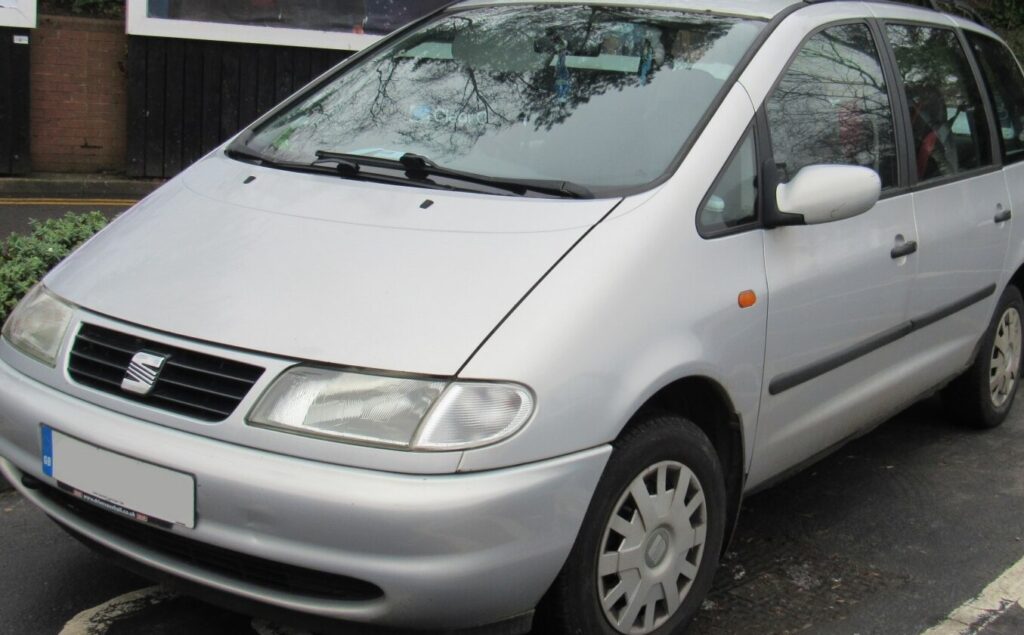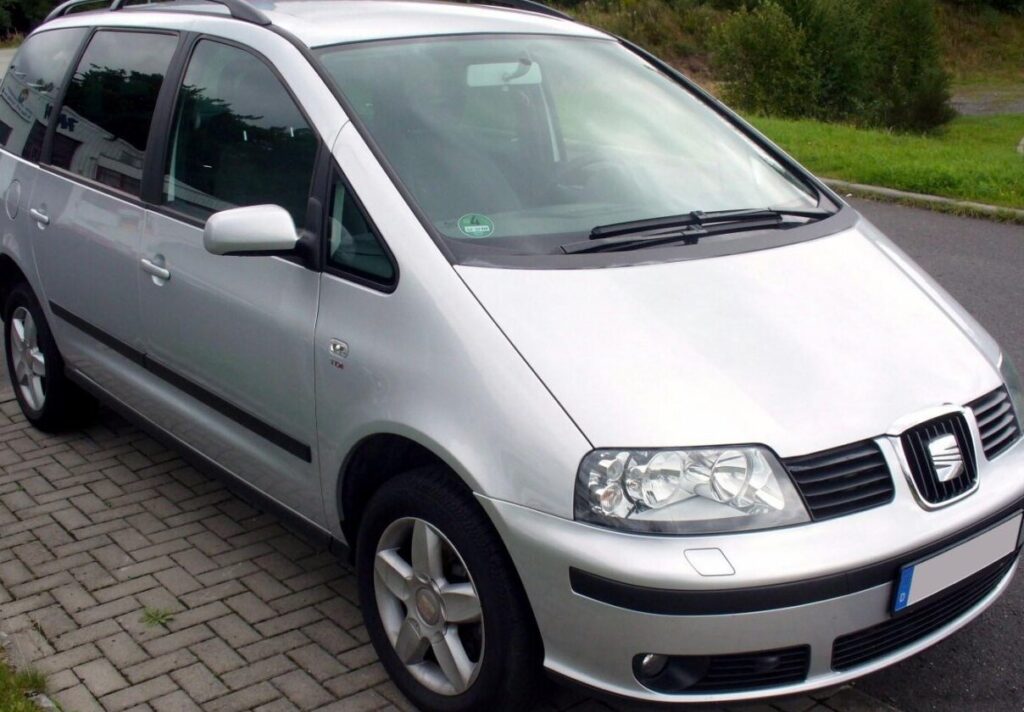
The Seat Alhambra I (7M), particularly the facelifted version introduced in 2000, represented Seat’s entry into the large MPV (Multi-Purpose Vehicle) segment. Produced from 2000 through 2010, the Alhambra was a collaborative effort with Ford, sharing its platform and many components with the Ford Galaxy. This first generation, designated 7M, aimed to provide a spacious and versatile vehicle for families, competing with established players like the Renault Espace and Volkswagen Sharan. The 2.8 V6 204 hp variant, offered throughout much of the production run, was positioned as the premium engine choice, offering significantly more performance than the four-cylinder options. It catered to buyers needing extra power for towing or frequent long-distance journeys with a full load.
Technical Specifications
| Brand | Seat |
| Model | Alhambra |
| Generation | Alhambra I (7M, facelift 2000) |
| Type (Engine) | 2.8 V6 (204 Hp) 4 |
| Start of production | 2000 year |
| End of production | 2010 year |
| Powertrain Architecture | Internal Combustion engine |
| Body type | Minivan, MPV |
| Seats | 7 |
| Doors | 5 |
| Fuel consumption (economy) – urban (NEDC) | 14.9 l/100 km (15.8 US mpg, 19 UK mpg, 6.7 km/l) |
| Fuel consumption (economy) – extra urban (NEDC) | 8.7 l/100 km (27 US mpg, 32.5 UK mpg, 11.5 km/l) |
| Fuel consumption (economy) – combined (NEDC) | 11 l/100 km (21.4 US mpg, 25.7 UK mpg, 9.1 km/l) |
| CO2 emissions (NEDC) | 265 g/km |
| Fuel Type | Petrol (Gasoline) |
| Acceleration 0 – 100 km/h | 10.3 sec |
| Acceleration 0 – 62 mph | 10.3 sec |
| Acceleration 0 – 60 mph | 9.8 sec |
| Maximum speed | 214 km/h (132.97 mph) |
| Emission standard | Euro 4 |
| Weight-to-power ratio | 8.4 kg/Hp, 119.2 Hp/tonne |
| Weight-to-torque ratio | 6.5 kg/Nm, 154.9 Nm/tonne |
| Power | 204 Hp @ 6200 rpm |
| Power per litre | 73.1 Hp/l |
| Torque | 265 Nm @ 3400 rpm (195.45 lb.-ft. @ 3400 rpm) |
| Engine layout | Front, Transverse |
| Engine Model/Code | AYL, AUE |
| Engine displacement | 2792 cm3 (170.38 cu. in.) |
| Number of cylinders | 6 |
| Engine configuration | VR-engine |
| Cylinder Bore | 81 mm (3.19 in.) |
| Piston Stroke | 90.3 mm (3.56 in.) |
| Compression ratio | 10.5:1 |
| Number of valves per cylinder | 4 |
| Fuel injection system | Multi-port manifold injection |
| Engine aspiration | Naturally aspirated engine |
| Valvetrain | DOHC |
| Engine oil capacity | 5.5 l (5.81 US qt, 4.84 UK qt) |
| Coolant | 9 l (9.51 US qt, 7.92 UK qt) |
| Kerb Weight | 1711 kg (3772.11 lbs.) |
| Max. weight | 2510 kg (5533.6 lbs.) |
| Max load | 799 kg (1761.49 lbs.) |
| Trunk (boot) space – minimum | 256 l (9.04 cu. ft.) |
| Trunk (boot) space – maximum | 2610 l (92.17 cu. ft.) |
| Fuel tank capacity | 70 l (18.49 US gal, 15.4 UK gal) |
| Max. roof load | 75 kg (165.35 lbs.) |
| Permitted trailer load with brakes (12%) | 2000 kg (4409.25 lbs.) |
| Permitted trailer load without brakes | 700 kg (1543.24 lbs.) |
| Permitted towbar download | 85 kg (187.39 lbs.) |
| Length | 4634 mm (182.44 in.) |
| Width | 1810 mm (71.26 in.) |
| Height | 1762 mm (69.37 in.) |
| Wheelbase | 2835 mm (111.61 in.) |
| Front track | 1532 mm (60.31 in.) |
| Rear (Back) track | 1518 mm (59.76 in.) |
| Front overhang | 892 mm (35.12 in.) |
| Rear overhang | 907 mm (35.71 in.) |
| Drag coefficient (Cd) | 0.31 |
| Minimum turning circle (turning diameter) | 11.9 m (39.04 ft.) |
| Drivetrain Architecture | The Internal combustion engine (ICE) drives the front wheels permanently, and the rear wheels are driven through an electrically or mechanically operated clutch if necessary. |
| Drive wheel | All wheel drive (4×4) |
| Number of gears and type of gearbox | 6 gears, manual transmission |
| Front suspension | Independent type McPherson, Transverse stabilizer |
| Rear suspension | Transverse stabilizer, Trailing arm, Coil spring |
| Front brakes | Ventilated discs |
| Rear brakes | Disc |
| Assisting systems | ABS (Anti-lock braking system) |
| Steering type | Steering rack and pinion |
| Power steering | Hydraulic Steering |
| Tires size | 215/55 R16 |
| Wheel rims size | 7J x 16 |
Powertrain & Engine Architecture
The 2.8-liter VR6 engine, identified by engine codes AYL and AUE, is the heart of this Alhambra variant. This engine is a 90-degree V6, but uniquely configured as a “VR” engine – meaning it utilizes a single cylinder head for all six cylinders, rather than two separate heads. This compact design contributes to the engine’s relatively small physical size for a V6. The engine features multi-port fuel injection and a double overhead camshaft (DOHC) valvetrain. The 2.8 VR6 is known for its smooth power delivery and distinctive exhaust note. The Alhambra 2.8 V6 came exclusively with a 6-speed manual transmission. This transmission was chosen to handle the engine’s torque output and provide a more engaging driving experience compared to an automatic.
Driving Characteristics
The 2.8 V6 Alhambra offered a noticeable performance upgrade over the lower-powered engine options. Acceleration to 60 mph took approximately 9.8 seconds, and it could reach a top speed of 133 mph. The 6-speed manual transmission allowed drivers to keep the engine in its optimal power band, providing responsive acceleration. While not a sports car, the Alhambra 2.8 V6 felt composed and capable, even when fully loaded with passengers and luggage. The all-wheel-drive system provided enhanced traction in adverse weather conditions. Compared to the 1.8L and 2.0L four-cylinder models, the V6 offered significantly more effortless cruising ability, particularly on highways and when towing.
Equipment & Trim Levels
The 2.8 V6 Alhambra typically came with a higher level of standard equipment than the base models. This included features like alloy wheels, air conditioning, power windows and mirrors, and a radio/CD player. Optional extras included leather upholstery, a sunroof, and a more advanced audio system. The interior was designed with practicality in mind, offering a spacious cabin with flexible seating arrangements. The seven seats could be configured in various ways to maximize cargo space or passenger comfort.
Chassis & Braking
The Alhambra’s chassis featured independent McPherson strut suspension at the front and a trailing arm setup at the rear. This configuration provided a comfortable ride quality while maintaining reasonable handling characteristics. All-wheel drive was standard on the 2.8 V6 model, enhancing stability and traction. The braking system consisted of ventilated discs at the front and solid discs at the rear, assisted by ABS (Anti-lock Braking System). The suspension was tuned to prioritize comfort, but the stabilizer bars helped to reduce body roll during cornering.
Market Reception & Comparison
The Seat Alhambra 2.8 V6 was generally well-received by automotive critics. It was praised for its spacious interior, comfortable ride, and strong performance. However, its fuel economy was a common criticism, as the V6 engine consumed significantly more fuel than the four-cylinder options. Compared to the Volkswagen Sharan, which it was mechanically very similar to, the Alhambra often offered a slightly more affordable price point. Against competitors like the Renault Espace, the Alhambra offered a more driver-focused experience and a more distinctive styling.
Legacy
The Seat Alhambra I 2.8 V6 has developed a reputation for being a reliable and durable vehicle, provided it has been well-maintained. The VR6 engine is known for its longevity, but regular servicing is essential. Common issues include oil leaks and occasional problems with the cooling system. On the used car market, the 2.8 V6 Alhambra commands a higher price than the lower-powered models, reflecting its superior performance and equipment levels. It remains a popular choice for families seeking a spacious and versatile MPV with a touch of performance.