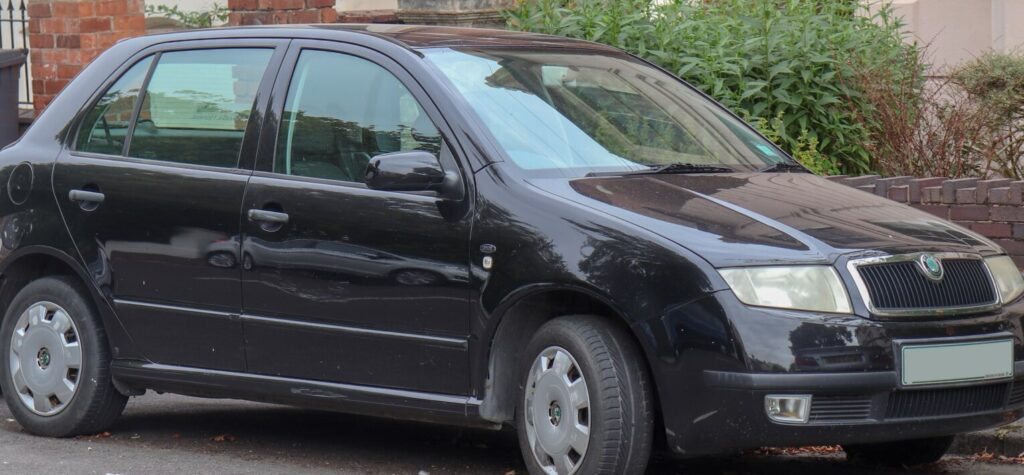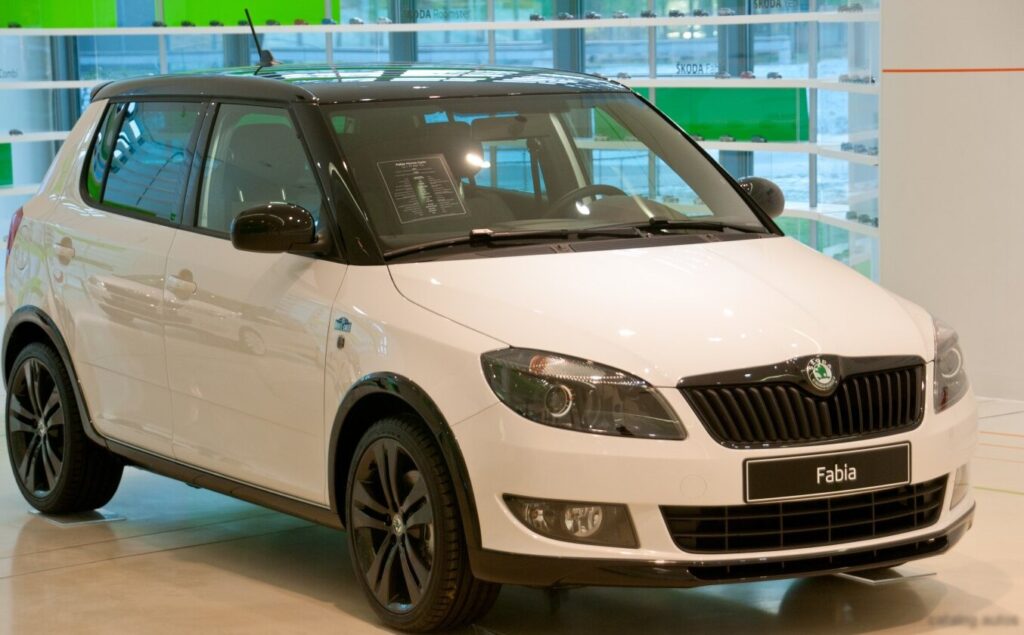
The Skoda Fabia II (facelift, introduced in March 2010) 1.6 TDI 90 hp represents a significant iteration within the second generation of Skoda’s popular supermini. Produced through 2014, this variant was positioned as an economical and practical choice within the Fabia lineup, appealing to buyers prioritizing fuel efficiency and low running costs. It sat within the 1HX0/A3 platform family, sharing components with the Volkswagen Polo, SEAT Ibiza, and Audi A1. The 1.6 TDI 90 hp model was a key offering in many European markets, where diesel engines held a substantial market share due to favorable taxation and fuel economy.
Technical Specifications
| Brand | Skoda |
| Model | Fabia |
| Generation | Fabia II (facelift 2010) |
| Type (Engine) | 1.6 TDI (90 Hp) |
| Start of production | March, 2010 |
| End of production | 2014 |
| Powertrain Architecture | Internal Combustion engine |
| Body type | Hatchback |
| Seats | 5 |
| Doors | 5 |
| Fuel consumption (economy) – urban (NEDC) | 5.1 l/100 km (46.1 US mpg, 55.4 UK mpg, 19.6 km/l) |
| Fuel consumption (economy) – extra urban (NEDC) | 3.6 l/100 km (65.3 US mpg, 78.5 UK mpg, 27.8 km/l) |
| Fuel consumption (economy) – combined (NEDC) | 4.2 l/100 km (56 US mpg, 67.3 UK mpg, 23.8 km/l) |
| CO2 emissions (NEDC) | 109 g/km |
| Fuel Type | Diesel |
| Acceleration 0 – 100 km/h | 12.6 sec |
| Acceleration 0 – 62 mph | 12.6 sec |
| Acceleration 0 – 60 mph | 12 sec |
| Maximum speed | 176 km/h (109.36 mph) |
| Emission standard | Euro 5 |
| Weight-to-power ratio | 12.5 kg/Hp, 79.7 Hp/tonne |
| Weight-to-torque ratio | 4.9 kg/Nm, 203.7 Nm/tonne |
| Power | 90 Hp @ 4200 rpm |
| Power per litre | 56.3 Hp/l |
| Torque | 230 Nm @ 1500-2500 rpm (169.64 lb.-ft. @ 1500-2500 rpm) |
| Engine layout | Front, Transverse |
| Engine Model/Code | EA189 / CAYB |
| Engine displacement | 1598 cm3 (97.52 cu. in.) |
| Number of cylinders | 4 |
| Engine configuration | Inline |
| Cylinder Bore | 79.5 mm (3.13 in.) |
| Piston Stroke | 80.5 mm (3.17 in.) |
| Compression ratio | 16.5:1 |
| Number of valves per cylinder | 4 |
| Fuel injection system | Diesel Commonrail |
| Engine aspiration | Turbocharger, Intercooler |
| Valvetrain | DOHC |
| Engine oil capacity | 4.3 l (4.54 US qt | 3.78 UK qt) |
| Coolant | 8.4 l (8.88 US qt | 7.39 UK qt) |
| Kerb Weight | 1129 kg (2489.02 lbs.) |
| Max. weight | 1659 kg (3657.47 lbs.) |
| Max load | 530 kg (1168.45 lbs.) |
| Trunk (boot) space – minimum | 315 l (11.12 cu. ft.) |
| Trunk (boot) space – maximum | 1180 l (41.67 cu. ft.) |
| Fuel tank capacity | 45 l (11.89 US gal | 9.9 UK gal) |
| Max. roof load | 75 kg (165.35 lbs.) |
| Permitted trailer load with brakes (12%) | 1200 kg (2645.55 lbs.) |
| Permitted trailer load without brakes | 500 kg (1102.31 lbs.) |
| Permitted towbar download | 50 kg (110.23 lbs.) |
| Length | 4000 mm (157.48 in.) |
| Width | 1642 mm (64.65 in.) |
| Width including mirrors | 1886 mm (74.25 in.) |
| Height | 1498 mm (58.98 in.) |
| Wheelbase | 2465 mm (97.05 in.) |
| Front track | 1433 mm (56.42 in.) |
| Rear (Back) track | 1426 mm (56.14 in.) |
| Front overhang | 860 mm (33.86 in.) |
| Rear overhang | 675 mm (26.57 in.) |
| Ride height (ground clearance) | 134 mm (5.28 in.) |
| Drag coefficient (Cd) | 0.32 |
| Minimum turning circle (turning diameter) | 10 m (32.81 ft.) |
| Approach angle | 14° |
| Departure angle | 16.2° |
| Drivetrain Architecture | The Internal combustion engine (ICE) drives the front wheels of the vehicle. |
| Drive wheel | Front wheel drive |
| Number of gears and type of gearbox | 5 gears, manual transmission |
| Front suspension | Independent, type McPherson with coil spring and anti-roll bar |
| Rear suspension | Coil spring, Torsion |
| Front brakes | Ventilated discs |
| Rear brakes | Drum |
| Assisting systems | ABS (Anti-lock braking system) |
| Steering type | Steering rack and pinion |
| Power steering | Electric Steering |
| Tires size | 185/60 R14; 195/55 R15 |
| Wheel rims size | 6J x 14; 6J x 15 |
INTRODUCTION
The Skoda Fabia II facelift, launched in 2010, represented a mid-cycle refresh of the popular second-generation Fabia. The 1.6 TDI 90 hp variant was a core model, designed to appeal to buyers seeking a fuel-efficient and affordable hatchback. Utilizing the Volkswagen Group’s EA189 engine family, this Fabia offered a balance between practicality, economy, and reasonable performance. It was primarily sold in European markets, where diesel-powered small cars were highly favored. This model aimed to provide a cost-effective entry point into the Fabia range, offering essential features and a reliable powertrain.
Powertrain & Engine Architecture
The heart of the Fabia 1.6 TDI 90 hp is the EA189 series 1.6-liter inline-four diesel engine, specifically the CAYB code. This engine features common rail direct injection, a turbocharger with intercooler, and a double overhead camshaft (DOHC) valvetrain with four valves per cylinder. The common rail system, operating at high pressure, ensures precise fuel delivery for optimized combustion and reduced emissions. The turbocharger boosts power output, providing increased torque at lower engine speeds. The engine produces 90 horsepower at 4200 rpm and 230 Nm (169.64 lb-ft) of torque between 1500 and 2500 rpm. The engine is transversely mounted at the front of the vehicle. The Fabia 1.6 TDI typically came equipped with a five-speed manual transmission, although a seven-speed DSG dual-clutch transmission was also available as an option. The manual gearbox provides a straightforward driving experience, while the DSG offers quicker shifts and improved fuel efficiency.
Driving Characteristics
The 1.6 TDI 90 hp Fabia delivers adequate, though not exhilarating, performance. Acceleration from 0 to 100 km/h (0-62 mph) takes around 12.6 seconds, and the top speed is 176 km/h (109.36 mph). The engine’s torque is readily available from low revs, making it suitable for everyday driving and urban commutes. However, overtaking maneuvers require planning, and the engine can feel strained at higher speeds. Compared to the more powerful 1.9 TDI or petrol variants, the 1.6 TDI offers a more relaxed driving experience, prioritizing fuel economy over outright performance. The five-speed manual transmission is well-matched to the engine’s characteristics, providing smooth gear changes. The gear ratios are optimized for fuel efficiency, with a relatively long fifth gear for highway cruising.
Equipment & Trim Levels
The 1.6 TDI 90 hp Fabia typically came with a reasonable level of standard equipment. This included central locking, electric front windows, power steering, an ABS anti-lock braking system, and a driver’s airbag. Higher trim levels, such as Elegance, added features like air conditioning, alloy wheels, a radio with CD player, and electric rear windows. Optional extras included parking sensors, a trip computer, and a panoramic sunroof. Interior upholstery was typically cloth, with a functional and durable design. The dashboard layout was straightforward and easy to use, with clearly labeled controls.
Chassis & Braking
The Fabia II utilized a McPherson strut front suspension and a torsion beam rear suspension. This setup provides a comfortable ride quality, absorbing bumps and imperfections in the road surface effectively. The front suspension incorporates a stabilizer bar to reduce body roll during cornering. Braking duties are handled by ventilated discs at the front and drum brakes at the rear. The ABS system ensures effective braking performance in various conditions. The steering is rack and pinion, providing precise and responsive handling. The chassis is tuned for comfort and stability, rather than sporty handling.
Market Reception & Comparison
The Skoda Fabia 1.6 TDI 90 hp was generally well-received by critics for its fuel efficiency and affordability. It was praised for its practicality and comfortable ride. However, some reviewers noted that the engine lacked outright power, particularly when fully loaded or on steep inclines. Compared to the 1.9 TDI variant, the 1.6 TDI offered lower running costs but sacrificed some performance. The 1.6 TDI also provided better fuel economy than the petrol-powered Fabia models. In terms of reliability, the EA189 engine has been known to have some issues with diesel particulate filter (DPF) clogging and injector failures, but these are generally manageable with regular maintenance.
Legacy
The Skoda Fabia 1.6 TDI 90 hp remains a popular choice in the used car market, particularly for buyers seeking an economical and reliable hatchback. The EA189 engine, while having some known issues, is generally durable and relatively inexpensive to repair. The Fabia’s practicality, comfortable ride, and low running costs continue to appeal to a wide range of buyers. However, potential buyers should be aware of the potential for DPF issues and injector failures and ensure that the vehicle has been properly maintained. The 1.6 TDI Fabia represents a solid and dependable option for those prioritizing fuel efficiency and affordability in a small car.