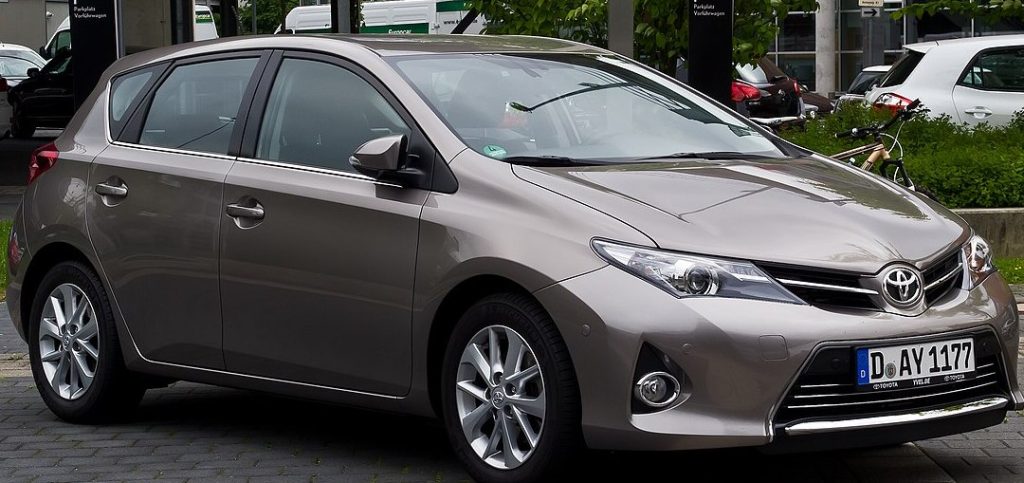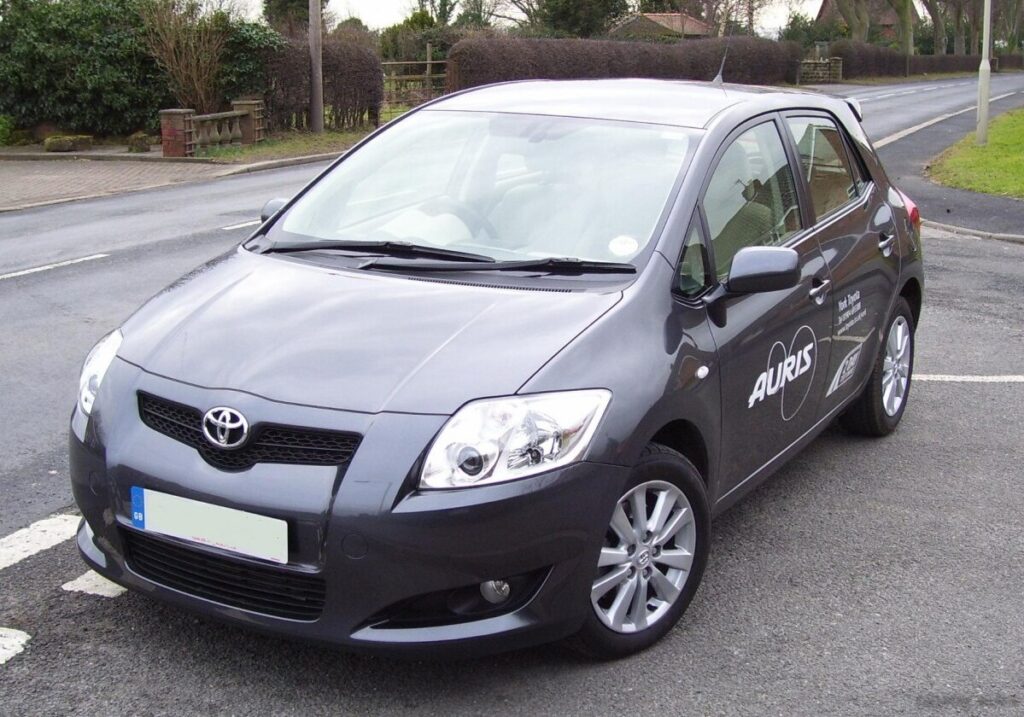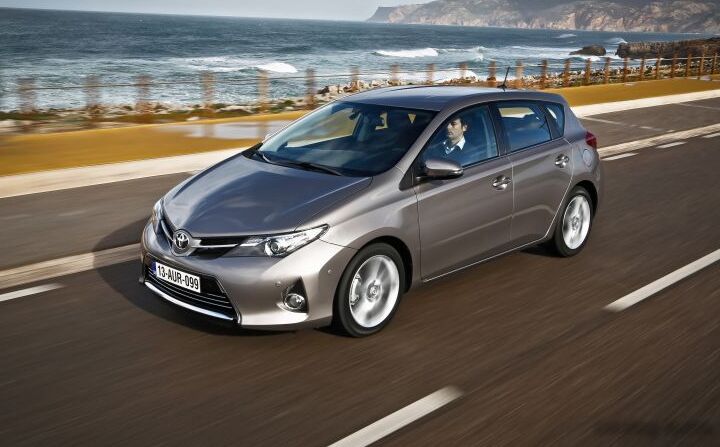
The Toyota Auris II 1.4 D-4D (90 hp) was a popular entry-level variant of Toyota’s compact hatchback, produced between 2012 and 2015. Positioned within the E180 series Auris, this model aimed to provide fuel-efficient motoring for the European market, capitalizing on the demand for diesel-powered vehicles. It served as the most economical option in the Auris II range, appealing to buyers prioritizing low running costs over outright performance. This generation Auris represented a significant step forward for Toyota in terms of design and interior quality, moving away from the more conservative styling of its predecessor.
Technical Specifications
| Brand | Toyota |
| Model | Auris |
| Generation | Auris II |
| Type (Engine) | 1.4 D-4D (90 Hp) |
| Start of production | 2012 |
| End of production | 2015 |
| Powertrain Architecture | Internal Combustion engine |
| Body type | Hatchback |
| Seats | 5 |
| Doors | 5 |
| Fuel consumption (urban) | 5 l/100 km (47 US mpg, 56.5 UK mpg, 20 km/l) |
| Fuel consumption (extra urban) | 3.7 l/100 km (63.6 US mpg, 76.3 UK mpg, 27 km/l) |
| Fuel consumption (combined) | 4.2 l/100 km (56 US mpg, 67.3 UK mpg, 23.8 km/l) |
| Fuel Type | Diesel |
| Acceleration 0 – 100 km/h | 12.5 sec |
| Acceleration 0 – 62 mph | 12.5 sec |
| Acceleration 0 – 60 mph | 11.9 sec |
| Maximum speed | 180 km/h (111.85 mph) |
| Emission standard | Euro 5 J |
| Weight-to-power ratio | 14.1 kg/Hp, 70.9 Hp/tonne |
| Weight-to-torque ratio | 6.2 kg/Nm, 161.4 Nm/tonne |
| Power | 90 Hp @ 3800 rpm |
| Power per litre | 66 Hp/l |
| Torque | 205 Nm @ 1800-2800 rpm (151.2 lb.-ft. @ 1800-2800 rpm) |
| Engine layout | Front, Transverse |
| Engine Model/Code | 1ND-TV |
| Engine displacement | 1364 cm3 (83.24 cu. in.) |
| Number of cylinders | 4 |
| Engine configuration | Inline |
| Cylinder Bore | 73 mm (2.87 in.) |
| Piston Stroke | 81.5 mm (3.21 in.) |
| Compression ratio | 16.5:1 |
| Number of valves per cylinder | 2 |
| Fuel injection system | Diesel Commonrail |
| Engine aspiration | Turbocharger, Intercooler |
| Valvetrain | SOHC |
| Engine oil capacity | 3.7 l (3.91 US qt | 3.26 UK qt) |
| Coolant | 6 l (6.34 US qt | 5.28 UK qt) |
| Kerb Weight | 1270 kg (2799.87 lbs.) |
| Max. weight | 1815 kg (4001.39 lbs.) |
| Max load | 545 kg (1201.52 lbs.) |
| Trunk (boot) space – minimum | 360 l (12.71 cu. ft.) |
| Fuel tank capacity | 50 l (13.21 US gal | 11 UK gal) |
| Length | 4275 mm (168.31 in.) |
| Width | 1760 mm (69.29 in.) |
| Height | 1460 mm (57.48 in.) |
| Wheelbase | 2600 mm (102.36 in.) |
| Front track | 1525 mm (60.04 in.) |
| Rear (Back) track | 1535 mm (60.43 in.) |
| Minimum turning circle | 10.4 m (34.12 ft.) |
| Drivetrain Architecture | Front wheel drive |
| Number of gears | 6 gears, manual transmission |
| Front suspension | Independent, type McPherson with coil spring and anti-roll bar |
| Rear suspension | Torsion |
| Front brakes | Disc |
| Rear brakes | Disc |
| Assisting systems | ABS (Anti-lock braking system) |
| Steering type | Steering rack and pinion |
Powertrain & Engine Architecture
The heart of the Auris 1.4 D-4D was the 1ND-TV engine, a 1.4-liter inline-four cylinder diesel. This engine was part of Toyota’s ‘D-4D’ family, known for its focus on efficiency and low emissions. The 1ND-TV utilized a turbocharger with an intercooler to boost power output, achieving 90 horsepower at 3800 rpm and 205 Nm (151.2 lb-ft) of torque between 1800 and 2800 rpm. It featured a common-rail direct injection system, delivering fuel directly into the cylinders at extremely high pressure for optimized combustion. The engine employed a Single Overhead Camshaft (SOHC) valvetrain with two valves per cylinder. A diesel particulate filter (DPF) was standard, helping to meet stringent Euro 5 emission standards. The engine was transversely mounted in the front of the vehicle, driving the front wheels.
Driving Characteristics
The 1.4 D-4D engine, paired with a six-speed manual transmission, provided adequate, though not exhilarating, performance. Acceleration from 0-60 mph took around 11.9 seconds, and top speed was limited to 111.85 mph. The engine’s strength lay in its low-end torque, making it suitable for everyday driving and urban commutes. Gear ratios were tuned for fuel economy, meaning the engine could feel strained at higher speeds or when overtaking. Compared to the more powerful 1.6L petrol or 1.8L Hybrid variants, the 1.4 D-4D offered significantly less power but superior fuel efficiency. The manual transmission provided a more engaging driving experience than an automatic, but the shift quality was generally smooth and precise.
Equipment & Trim Levels
The 1.4 D-4D typically came with a reasonable level of standard equipment, though it was positioned as the entry point to the Auris II range. Standard features generally included air conditioning, power steering, electric front windows, a CD player with auxiliary input, and ABS brakes. Higher trim levels, such as Active, Icon, and Design, added features like alloy wheels, climate control, a touchscreen infotainment system, and rear parking sensors. Interior upholstery was typically cloth, with a functional and durable design. Optional extras included satellite navigation, Bluetooth connectivity, and a panoramic sunroof.
Chassis & Braking
The Auris II utilized a McPherson strut front suspension and a torsion beam rear suspension. This setup provided a comfortable ride quality, prioritizing smoothness over sporty handling. The front brakes were ventilated discs, while the rear brakes were solid discs. ABS (Anti-lock Braking System) was standard, enhancing safety during emergency braking. The steering was a rack and pinion system, providing reasonably precise control. Stabilizer bars were fitted to both the front and rear axles to reduce body roll during cornering.
Market Reception & Comparison
The Toyota Auris II 1.4 D-4D was well-received by critics for its fuel efficiency and low running costs. It was often praised as a practical and reliable choice for those seeking economical transportation. However, some reviewers noted that the engine lacked outright power and could feel underpowered when fully loaded or driving on steep inclines. Compared to competitors like the Volkswagen Golf and Ford Focus, the Auris offered a more comfortable ride but less engaging driving dynamics. Its fuel economy was competitive, often exceeding that of its petrol-powered rivals.
Legacy
The 1.4 D-4D engine proved to be a reliable unit, with many examples still on the road today. While not known for its performance, it has earned a reputation for durability and longevity. The Auris II, in general, has also proven to be a dependable vehicle, with relatively low maintenance costs. On the used car market, the 1.4 D-4D variant represents a good value proposition for buyers seeking an economical and reliable hatchback. However, potential buyers should be aware of the potential for DPF issues, which can occur with any diesel engine, particularly those used primarily for short journeys.