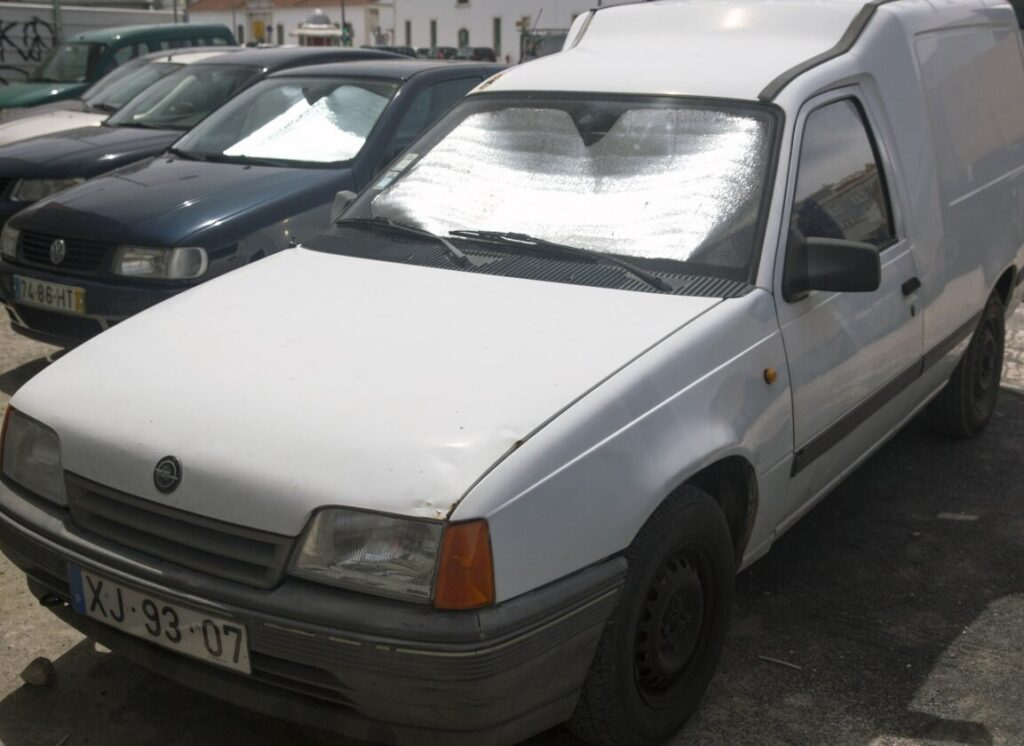
The Opel Kadett E Combo 1.3 N, produced between January 1986 and April 1989, represented an entry-level offering within the broader Kadett E range. The Combo was a panel van/estate variant, designed primarily for commercial use, offering a practical and affordable solution for small businesses and tradespeople. Positioned as the most basic version of the Combo, the 1.3 N engine and five-speed manual transmission combination prioritized fuel economy and low running costs over outright performance. It was part of the Kadett E generation (1986-1993), which was a significant model for Opel, representing a move towards more modern design and engineering.
Technical Specifications
| Brand | Opel |
| Model | Kadett |
| Generation | Kadett E Combo |
| Type (Engine) | 1.3 N (60 Hp) |
| Start of production | January, 1986 |
| End of production | April, 1989 |
| Powertrain Architecture | Internal Combustion engine |
| Body type | Station wagon (estate) |
| Seats | 2 |
| Doors | 3 |
| Fuel Type | Petrol (Gasoline) |
| Power | 60 Hp |
| Power per litre | 46.3 Hp/l |
| Torque | 94 Nm @ 3400-3800 rpm |
| Torque (lb.-ft.) | 69.33 lb.-ft. @ 3400-3800 rpm |
| Engine layout | Front, Transverse |
| Engine Model/Code | 13N |
| Engine displacement | 1297 cm3 |
| Engine displacement (cu. in.) | 79.15 cu. in. |
| Number of cylinders | 4 |
| Engine configuration | Inline |
| Cylinder Bore | 75 mm |
| Cylinder Bore (in.) | 2.95 in. |
| Piston Stroke | 73.4 mm |
| Piston Stroke (in.) | 2.89 in. |
| Compression ratio | 8.2:1 |
| Number of valves per cylinder | 2 |
| Fuel injection system | Carburettor |
| Engine aspiration | Naturally aspirated engine |
| Valvetrain | SOHC |
| Engine oil capacity | 3 l |
| Engine oil capacity (US qt) | 3.17 US qt |
| Engine oil capacity (UK qt) | 2.64 UK qt |
| Coolant | 7 l |
| Coolant (US qt) | 7.4 US qt |
| Coolant (UK qt) | 6.16 UK qt |
| Trunk (boot) space – maximum | 2450 l |
| Trunk (boot) space – maximum (cu. ft.) | 86.52 cu. ft. |
| Length | 4221 mm |
| Length (in.) | 166.18 in. |
| Width | 1674 mm |
| Width (in.) | 65.91 in. |
| Height | 1670 mm |
| Height (in.) | 65.75 in. |
| Wheelbase | 2530 mm |
| Wheelbase (in.) | 99.61 in. |
| Drivetrain Architecture | The Internal combustion engine (ICE) drives the front wheels of the vehicle. |
| Drive wheel | Front wheel drive |
| Number of gears and type of gearbox | 5 gears, manual transmission |
Powertrain & Engine Architecture
The heart of the Kadett E Combo 1.3 N was the 13N engine, a 1.3-liter inline-four cylinder petrol engine. This engine was a relatively simple design, utilizing a single overhead camshaft (SOHC) valvetrain with two valves per cylinder. Fuel delivery was managed by a carburetor, a common feature for entry-level vehicles of this era, prioritizing cost-effectiveness over the precision of fuel injection. The 13N engine produced 60 horsepower and 94 Nm (69.33 lb-ft) of torque. The engine was transversely mounted at the front of the vehicle, driving the front wheels. The five-speed manual transmission was a standard feature, offering a reasonable spread of gears for both urban driving and highway cruising. The 13N engine was known for its robustness, though it lacked the refinement and power of Opel’s larger engines.
Driving Characteristics
The Kadett E Combo 1.3 N offered a utilitarian driving experience. With only 60 horsepower, acceleration was modest, and overtaking required careful planning. The five-speed manual transmission helped to keep the engine within its optimal power band, but the engine lacked significant low-end torque. The gear ratios were geared towards economy, rather than performance. Compared to the more powerful Kadett E variants, such as those equipped with 1.6 or 2.0-liter engines, the 1.3 N felt significantly underpowered. However, the lighter weight of the Combo, compared to the passenger car versions, partially mitigated this disadvantage. The steering was light and responsive, making it easy to maneuver in tight spaces, a key benefit for its intended commercial use.
Equipment & Trim Levels
As the base model, the Kadett E Combo 1.3 N was sparsely equipped. Standard features were minimal, focusing on functionality rather than luxury. The interior typically featured durable, hard-wearing vinyl or basic cloth upholstery. The dashboard was simple and functional, with basic instrumentation including a speedometer, fuel gauge, and temperature gauge. Power steering and central locking were not typically included as standard equipment. Optional extras were limited, and often included upgrades like a radio, improved interior trim, or a more robust suspension setup. The emphasis was on providing a no-frills, affordable work vehicle.
Chassis & Braking
The Kadett E Combo utilized a relatively simple chassis design. The front suspension consisted of MacPherson struts, while the rear suspension employed a twist-beam axle. This setup provided a reasonable balance between ride comfort and handling, although it wasn’t particularly sporty. Braking was typically accomplished with disc brakes at the front and drum brakes at the rear. The braking system was adequate for the vehicle’s weight and performance, but lacked the stopping power of more advanced systems found on higher-spec Kadett E models. Stabilizer bars were often omitted on the base model to further reduce costs.
Market Reception & Comparison
The Kadett E Combo 1.3 N was generally well-received in its target market – small businesses and tradespeople. Critics acknowledged its affordability and practicality, but often noted its lack of power and refinement. Compared to other small vans and estates of the time, such as the Volkswagen Caddy or the Fiat Fiorino, the Kadett E Combo offered a competitive price point and a relatively spacious cargo area. Fuel economy was a key selling point, and the 1.3 N engine proved to be reasonably economical in real-world driving conditions. However, the carburetor-equipped engine was less fuel-efficient than later fuel-injected variants. Reliability was generally good, although the carburetor required periodic adjustment and maintenance.
Legacy
The Opel Kadett E Combo 1.3 N, while not a particularly glamorous vehicle, played an important role in the European light commercial vehicle market. Its robust engine and simple design contributed to its longevity, and many examples remain on the road today. In the used car market, these models are valued for their affordability and practicality. The 13N engine, while not known for its performance, is relatively easy to maintain and repair. The Kadett E Combo 1.3 N represents a bygone era of simple, functional vehicles, prioritizing affordability and reliability over luxury and performance. It remains a popular choice for those seeking a classic, affordable, and practical work vehicle.