
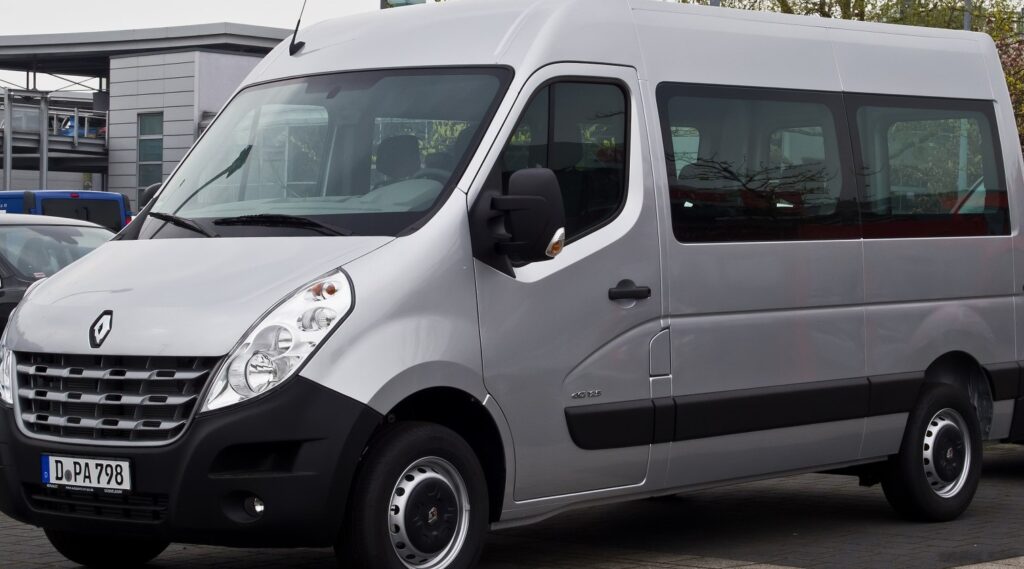
The Renault Master III (Phase II), specifically the Combi 2.3 dCi variant producing 110 horsepower, was a popular choice in the European commercial vehicle market from 2014 to 2016. Positioned as a mid-range offering within the Master III lineup, this version catered to businesses and families needing a versatile and spacious van for both cargo and passenger transport. The “Combi” designation indicates a focus on passenger carrying capability, differentiating it from the panel van configurations. This iteration of the Master built upon the foundation of the earlier Phase I models, incorporating refinements to the engine, interior, and safety features.
Technical Specifications
| Brand | Renault |
| Model | Master |
| Generation | Master III (Phase II, 2014) Combi |
| Type (Engine) | 2.3 dCi (110 Hp) L1H1 |
| Start of production | 2014 |
| End of production | 2016 |
| Powertrain Architecture | Internal Combustion engine |
| Body type | Minivan, MPV |
| Seats | 6 |
| Doors | 4 |
| Fuel consumption (urban) | 8.5-8.7 l/100 km (27.7 – 27 US mpg, 33.2 – 32.5 UK mpg, 11.8 – 11.5 km/l) |
| Fuel consumption (extra urban) | 6.5-6.7 l/100 km (36.2 – 35.1 US mpg, 43.5 – 42.2 UK mpg, 15.4 – 14.9 km/l) |
| Fuel consumption (combined) | 7.2-7.4 l/100 km (32.7 – 31.8 US mpg, 39.2 – 38.2 UK mpg, 13.9 – 13.5 km/l) |
| CO2 emissions | 190-195 g/km |
| Fuel Type | Diesel |
| Emission standard | Euro 5 |
| Weight-to-power ratio | 18.3 kg/Hp, 54.8 Hp/tonne |
| Weight-to-torque ratio | 7 kg/Nm, 141.9 Nm/tonne |
| Power | 110 Hp @ 3500 rpm |
| Power per litre | 47.9 Hp/l |
| Torque | 285 Nm @ 1250 rpm (210.21 lb.-ft. @ 1250 rpm) |
| Engine Model/Code | M9T |
| Engine displacement | 2298 cm3 (140.23 cu. in.) |
| Number of cylinders | 4 |
| Engine configuration | Inline |
| Cylinder Bore | 85 mm (3.35 in.) |
| Piston Stroke | 101.3 mm (3.99 in.) |
| Number of valves per cylinder | 4 |
| Fuel injection system | Diesel Commonrail |
| Engine aspiration | Turbocharger, Intercooler |
| Engine oil capacity | 8 l (8.45 US qt | 7.04 UK qt) |
| Coolant | 11 l (11.62 US qt | 9.68 UK qt) |
| Kerb Weight | 2008 kg (4426.88 lbs.) |
| Max. weight | 3000 kg (6613.87 lbs.) |
| Max load | 992 kg (2186.99 lbs.) |
| Trunk (boot) space – maximum | 4100 l (144.79 cu. ft.) |
| Fuel tank capacity | 105 l (27.74 US gal | 23.1 UK gal) |
| Permitted trailer load with brakes (12%) | 2500 kg (5511.56 lbs.) |
| Permitted trailer load without brakes | 750 kg (1653.47 lbs.) |
| Length | 5048 mm (198.74 in.) |
| Width | 2070 mm (81.5 in.) |
| Width including mirrors | 2470 mm (97.24 in.) |
| Height | 2303 mm (90.67 in.) |
| Wheelbase | 3182 mm (125.28 in.) |
| Front track | 1750 mm (68.9 in.) |
| Rear (Back) track | 1730 mm (68.11 in.) |
| Front overhang | 842 mm (33.15 in.) |
| Rear overhang | 1024 mm (40.31 in.) |
| Minimum turning circle (turning diameter) | 12.5 m (41.01 ft.) |
| Drivetrain Architecture | Front wheel drive |
| Number of gears and type of gearbox | 6 gears, manual transmission |
| Front suspension | Independent, type McPherson with coil spring and anti-roll bar |
| Rear suspension | Leaf spring |
| Front brakes | Ventilated discs, 302 mm |
| Rear brakes | Disc, 305 mm |
| Tires size | 215/65 R16 |
| Wheel rims size | 16 |
Powertrain & Engine Architecture
The heart of the Master III 2.3 dCi 110 was the M9T engine, a 2.3-liter inline-four cylinder diesel. This engine was a mainstay in Renault’s commercial vehicle range and also found application in other models like the Trafic. The M9T utilized a common rail direct injection system, delivering fuel at high pressure for improved combustion efficiency and reduced emissions. A turbocharger with an intercooler further enhanced performance, providing increased air intake to the engine. The 110 horsepower output was achieved at 3500 rpm, while peak torque of 285 Nm (210.21 lb-ft) was available from a low 1250 rpm, prioritizing usability and driveability over outright speed. The engine featured four valves per cylinder, contributing to improved breathing and power delivery. This specific variant was typically paired with a six-speed manual transmission, although an automated manual transmission (AMT) was sometimes offered as an option.
Driving Characteristics
The 110 hp 2.3 dCi engine, coupled with the six-speed manual gearbox, provided a balance between performance and economy. While not a particularly fast van, it offered sufficient power for everyday driving and hauling moderate loads. The low-end torque made it easy to navigate urban environments and provided good acceleration from standstill. On the highway, the engine felt comfortable at cruising speeds, although overtaking required downshifting. Compared to the higher-output 125 or 150 hp versions of the 2.3 dCi, the 110 hp model felt noticeably less powerful, especially when fully loaded. However, the lower power output also translated to slightly better fuel economy. The gear ratios in the six-speed manual were well-spaced, allowing the driver to keep the engine in its optimal power band.
Equipment & Trim Levels
The Combi version of the Master III was designed with passenger comfort in mind. Standard equipment typically included air conditioning, power steering, an adjustable steering column, and a driver’s seat with multiple adjustments. The interior featured durable, easy-to-clean materials. The Combi configuration offered flexible seating arrangements, with options for different seat configurations and layouts. Optional extras included features like a navigation system, rear parking sensors, cruise control, and upgraded audio systems. The dashboard layout was functional and straightforward, prioritizing practicality over aesthetics. Safety features included ABS brakes, electronic brake-force distribution (EBD), and driver and passenger airbags.
Chassis & Braking
The Renault Master III utilized a robust chassis designed to handle the demands of commercial use. The front suspension consisted of independent McPherson struts with coil springs and an anti-roll bar, providing a comfortable ride and good handling. The rear suspension employed a leaf spring setup, which was well-suited for carrying heavy loads. The braking system featured ventilated discs on the front wheels and solid discs on the rear, providing adequate stopping power. The 110 hp variant typically came equipped with 16-inch steel wheels. The steering was hydraulic, offering a good balance between assistance and feedback.
Market Reception & Comparison
The Renault Master III 2.3 dCi 110 Combi was generally well-received by critics and customers alike. It was praised for its spacious interior, comfortable ride, and fuel efficiency. However, some reviewers noted that the engine could feel underpowered when fully loaded. Compared to competitors like the Fiat Ducato and Volkswagen Crafter, the Master offered a competitive package in terms of price, features, and reliability. The 110 hp version was often seen as a good value proposition for businesses and families who didn’t require the extra power of the higher-output engines. Fuel economy was a strong point, making it an attractive option for those covering long distances.
Legacy
The Renault Master III, including the 2.3 dCi 110 Combi variant, has proven to be a durable and reliable workhorse. While not without its quirks, the M9T engine is generally considered to be a robust unit, capable of covering high mileages with proper maintenance. On the used car market, these vans remain relatively affordable and are still widely used for a variety of purposes. Common issues include wear and tear on the turbocharger and potential problems with the fuel injection system. However, parts availability is generally good, and maintenance costs are reasonable. The Master III continues to be a popular choice for businesses and individuals seeking a practical and versatile van.

