
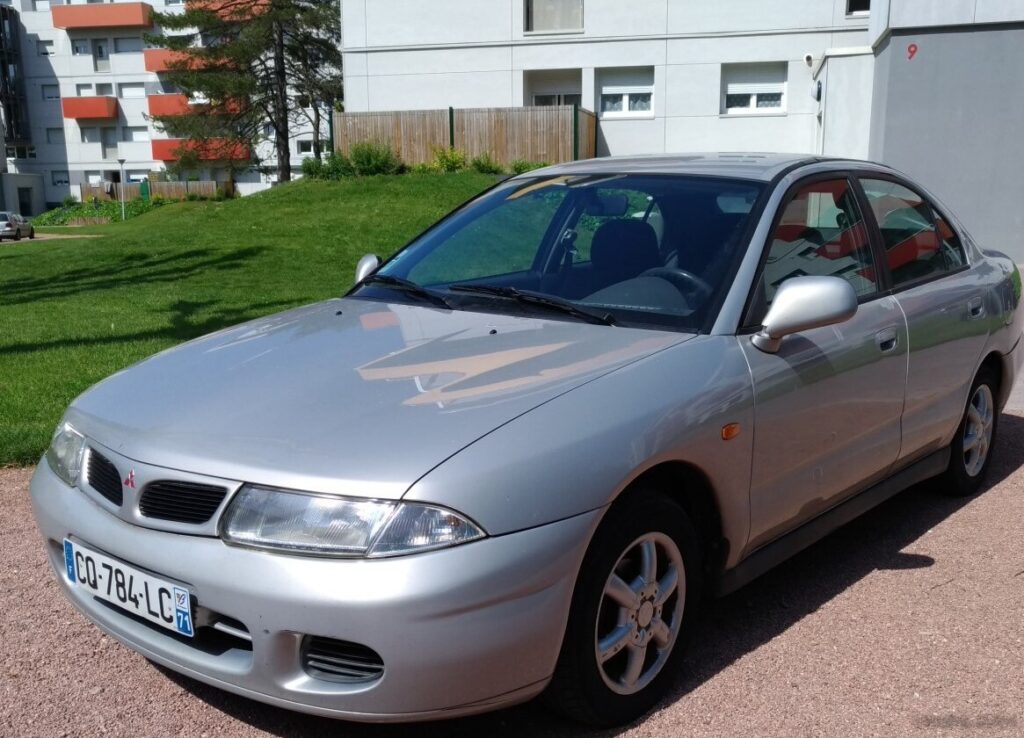
The Mitsubishi Carisma 1.6, producing 90 horsepower, was a mainstay of the Carisma range produced between 1995 and 2000. Positioned as the entry-level model, it offered a balance of affordability and practicality within the broader Carisma lineup, which also included more powerful 1.8L and 2.0L variants. The Carisma, internally designated as the DX platform, represented Mitsubishi’s attempt to create a competitive family sedan for the European market, developed in collaboration with Volvo (resulting in shared components with the S40/V40). This variant aimed at buyers prioritizing fuel efficiency and lower running costs over outright performance.
Technical Specifications
| Brand | Mitsubishi |
| Model | Carisma |
| Generation | Carisma |
| Type (Engine) | 1.6 (90 Hp) |
| Start of production | 1995 |
| End of production | 2000 |
| Powertrain Architecture | Internal Combustion engine |
| Body type | Sedan |
| Seats | 5 |
| Doors | 4 |
| Fuel consumption (urban) | 9.5 l/100 km (24.8 US mpg) |
| Fuel consumption (extra urban) | 6 l/100 km (39.2 US mpg) |
| Fuel Type | Petrol (Gasoline) |
| Acceleration 0 – 100 km/h | 12 sec |
| Acceleration 0 – 62 mph | 12 sec |
| Acceleration 0 – 60 mph | 11.4 sec |
| Maximum speed | 180 km/h (111.85 mph) |
| Weight-to-power ratio | 12 kg/Hp |
| Weight-to-torque ratio | 7.9 kg/Nm |
| Power | 90 Hp @ 5500 rpm |
| Power per litre | 56.4 Hp/l |
| Torque | 137 Nm @ 4000 rpm (101.05 lb.-ft. @ 4000 rpm) |
| Engine layout | Front, Transverse |
| Engine displacement | 1597 cm3 (97.45 cu. in.) |
| Number of cylinders | 4 |
| Engine configuration | Inline |
| Cylinder Bore | 81 mm (3.19 in.) |
| Piston Stroke | 77.5 mm (3.05 in.) |
| Compression ratio | 10:1 |
| Number of valves per cylinder | 4 |
| Fuel injection system | Multi-port manifold injection |
| Engine aspiration | Naturally aspirated engine |
| Valvetrain | OHC |
| Kerb Weight | 1080 kg (2380.99 lbs.) |
| Max. weight | 1610 kg (3549.44 lbs.) |
| Max load | 530 kg (1168.45 lbs.) |
| Trunk (boot) space – maximum | 460 l (16.24 cu. ft.) |
| Fuel tank capacity | 60 l (15.85 US gal | 13.2 UK gal) |
| Length | 4435 mm (174.61 in.) |
| Width | 1710 mm (67.32 in.) |
| Height | 1405 mm (55.31 in.) |
| Wheelbase | 2550 mm (100.39 in.) |
| Front track | 1455 mm (57.28 in.) |
| Rear (Back) track | 1475 mm (58.07 in.) |
| Drivetrain Architecture | The Internal combustion engine (ICE) drives the front wheels of the vehicle. |
| Drive wheel | Front wheel drive |
| Number of gears and type of gearbox | 5 gears, manual transmission |
| Front suspension | Spring Strut |
| Rear suspension | Coil spring |
| Front brakes | Ventilated discs |
| Rear brakes | Drum |
| Assisting systems | ABS (Anti-lock braking system) |
| Steering type | Steering rack and pinion |
| Power steering | Hydraulic Steering |
| Tires size | 185/70 R14 |
Powertrain & Engine Architecture
The Carisma 1.6 utilized the 4G15 engine, a 1.6-liter inline-four cylinder gasoline engine. This engine featured a single overhead camshaft (SOHC) valvetrain with four valves per cylinder. Fuel delivery was managed by a multi-point fuel injection system, contributing to reasonable fuel efficiency for its time. The engine’s 10:1 compression ratio was a typical value for naturally aspirated engines of this era. The 4G15 engine, while not known for its high performance, was considered relatively durable and easy to maintain. The transmission paired with this engine was typically a five-speed manual, although a four-speed automatic transmission was also available, albeit less common. The automatic transmission, while offering convenience, did noticeably impact acceleration and fuel economy.
Driving Characteristics
The 1.6L engine in the Carisma delivered modest performance. Acceleration from 0-60 mph took around 11.4 to 12 seconds, making it suitable for everyday commuting and general driving rather than spirited performance. The engine felt somewhat strained at higher speeds, and overtaking required careful planning. The five-speed manual transmission allowed drivers to make the most of the available power, while the optional automatic transmission, with its four forward gears, resulted in a more relaxed but less responsive driving experience. Gear ratios were geared towards fuel economy, with a relatively tall final drive. Compared to the 1.8L and 2.0L versions, the 1.6L felt noticeably less powerful, particularly when fully loaded with passengers and luggage.
Equipment & Trim Levels
The Carisma 1.6 typically came with a fairly basic level of equipment, reflecting its position as the entry-level model. Standard features generally included power steering, central locking, and electric front windows. Air conditioning was often an optional extra. Interior upholstery was typically cloth, and the dashboard featured a simple, functional design. Higher trim levels, such as the GLX, added features like alloy wheels, upgraded audio systems, and more luxurious interior trim. Safety features were relatively basic for the time, typically including a driver’s airbag and ABS brakes.
Chassis & Braking
The Carisma featured a front-wheel-drive layout with independent front suspension using MacPherson struts and a torsion beam rear suspension. The front brakes were ventilated discs, providing adequate stopping power, while the rear brakes were typically drum brakes, a cost-saving measure for the base model. The suspension setup prioritized ride comfort over sporty handling, resulting in a relatively soft and compliant ride. Stabilizer bars were fitted to both the front and rear axles to reduce body roll during cornering, but the overall handling characteristics were geared towards everyday usability rather than dynamic performance.
Market Reception & Comparison
The Mitsubishi Carisma 1.6 was generally well-received as a practical and affordable family sedan. Critics praised its comfortable ride, spacious interior, and reasonable fuel economy. However, the 1.6L engine was often criticized for its lack of power, particularly when compared to competitors offering larger displacement engines. Compared to the 1.8L and 2.0L Carisma variants, the 1.6L offered significantly lower running costs but at the expense of performance. The 1.8L provided a noticeable improvement in acceleration and overall driving experience, while the 2.0L offered the most performance but also the highest fuel consumption. In terms of reliability, the Carisma 1.6 proved to be a generally dependable vehicle, although some owners reported issues with the automatic transmission.
Legacy
The Mitsubishi Carisma 1.6 remains a relatively affordable and accessible used car today. The 4G15 engine is known for its durability, and parts availability is generally good. However, potential buyers should be aware of the possibility of age-related issues, such as corrosion and wear and tear on suspension components. The automatic transmission, if fitted, should be carefully inspected for smooth operation. While not a particularly exciting vehicle, the Carisma 1.6 represents a solid and practical choice for buyers seeking an affordable and reliable family sedan. Its simplicity and relatively low maintenance costs make it an appealing option for those on a budget. The Carisma, while not a sales success for Mitsubishi in Europe, laid the groundwork for future models and demonstrated the company’s commitment to the family car segment.
