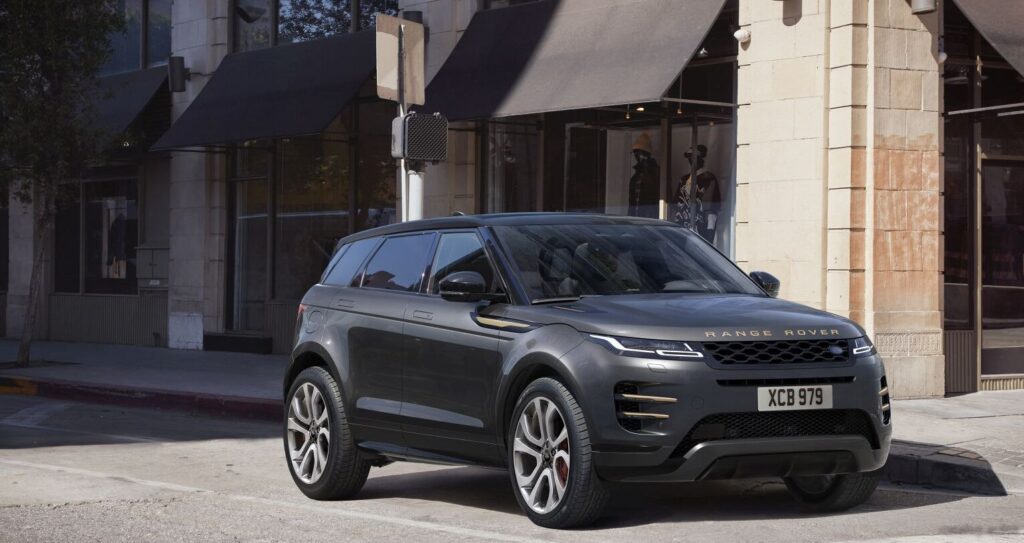
The Land Rover Range Rover Evoque II 1.5 P160 Mild Hybrid Automatic, produced from August 2020 to 2023, represents an entry point into the second generation of the Evoque lineup. Positioned as a fuel-efficient and technologically advanced compact SUV, this variant aimed to broaden the Evoque’s appeal to a wider customer base. It utilizes a 1.5-liter turbocharged three-cylinder engine coupled with a 48-volt mild hybrid system and an eight-speed automatic transmission, primarily targeting buyers seeking a balance between style, comfort, and reasonable running costs. The Evoque II, built on the Premium Transverse Architecture (PTA), continued Land Rover’s tradition of offering a luxurious and capable vehicle in a smaller package.
Technical Specifications
| Brand | Land Rover |
| Model | Range Rover Evoque |
| Generation | Range Rover Evoque II |
| Type (Engine) | 1.5 P160 (160 Hp) Mild Hybrid Automatic |
| Start of production | August, 2020 |
| End of production | 2023 |
| Powertrain Architecture | MHEV (Mild Hybrid Electric Vehicle) |
| Body type | SUV |
| Seats | 5 |
| Doors | 5 |
| Combined fuel consumption (WLTP) | 8-8.3 l/100 km (29.4 – 28.3 US mpg) |
| CO2 emissions (WLTP) | 180-188 g/km |
| Fuel consumption (NEDC) | 6.8 l/100 km (34.6 US mpg) |
| CO2 emissions (NEDC) | 154 g/km |
| Fuel Type | Petrol (Gasoline) |
| Acceleration 0 – 100 km/h | 10.3 sec |
| Acceleration 0 – 62 mph | 10.3 sec |
| Acceleration 0 – 60 mph | 9.7 sec |
| Maximum speed | 199 km/h (123.65 mph) |
| Emission standard | Euro 6 |
| Weight-to-power ratio | 10.7 kg/Hp |
| Weight-to-torque ratio | 6.6 kg/Nm |
| Power | 160 Hp @ 5500 rpm |
| Torque | 260 Nm @ 1600-4000 rpm (191.77 lb.-ft.) |
| Engine layout | Front, Transverse |
| Engine Model/Code | Ingenium / PT153 |
| Engine displacement | 1498 cm3 (91.41 cu. in.) |
| Number of cylinders | 3 |
| Engine configuration | Inline |
| Cylinder Bore | 83.01 mm (3.27 in.) |
| Piston Stroke | 92.3 mm (3.63 in.) |
| Compression ratio | 10.5:1 |
| Number of valves per cylinder | 4 |
| Fuel injection system | Direct injection |
| Engine aspiration | Twin-Turbo, Intercooler |
| Valvetrain | DOHC |
| Engine oil capacity | 5.9 l (6.23 US qt | 5.19 UK qt) |
| Coolant capacity | 8.7 l (9.19 US qt | 7.65 UK qt) |
| Kerb Weight | 1717 kg (3785.34 lbs.) |
| Trunk (boot) space – minimum | 591 l (20.87 cu. ft.) |
| Trunk (boot) space – maximum | 1383 l (48.84 cu. ft.) |
| Fuel tank capacity | 65 l (17.17 US gal | 14.3 UK gal) |
| Length | 4371 mm (172.09 in.) |
| Width with mirrors folded | 1996 mm (78.58 in.) |
| Width including mirrors | 2100 mm (82.68 in.) |
| Height | 1649 mm (64.92 in.) |
| Wheelbase | 2681 mm (105.55 in.) |
| Front track | 1625-1636 mm (63.98 – 64.41 in.) |
| Rear track | 1631-1643 mm (64.21 – 64.69 in.) |
| Front overhang | 880 mm (34.65 in.) |
| Rear overhang | 810 mm (31.89 in.) |
| Ride height (ground clearance) | 212 mm (8.35 in.) |
| Drag coefficient (Cd) | 0.33 |
| Minimum turning circle | 11.6 m (38.06 ft.) |
| Approach angle | 22.2-25.0° |
| Departure angle | 30.6° |
| Ramp-over angle | 20.7° |
| Wading depth | 530 mm (20.87 in.) |
| Drivetrain | Front wheel drive, MHEV |
| Number of gears | 8 |
| Gearbox type | Automatic transmission |
| Front suspension | Independent type McPherson |
| Rear suspension | Independent multi-link suspension |
INTRODUCTION
The Range Rover Evoque II 1.5 P160 Mild Hybrid Automatic, launched in 2020, represented a significant step in Land Rover’s commitment to electrification. This variant was designed to offer a more accessible entry point into the Evoque range, appealing to buyers prioritizing fuel efficiency and lower emissions without sacrificing the brand’s signature style and refinement. It slots into the lineup below the more powerful P200 and P250 models, offering a compelling alternative for those who didn’t require the extra performance. The Evoque II, built on the PTA platform, shares its underpinnings with the Jaguar E-Pace, allowing for economies of scale and a focus on advanced technology.
Powertrain & Engine Architecture
At the heart of the 1.5 P160 lies Land Rover’s Ingenium engine family, specifically the PT153 – a 1.5-liter turbocharged three-cylinder gasoline engine. This engine utilizes direct fuel injection and a twin-scroll turbocharger to deliver 160 horsepower at 5500 rpm and 260 Nm (191.77 lb-ft) of torque between 1600 and 4000 rpm. The mild hybrid system, a 48-volt electrical architecture, incorporates a belt-integrated starter generator (BiSG) that assists the engine during acceleration and enables smoother start-stop functionality. This system recovers energy during deceleration, storing it in a small battery to reduce engine load and improve fuel economy. The engine’s DOHC valvetrain and carefully tuned engine management system contribute to its responsiveness and efficiency. The eight-speed automatic transmission, sourced from ZF, is calibrated to prioritize smooth shifts and optimal fuel consumption.
Driving Characteristics
The 1.5 P160 Automatic delivers a comfortable and refined driving experience, well-suited for urban and highway driving. While not as overtly sporty as the higher-powered Evoque variants, it provides adequate acceleration for most situations, achieving 0-60 mph in approximately 9.7 seconds. The mild hybrid system provides a noticeable boost during initial acceleration, mitigating some of the turbo lag inherent in smaller displacement engines. The eight-speed automatic transmission shifts smoothly and efficiently, and the gear ratios are optimized for fuel economy. Compared to the more powerful P200, the P160 feels less urgent, but its lighter weight and efficient powertrain contribute to improved fuel economy. The front-wheel-drive configuration, standard on this variant, provides good traction in most conditions, although all-wheel drive is available as an option.
Equipment & Trim Levels
The 1.5 P160 typically came equipped with a generous level of standard features, including a touchscreen infotainment system with Apple CarPlay and Android Auto compatibility, automatic climate control, and a suite of driver-assistance systems such as lane departure warning and emergency braking. Interior upholstery typically consisted of cloth or leatherette, with options for full leather upgrades. Trim levels varied depending on the market, but generally included S, SE, and HSE specifications. Higher trims offered features like premium audio systems, heated seats, and advanced driver-assistance technologies. Optional extras included a panoramic sunroof, adaptive cruise control, and a head-up display.
Chassis & Braking
The Evoque II utilizes an independent McPherson strut suspension at the front and an independent multi-link suspension at the rear, providing a comfortable and controlled ride. The suspension is tuned to balance ride comfort with handling agility. The 1.5 P160 typically features disc brakes at the front and disc brakes at the rear, providing adequate stopping power. Electric power steering provides precise and responsive steering feel. Stabilizer bars are fitted front and rear to reduce body roll during cornering. The chassis is designed to be lightweight yet rigid, contributing to the Evoque’s overall handling characteristics.
Market Reception & Comparison
The Range Rover Evoque II 1.5 P160 was generally well-received by critics, who praised its fuel efficiency, comfortable ride, and stylish design. However, some reviewers noted that the engine could feel strained under hard acceleration, and the front-wheel-drive configuration didn’t offer the same level of all-weather capability as the all-wheel-drive variants. Compared to the P200, the P160 offered a more affordable entry point into the Evoque range, but at the expense of performance. Its fuel economy, ranging from 28.3 to 29.4 US mpg, was a significant improvement over the more powerful engines, making it an attractive option for buyers prioritizing running costs.
Legacy
The 1.5 P160 Mild Hybrid Automatic represents an important step in Land Rover’s transition towards electrification. While not the most powerful Evoque variant, it offered a compelling combination of style, comfort, and efficiency. On the used car market, these models are generally considered reliable, with the Ingenium engine proving to be durable and relatively maintenance-free. The mild hybrid system has also proven to be robust, adding to the vehicle’s long-term appeal. As consumer demand for fuel-efficient vehicles continues to grow, the Evoque II 1.5 P160 is likely to remain a popular choice in the used car market for years to come.