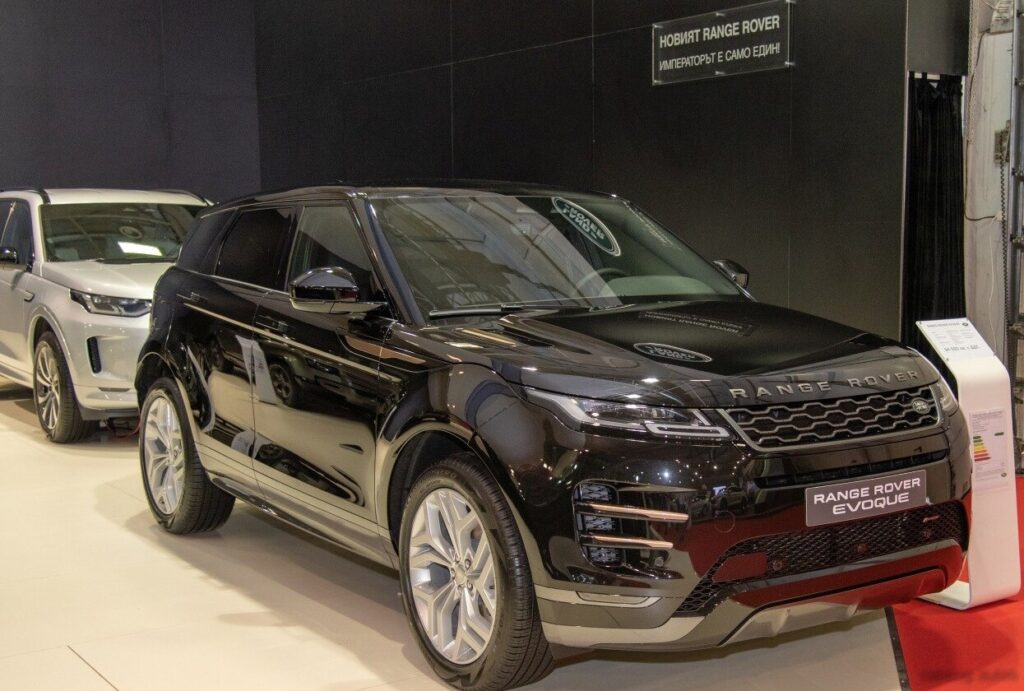
The Land Rover Range Rover Evoque II 1.5 P300e, produced from April 2020 to 2023, represents a significant step in the Evoque lineage, integrating plug-in hybrid technology into the compact luxury SUV segment. This variant, utilizing a 1.5-liter three-cylinder gasoline engine paired with an electric motor, delivers a combined system output of 309 horsepower. It sits within the second generation of the Evoque (L551), built on the Premium Transverse Architecture (PTA) platform, and was positioned as a premium, eco-conscious offering within the Evoque range, appealing to buyers seeking reduced emissions and the flexibility of electric driving. The P300e aimed to bridge the gap between traditional internal combustion engine models and fully electric vehicles, offering a balance of performance, efficiency, and luxury.
Technical Specifications
| Brand | Land Rover |
| Model | Range Rover Evoque |
| Generation | Range Rover Evoque II |
| Type (Engine) | 1.5 P300e (309 Hp) Plug-in Hybrid AWD Automatic |
| Start of production | April, 2020 |
| End of production | 2023 |
| Powertrain Architecture | PHEV (Plug-in Hybrid Electric Vehicle) |
| Body type | SUV |
| Seats | 5 |
| Doors | 5 |
| Combined fuel consumption (WLTP) | 1.4-1.7 l/100 km (168 – 138.4 US mpg, 201.8 – 166.2 UK mpg, 71.4 – 58.8 km/l) |
| CO2 emissions (WLTP) | 32-38 g/km |
| Fuel consumption (NEDC, WLTP equivalent) | 1.9 l/100 km (123.8 US mpg, 148.7 UK mpg, 52.6 km/l) |
| CO2 emissions (NEDC, WLTP equivalent) | 43 g/km |
| Fuel Type | Petrol / electricity |
| Acceleration 0 – 100 km/h | 6.4 sec |
| Acceleration 0 – 62 mph | 6.4 sec |
| Acceleration 0 – 60 mph | 6.1 sec |
| Maximum speed | 213 km/h (132.35 mph) |
| Emission standard | Euro 6d-ISC-FCM |
| Weight-to-power ratio | 6.7 kg/Hp, 148.4 Hp/tonne |
| Weight-to-torque ratio | 3.9 kg/Nm, 259.4 Nm/tonne |
| Gross battery capacity | 15 kWh |
| Net (usable) battery capacity | 12.2 kWh |
| Battery technology | Lithium-ion (Li-Ion) |
| Battery location | Below the floor, under the rear seats |
| All-electric range (WLTP) | 66 km (41.01 mi) |
| All-electric range (NEDC, WLTP equivalent) | 68 km (42.25 mi) |
| Average Energy consumption (WLTP) | 19.1 kWh/100 km (30.74 kWh/100 mi, 110 MPGe, 5.2 km/kWh, 3.3 mi/kWh) |
| Average Energy consumption (NEDC, WLTP equivalent) | 15.9 kWh/100 km (25.59 kWh/100 mi, 132 MPGe, 6.3 km/kWh, 3.9 mi/kWh) |
| Max speed (electric) | 135 km/h (83.89 mph) |
| Electric motor power | 109 Hp |
| Electric motor Torque | 260 Nm (191.77 lb.-ft.) |
| Electric motor location | Rear axle, Transverse |
| System power | 309 Hp @ 5500 rpm |
| System torque | 540 Nm @ 2000-2500 rpm (398.28 lb.-ft. @ 2000-2500 rpm) |
| Power | 200 Hp |
| Power per litre | 133.6 Hp/l |
| Engine layout | Front, Transverse |
| Engine Model/Code | Ingenium / PT153 |
| Engine displacement | 1497 cm3 (91.35 cu. in.) |
| Number of cylinders | 3 |
| Engine configuration | Inline |
| Cylinder Bore | 83 mm (3.27 in.) |
| Piston Stroke | 92.3 mm (3.63 in.) |
| Compression ratio | 10.5:1 |
| Number of valves per cylinder | 4 |
| Fuel injection system | Direct injection |
| Engine aspiration | Turbocharger, Intercooler |
| Engine oil capacity | 5.9 l (6.23 US qt | 5.19 UK qt) |
| Coolant | 14.6 l (15.43 US qt | 12.85 UK qt) |
| Kerb Weight | 2082 kg (4590.02 lbs.) |
| Max. weight | 2660 kg (5864.3 lbs.) |
| Max load | 578 kg (1274.27 lbs.) |
| Trunk (boot) space – minimum | 591 l (20.87 cu. ft.) |
| Trunk (boot) space – maximum | 1383 l (48.84 cu. ft.) |
| Fuel tank capacity | 57 l (15.06 US gal | 12.54 UK gal) |
| Max. roof load | 75 kg (165.35 lbs.) |
| Permitted trailer load with brakes (12%) | 1600 kg (3527.4 lbs.) |
| Permitted trailer load without brakes | 750 kg (1653.47 lbs.) |
| Permitted towbar download | 100 kg (220.46 lbs.) |
| Length | 4371 mm (172.09 in.) |
| Width with mirrors folded | 1996 mm (78.58 in.) |
| Width including mirrors | 2100 mm (82.68 in.) |
| Height | 1649 mm (64.92 in.) |
| Wheelbase | 2681 mm (105.55 in.) |
| Front track | 1626 mm (64.02 in.) |
| Rear (Back) track | 1631 mm (64.21 in.) |
| Ride height (ground clearance) | 212 mm (8.35 in.) |
| Minimum turning circle (turning diameter) | 11.9 m (39.04 ft.) |
| Approach angle | 25.0° |
| Departure angle | 30.6° |
| Ramp-over (brakeover) angle | 19.5° |
| Wading depth | 600 mm (23.62 in.) |
| Drivetrain Architecture | The Internal combustion engine (ICE) permanently drives the front wheels of the vehicle, the electric motor drives the rear wheels of the vehicle, capable of running in full electric mode, only by the Internal combustion engine (ICE) or in mixed mode. |
| Drive wheel | All wheel drive (4×4) |
| Number of gears and type of gearbox | 8 gears, automatic transmission |
| Front brakes | Ventilated discs, 349 mm |
| Rear brakes | Ventilated discs, 325 mm |
| Assisting systems | ABS (Anti-lock braking system) |
| Steering type | Steering rack and pinion |
| Power steering | Electric Steering |
| Wheel rims size | 17; 18; 19; 20; 21 |
Powertrain & Engine Architecture
The heart of the P300e is a combination of Land Rover’s Ingenium 1.5-liter three-cylinder turbocharged gasoline engine (code PT153) and an 80 kW (109 hp) electric motor integrated into the rear axle. This configuration allows for both all-wheel drive and the ability to operate in full electric mode. The gasoline engine utilizes direct injection and a single twin-scroll turbocharger, producing 200 horsepower. The electric motor draws power from a 15 kWh lithium-ion battery pack located under the rear seats, providing a usable capacity of 12.2 kWh. The powertrain is managed by an eight-speed automatic transmission, optimized for both efficiency and responsiveness. The electric motor’s placement on the rear axle enables torque vectoring, enhancing handling and stability.
Driving Characteristics
The 1.5 P300e offers a unique driving experience. In electric-only mode, it provides near-silent operation and instant torque, making it ideal for urban driving. The combined system output of 309 hp delivers brisk acceleration, achieving 0-60 mph in approximately 6.1 seconds. The automatic transmission is well-tuned, providing smooth gear changes. While the three-cylinder engine can be noticeable under hard acceleration, the electric motor assists in filling torque gaps. Compared to the four-cylinder gasoline variants, the P300e offers a more refined and quieter driving experience, particularly at lower speeds. The rear-mounted electric motor contributes to a balanced feel, especially during cornering.
Equipment & Trim Levels
The P300e was typically offered in higher trim levels, such as SE, HSE, and Autobiography, reflecting its premium positioning. Standard features included leather upholstery, a touchscreen infotainment system with Apple CarPlay and Android Auto compatibility, navigation, and a suite of advanced driver-assistance systems (ADAS). Optional extras included a panoramic sunroof, premium audio systems, adaptive cruise control, and various cosmetic enhancements. Interior trim options varied depending on the trim level, with higher trims offering more luxurious materials and finishes.
Chassis & Braking
The Evoque II utilizes a sophisticated chassis design with all-wheel drive as standard. The P300e variant features a MacPherson strut front suspension and an integral link rear suspension, tuned to provide a comfortable ride while maintaining good handling characteristics. The vehicle is equipped with ventilated disc brakes on all four wheels, providing ample stopping power. ABS (Anti-lock Braking System) is standard, along with electronic stability control and traction control. Due to the added weight of the battery pack, the suspension was slightly recalibrated to maintain ride quality and handling balance.
Market Reception & Comparison
The Range Rover Evoque P300e was generally well-received by critics, praised for its fuel efficiency, refined driving experience, and stylish design. It offered a compelling alternative to traditional gasoline-powered SUVs, particularly for buyers seeking to reduce their carbon footprint. Compared to the 2.0-liter four-cylinder gasoline models, the P300e offered superior fuel economy and lower emissions, albeit at a higher initial cost. The P300e’s real-world fuel economy varied depending on driving conditions and charging habits, but it consistently demonstrated significant savings compared to non-hybrid Evoque models.
Legacy
The Land Rover Range Rover Evoque II 1.5 P300e represents an important step in Land Rover’s electrification strategy. While relatively new to the market, early reports suggest good long-term reliability of the powertrain. The Ingenium engine family has proven to be robust, and the electric motor and battery pack are covered by Land Rover’s standard warranty. On the used car market, the P300e commands a premium over comparable gasoline-powered Evoques, reflecting its advanced technology and fuel-saving potential. As demand for plug-in hybrid vehicles continues to grow, the Evoque P300e is likely to remain a desirable and sought-after model.