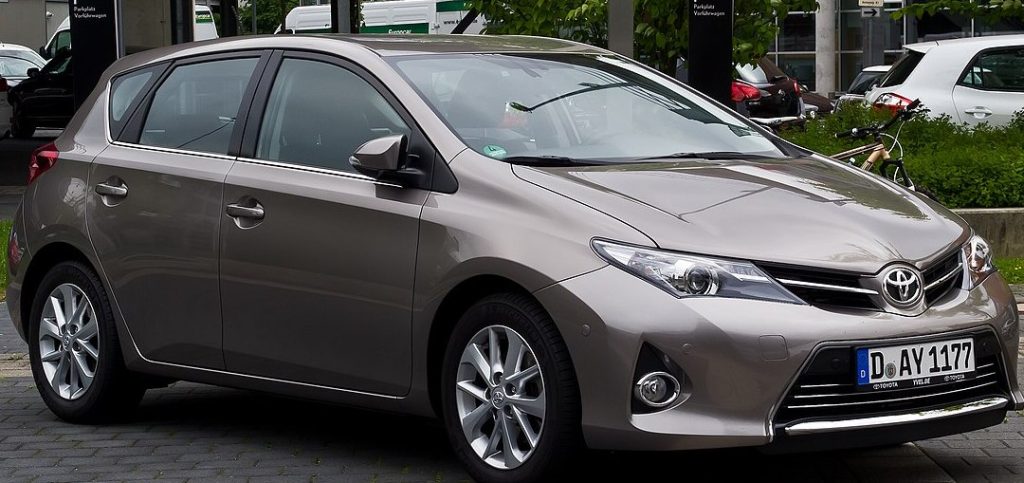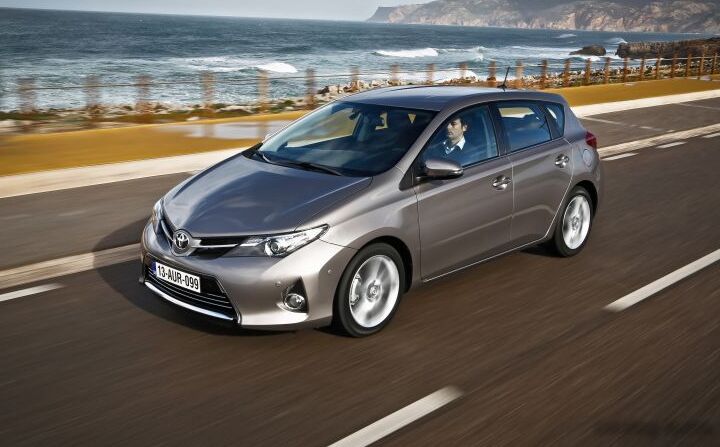
The Toyota Auris II 1.6 Valvematic (132 hp) Multidrive S, produced between 2012 and 2015, represented a key offering in Toyota’s European C-segment hatchback lineup. Positioned as a mid-range trim, it aimed to balance fuel efficiency with acceptable performance, appealing to buyers seeking a practical and economical family car. This variant was a significant part of the E180 series Auris, built on the New Global Architecture (NGA) platform, and served as a bridge between the more basic 1.33L models and the more powerful, though less fuel-efficient, options. The Multidrive S transmission, Toyota’s continuously variable transmission (CVT), was a central feature of this configuration, designed to optimize fuel consumption and provide smooth acceleration.
Technical Specifications
| Brand | Toyota |
| Model | Auris |
| Generation | Auris II |
| Type (Engine) | 1.6 Valvematic (132 Hp) Multidrive S |
| Start of production | 2012 |
| End of production | 2015 |
| Powertrain Architecture | Internal Combustion engine |
| Body type | Hatchback |
| Seats | 5 |
| Doors | 5 |
| Fuel consumption (economy) – urban (NEDC) | 7.4 l/100 km (31.8 US mpg, 38.2 UK mpg, 13.5 km/l) |
| Fuel consumption (economy) – extra urban (NEDC) | 4.8 l/100 km (49 US mpg, 58.9 UK mpg, 20.8 km/l) |
| Fuel consumption (economy) – combined (NEDC) | 5.7 l/100 km (41.3 US mpg, 49.6 UK mpg, 17.5 km/l) |
| CO2 emissions (NEDC) | 134 g/km |
| Fuel Type | Petrol (Gasoline) |
| Acceleration 0 – 100 km/h | 11.1 sec |
| Acceleration 0 – 62 mph | 11.1 sec |
| Acceleration 0 – 60 mph | 10.5 sec |
| Maximum speed | 190 km/h (118.06 mph) |
| Emission standard | Euro 5 |
| Weight-to-power ratio | 9.1 kg/Hp, 109.5 Hp/tonne |
| Weight-to-torque ratio | 7.5 kg/Nm, 132.8 Nm/tonne |
| Power | 132 Hp @ 6400 rpm |
| Power per litre | 82.6 Hp/l |
| Torque | 160 Nm @ 4400 rpm (118.01 lb.-ft. @ 4400 rpm) |
| Engine layout | Front, Transverse |
| Engine Model/Code | 1ZR-FAE |
| Engine displacement | 1598 cm3 (97.52 cu. in.) |
| Number of cylinders | 4 |
| Engine configuration | Inline |
| Cylinder Bore | 80.5 mm (3.17 in.) |
| Piston Stroke | 78.5 mm (3.09 in.) |
| Compression ratio | 10.7:1 |
| Number of valves per cylinder | 4 |
| Fuel injection system | Multi-port manifold injection |
| Engine aspiration | Naturally aspirated engine |
| Valvetrain | DOHC, Valvematic |
| Engine oil capacity | 4.2 l (4.44 US qt | 3.7 UK qt) |
| Coolant | 5.8 l (6.13 US qt | 5.1 UK qt) |
| Kerb Weight | 1205-1360 kg (2656.57 – 2998.29 lbs.) |
| Max. weight | 1830 kg (4034.46 lbs.) |
| Max load | 470-625 kg (1036.17 – 1377.89 lbs.) |
| Trunk (boot) space – minimum | 360 l (12.71 cu. ft.) |
| Trunk (boot) space – maximum | 1200 l (42.38 cu. ft.) |
| Fuel tank capacity | 50 l (13.21 US gal | 11 UK gal) |
| Max. roof load | 75 kg (165.35 lbs.) |
| Permitted trailer load with brakes (12%) | 1300 kg (2866.01 lbs.) |
| Permitted trailer load without brakes | 450 kg (992.08 lbs.) |
| Permitted towbar download | 55 kg (121.25 lbs.) |
| Length | 4275 mm (168.31 in.) |
| Width | 1760 mm (69.29 in.) |
| Height | 1460 mm (57.48 in.) |
| Wheelbase | 2600 mm (102.36 in.) |
| Front track | 1515-1535 mm (59.65 – 60.43 in.) |
| Rear (Back) track | 1510-1535 mm (59.45 – 60.43 in.) |
| Minimum turning circle (turning diameter) | 11 m (36.09 ft.) |
| Drivetrain Architecture | The Internal combustion engine (ICE) drives the front wheels of the vehicle. |
| Drive wheel | Front wheel drive |
| Number of gears and type of gearbox | automatic transmission Multidrive S |
| Front suspension | Independent, type McPherson with coil spring and anti-roll bar |
| Rear suspension | Double wishbone |
| Front brakes | Ventilated discs |
| Rear brakes | Disc |
| Assisting systems | ABS (Anti-lock braking system) |
| Steering type | Steering rack and pinion |
| Power steering | Electric Steering |
| Tires size | 195/65 R15; 205/55 R16; 225/45 R17 |
| Wheel rims size | 6J x 15; 6.5J x 16; 7J x 17 |
Powertrain & Engine Architecture
The heart of this Auris variant is the 1ZR-FAE 1.6-liter inline-four engine. This engine utilizes Toyota’s Valvematic technology, a variable valve lift system that continuously adjusts the intake valve lift and timing to optimize engine efficiency and performance. Unlike traditional variable valve timing systems that only alter valve timing, Valvematic directly controls the lift amount, resulting in improved fuel economy and a broader torque curve. The engine employs multi-port fuel injection and a compression ratio of 10.7:1. The Multidrive S transmission is a CVT, offering stepless gear ratios. It simulates traditional automatic gear changes but provides a smoother, more efficient driving experience. It’s important to note that while marketed as an automatic, the Multidrive S operates differently than a conventional torque-converter automatic; it relies more on a belt-and-pulley system.
Driving Characteristics
The 1.6 Valvematic with the Multidrive S transmission delivers a comfortable, if not particularly sporty, driving experience. Acceleration from 0-60 mph takes around 10.5 seconds, and top speed is 190 km/h (118 mph). The CVT tends to hold the engine at its optimal RPM for efficiency, which can sometimes result in a “rubber band” feel during hard acceleration, where engine speed rises without a corresponding immediate increase in vehicle speed. Compared to the manual transmission versions of the 1.6L, the Multidrive S prioritizes fuel economy over outright performance. Higher-spec Auris models equipped with the 1.8L engine offered significantly more power and a more engaging driving experience, but at the cost of increased fuel consumption. The gear ratios in the Multidrive S are continuously adjusted to maintain optimal engine speed, contributing to its fuel efficiency.
Equipment & Trim Levels
The 1.6 Valvematic Multidrive S trim typically included standard features such as air conditioning, power windows, power mirrors, a CD player with auxiliary input, and ABS brakes. Higher trim levels added features like alloy wheels, a touchscreen infotainment system, rear parking sensors, and automatic climate control. Interior upholstery was generally cloth, with options for upgraded materials available. The dashboard layout was functional and straightforward, prioritizing ease of use over stylistic flair.
Chassis & Braking
The Auris II utilized a McPherson strut front suspension and a double wishbone rear suspension. This setup provided a comfortable ride quality, suitable for everyday driving. Braking consisted of ventilated discs at the front and solid discs at the rear. ABS was standard. Stabilizer bars were fitted to both the front and rear axles to reduce body roll during cornering. The weight of the vehicle, ranging from 1205 to 1360 kg depending on equipment, influenced the suspension tuning and braking performance.
Market Reception & Comparison
The Auris II 1.6 Valvematic Multidrive S was generally well-received by critics as a practical and economical family car. Its fuel economy of around 5.7 l/100 km (41.3 US mpg) was a major selling point. However, some reviewers found the CVT transmission to be less engaging than a traditional automatic or manual gearbox. Compared to the 1.33L Auris, the 1.6L offered noticeably more power and refinement. Against competitors like the Volkswagen Golf and Ford Focus, the Auris offered a competitive level of equipment and fuel efficiency, but often lacked the same level of driving dynamics.
Legacy
The 1ZR-FAE engine and Multidrive S transmission have proven to be relatively reliable powertrains. Common issues are generally limited to routine maintenance items, such as oil leaks and CVT fluid changes. The Multidrive S transmission requires regular fluid changes to maintain optimal performance and prevent premature wear. On the used car market, the Auris II 1.6 Valvematic Multidrive S represents a good value proposition for buyers seeking a reliable and fuel-efficient hatchback. Its reputation for dependability and low running costs continues to make it a popular choice.