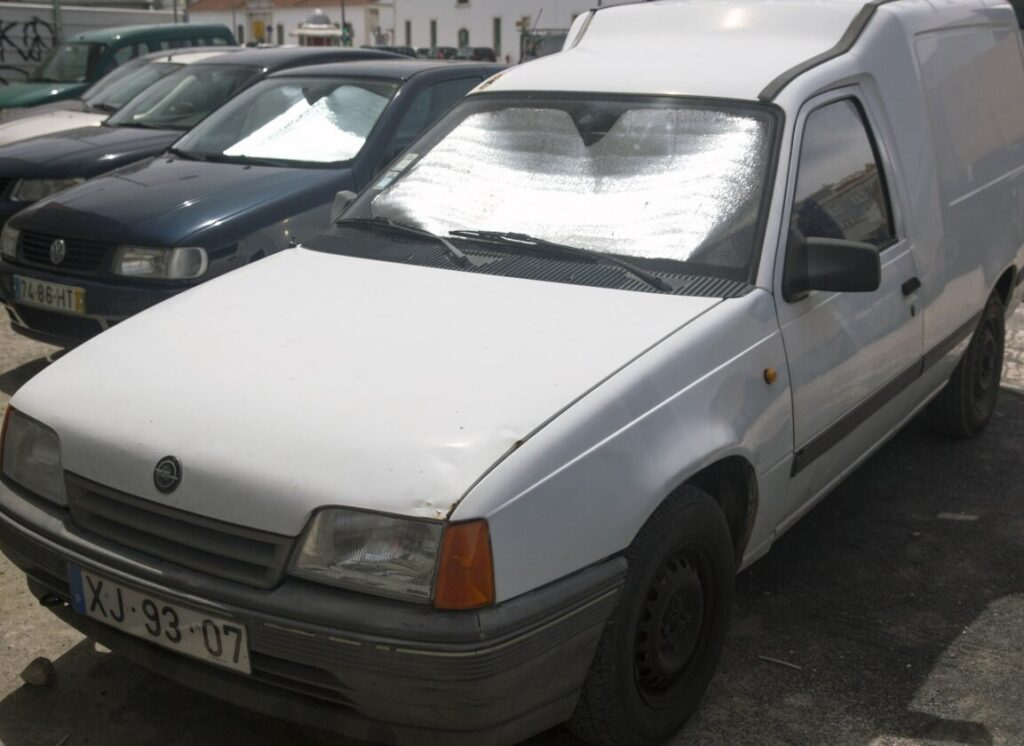
The Opel Kadett E Combo 1.4i, produced between 1991 and 1993, represented a practical and affordable entry point into the compact station wagon segment in Europe. Part of the broader Kadett E range (1986-1993), the Combo variant was specifically designed as a light commercial vehicle, offering a spacious cargo area combined with the Kadett’s reliable, if modest, mechanicals. It served as a popular choice for small businesses and individuals needing a versatile vehicle for both work and leisure. The Kadett E platform itself was a significant step forward for Opel, offering improved aerodynamics, interior space, and build quality compared to its predecessor, the Kadett D.
Technical Specifications
| Brand | Opel |
| Model | Kadett |
| Generation | Kadett E Combo |
| Type (Engine) | 1.4i (60 Hp) |
| Start of production | August, 1991 |
| End of production | 1993 |
| Powertrain Architecture | Internal Combustion engine |
| Body type | Station wagon (estate) |
| Seats | 2 |
| Doors | 3 |
| Fuel Type | Petrol (Gasoline) |
| Power | 60 Hp @ 5600 rpm |
| Power per litre | 43.2 Hp/l |
| Torque | 103 Nm @ 2600 rpm (75.97 lb.-ft. @ 2600 rpm) |
| Engine layout | Front, Transverse |
| Engine Model/Code | C14NZ |
| Engine displacement | 1389 cm3 (84.76 cu. in.) |
| Number of cylinders | 4 |
| Engine configuration | Inline |
| Cylinder Bore | 77.6 mm (3.06 in.) |
| Piston Stroke | 73.4 mm (2.89 in.) |
| Compression ratio | 9.4:1 |
| Number of valves per cylinder | 2 |
| Fuel injection system | Multi-port manifold injection |
| Engine aspiration | Naturally aspirated engine |
| Valvetrain | SOHC |
| Engine oil capacity | 3 l (3.17 US qt | 2.64 UK qt) |
| Coolant | 6.2 l (6.55 US qt | 5.46 UK qt) |
| Trunk (boot) space – maximum | 2450 l (86.52 cu. ft.) |
| Length | 4221 mm (166.18 in.) |
| Width | 1674 mm (65.91 in.) |
| Height | 1670 mm (65.75 in.) |
| Wheelbase | 2530 mm (99.61 in.) |
| Drivetrain Architecture | The Internal combustion engine (ICE) drives the front wheels of the vehicle. |
| Drive wheel | Front wheel drive |
| Number of gears and type of gearbox | 5 gears, manual transmission |
Powertrain & Engine Architecture
The Kadett E Combo 1.4i was powered by the C14NZ engine, a 1.4-liter inline-four cylinder gasoline engine. This engine was a relatively simple design, featuring a single overhead camshaft (SOHC) and two valves per cylinder. The C14NZ utilized multi-port fuel injection, a significant improvement over earlier carbureted Opel engines, contributing to better fuel efficiency and smoother operation. The engine’s 60 horsepower output at 5600 rpm and 103 Nm (75.97 lb-ft) of torque at 2600 rpm were modest, but adequate for the Combo’s intended purpose as a light commercial vehicle. The engine was known for its durability and relatively low maintenance requirements. The standard transmission was a five-speed manual gearbox, optimized for fuel economy and providing reasonable acceleration for everyday driving. An automatic transmission was not offered with this specific engine configuration.
Driving Characteristics
The driving experience in the Kadett E Combo 1.4i was characterized by its practicality rather than performance. The 60 horsepower engine provided sufficient power for urban driving and moderate highway speeds, but acceleration was slow, particularly when fully loaded. The five-speed manual transmission allowed drivers to keep the engine in its optimal power band, but frequent gear changes were often necessary, especially when climbing hills. The front-wheel-drive layout provided predictable handling, although the suspension was tuned for comfort rather than sporty handling. Compared to the more powerful Kadett E variants, such as the 1.6 or 2.0-liter models, the 1.4i felt noticeably underpowered. However, this was offset by its superior fuel economy and lower running costs.
Equipment & Trim Levels
The Kadett E Combo 1.4i was typically offered with a basic level of equipment, reflecting its positioning as a work-oriented vehicle. Standard features generally included a simple dashboard layout, cloth upholstery, and basic instrumentation. Power steering and central locking were often optional extras. The interior was designed for durability and ease of cleaning, with hard-wearing plastics and minimal ornamentation. The focus was on functionality rather than luxury. The Combo’s defining feature was its large cargo area, accessible through a rear tailgate. The rear seats could be folded down to create a flat load floor, maximizing cargo capacity.
Chassis & Braking
The Kadett E Combo utilized a MacPherson strut front suspension and a twist-beam rear suspension. This setup provided a comfortable ride, but wasn’t particularly sophisticated. Braking was typically accomplished with disc brakes on the front wheels and drum brakes on the rear. The braking system was adequate for the vehicle’s weight and performance, but lacked the stopping power of more advanced systems found on higher-end vehicles. Stabilizer bars were often omitted on the base models to keep costs down, further contributing to a softer, less controlled ride.
Market Reception & Comparison
The Kadett E Combo 1.4i was generally well-received in the European market as a practical and affordable light commercial vehicle. Critics praised its spacious cargo area, fuel efficiency, and reliability. However, the engine’s lack of power was a common criticism. Compared to other small station wagons of the time, such as the Ford Escort Estate or the Volkswagen Golf Estate, the Kadett E Combo offered a more utilitarian interior and a lower price point. The 1.6-liter Kadett E offered significantly more performance, but at a higher cost. The diesel-powered Kadett E models provided better fuel economy, but were slower and noisier.
Legacy
The Opel Kadett E Combo 1.4i, while not a performance icon, remains a fondly remembered vehicle for many European drivers. The C14NZ engine proved to be remarkably durable, and many examples are still on the road today. In the used car market, the Kadett E Combo 1.4i is valued for its simplicity, affordability, and practicality. Its robust construction and readily available spare parts make it a relatively easy vehicle to maintain. The Kadett E Combo represents a significant chapter in Opel’s history, showcasing the brand’s commitment to providing affordable and reliable transportation for a wide range of customers.