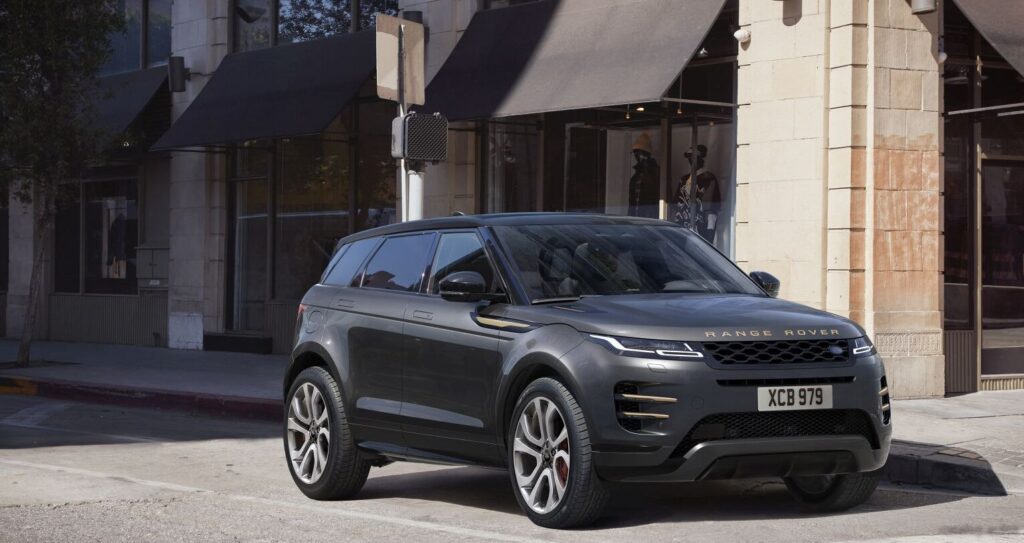
The Land Rover Range Rover Evoque II 2.0 D165 (163 hp) represents a key variant within the second generation of the Evoque, produced from August 2020 through 2023. Positioned as an entry-level diesel option, it aimed to balance fuel efficiency with the Range Rover brand’s signature luxury and capability. This model played a significant role in the European market, where diesel engines remained popular due to favorable taxation and fuel economy. It offered a more accessible price point compared to the higher-powered Ingenium engines, targeting buyers prioritizing practicality and running costs over outright performance. The Evoque II, built on the Premium Transverse Architecture (PTA), represented a substantial upgrade over the first-generation model, offering increased refinement, technology, and interior space.
Technical Specifications
| Brand | Land Rover |
| Model | Range Rover Evoque |
| Generation | Range Rover Evoque II |
| Type (Engine) | 2.0 D165 (163 Hp) |
| Start of production | August, 2020 |
| End of production | 2023 |
| Powertrain Architecture | Internal Combustion engine |
| Body type | SUV |
| Seats | 5 |
| Doors | 5 |
| Combined fuel consumption (WLTP) | 6.0-6.5 l/100 km (39.2 – 36.2 US mpg, 47.1 – 43.5 UK mpg, 16.7 – 15.4 km/l) |
| CO2 emissions (WLTP) | 158-170 g/km |
| Fuel consumption (NEDC, WLTP equivalent) | 5.0 l/100 km (47 US mpg, 56.5 UK mpg, 20 km/l) |
| CO2 emissions (NEDC, WLTP equivalent) | 131 g/km |
| Fuel Type | Diesel |
| Acceleration 0 – 100 km/h | 10.1 sec |
| Acceleration 0 – 62 mph | 10.1 sec |
| Acceleration 0 – 60 mph | 9.5 sec |
| Maximum speed | 206 km/h (128 mph) |
| Emission standard | Euro 6 |
| Weight-to-power ratio | 10.5 kg/Hp, 95.2 Hp/tonne |
| Weight-to-torque ratio | 4.5 kg/Nm, 222 Nm/tonne |
| Power | 163 Hp @ 3750 rpm |
| Power per litre | 81.6 Hp/l |
| Torque | 380 Nm @ 1500-2500 rpm (280.27 lb.-ft. @ 1500-2500 rpm) |
| Engine layout | Front, Transverse |
| Engine Model/Code | Ingenium / 204DTY |
| Engine displacement | 1997 cm3 (121.86 cu. in.) |
| Number of cylinders | 4 |
| Engine configuration | Inline |
| Cylinder Bore | 83 mm (3.27 in.) |
| Piston Stroke | 92.3 mm (3.63 in.) |
| Compression ratio | 16.5:1 |
| Number of valves per cylinder | 4 |
| Fuel injection system | Diesel Commonrail |
| Engine aspiration | Turbocharger, Intercooler |
| Valvetrain | DOHC |
| Engine oil capacity | 6.5 l (6.87 US qt | 5.72 UK qt) |
| Coolant | 11.2 l (11.83 US qt | 9.85 UK qt) |
| Kerb Weight | 1712 kg (3774.31 lbs.) |
| Trunk (boot) space – minimum | 591 l (20.87 cu. ft.) |
| Trunk (boot) space – maximum | 1383 l (48.84 cu. ft.) |
| Fuel tank capacity | 65 l (17.17 US gal | 14.3 UK gal) |
| AdBlue tank | 17.3 l (4.57 US gal | 3.81 UK gal) |
| Permitted trailer load with brakes (12%) | 1600 kg (3527.4 lbs.) |
| Permitted trailer load without brakes | 750 kg (1653.47 lbs.) |
| Length | 4371 mm (172.09 in.) |
| Width with mirrors folded | 1996 mm (78.58 in.) |
| Width including mirrors | 2100 mm (82.68 in.) |
| Height | 1649 mm (64.92 in.) |
| Wheelbase | 2681 mm (105.55 in.) |
| Front track | 1625-1636 mm (63.98 – 64.41 in.) |
| Rear (Back) track | 1631-1643 mm (64.21 – 64.69 in.) |
| Front overhang | 880 mm (34.65 in.) |
| Rear overhang | 810 mm (31.89 in.) |
| Ride height (ground clearance) | 212 mm (8.35 in.) |
| Drag coefficient (Cd) | 0.32 |
| Minimum turning circle (turning diameter) | 11.6 m (38.06 ft.) |
| Approach angle | 22.2-25.0° |
| Departure angle | 30.6° |
| Ramp-over (brakeover) angle | 20.7° |
| Wading depth | 530 mm (20.87 in.) |
| Drivetrain Architecture | The Internal combustion engine (ICE) drives the front wheels of the vehicle. |
| Drive wheel | Front wheel drive |
| Number of gears and type of gearbox | 6 gears, manual transmission |
| Front suspension | Independent type McPherson |
| Rear suspension | Independent multi-link suspension |
| Assisting systems | ABS (Anti-lock braking system) |
| Steering type | Steering rack and pinion |
| Power steering | Electric Steering |
| Wheel rims size | 17; 18 |
Powertrain & Engine Architecture
The 2.0 D165 variant utilizes Land Rover’s Ingenium engine family, specifically the 204DTY code. This is a four-cylinder, turbocharged diesel engine featuring direct injection and a sophisticated valvetrain. The Ingenium engines were designed for modularity and efficiency, allowing for a range of power outputs from a common base. The 204DTY employs a common-rail direct injection system, delivering fuel at extremely high pressures for optimized combustion. The turbocharger, coupled with an intercooler, provides increased air density for improved power and torque. The engine’s 16.5:1 compression ratio contributes to its thermal efficiency. The 6-speed manual transmission was standard on this model, offering a balance between fuel economy and driver engagement.
Driving Characteristics
The 163 hp output and 380 Nm of torque provide adequate, though not exhilarating, performance. Acceleration from 0-60 mph takes around 9.5 seconds, making it suitable for everyday driving but not particularly sporty. The manual transmission allows for greater driver control, but the relatively long gearing prioritizes fuel economy over rapid acceleration. Compared to the higher-output 204 hp diesel or the petrol variants, the D165 feels noticeably less powerful, especially when fully loaded or tackling steep inclines. However, the torque delivery is strong from low RPMs, making it easy to drive in urban environments and on winding roads.
Equipment & Trim Levels
The 2.0 D165 typically came equipped with a respectable level of standard features, including automatic headlights, rain-sensing wipers, and a touchscreen infotainment system with Apple CarPlay and Android Auto compatibility. Interior upholstery was generally cloth, with options for leather upgrades. Standard safety features included multiple airbags, ABS, and stability control. Common optional extras included a panoramic sunroof, heated seats, and upgraded audio systems. Trim levels varied by market, but generally, the D165 sat within the lower to mid-range of the Evoque II lineup.
Chassis & Braking
The Evoque II utilizes an independent McPherson strut front suspension and an independent multi-link rear suspension, providing a comfortable ride quality. The D165 variant typically featured disc brakes on the front wheels and drum brakes on the rear, a cost-saving measure compared to the all-disc setups found on higher-spec models. The electric power steering offers a light and precise feel. Stabilizer bars are fitted to both the front and rear axles to reduce body roll during cornering.
Market Reception & Comparison
The Range Rover Evoque II 2.0 D165 was generally well-received as a practical and efficient option within the Evoque range. Critics praised its fuel economy and comfortable ride, but some noted its lack of outright performance compared to more powerful variants. Compared to the 204 hp diesel, the D165 offered lower running costs but sacrificed some driving enjoyment. Against petrol-powered Evoques, the D165 provided superior fuel economy, making it a popular choice for drivers covering long distances.
Legacy
The Ingenium engine family has proven to be relatively reliable, although some owners have reported issues with the diesel particulate filter (DPF), particularly on vehicles used primarily for short journeys. The 2.0 D165 variant remains a popular choice on the used car market due to its affordability and fuel efficiency. Its blend of Range Rover style, practicality, and reasonable running costs continues to appeal to a wide range of buyers. Regular maintenance, including timely oil changes and DPF regeneration, is crucial for ensuring the long-term reliability of this powertrain.