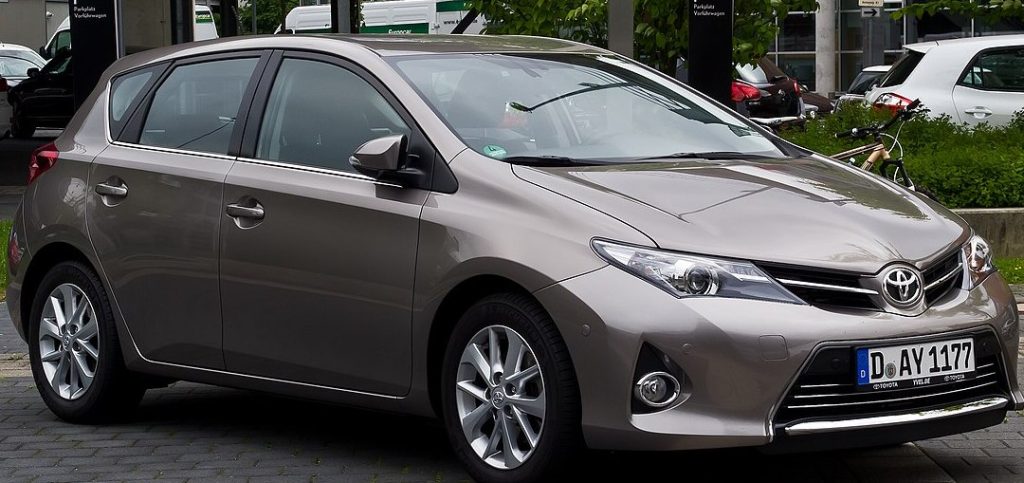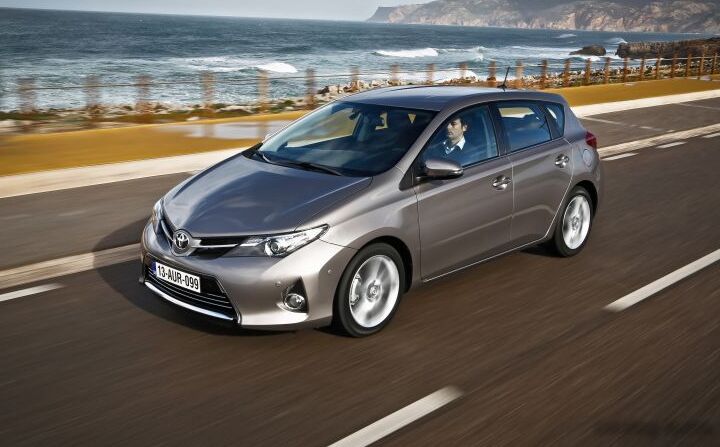
The Toyota Auris II 1.8 VVT-i Hybrid, produced from 2012 to 2015, represented a significant step forward in Toyota’s hybrid technology within the European compact hatchback market. Positioned as a mid-range offering within the Auris II lineup, it aimed to provide a balance between fuel efficiency, practicality, and reasonable performance. This variant utilized Toyota’s Hybrid Synergy Drive system, combining a 1.8-liter gasoline engine with an electric motor to deliver improved fuel economy and reduced emissions compared to conventional petrol-powered Auris models. The Auris II itself was a crucial model for Toyota in Europe, designed to appeal to a broader customer base than its predecessor and compete effectively with established rivals like the Volkswagen Golf and Ford Focus.
Technical Specifications
| Brand | Toyota |
| Model | Auris |
| Generation | Auris II |
| Type (Engine) | 1.8 VVT-i (136 Hp) Hybrid e-CVT |
| Start of production | 2012 |
| End of production | 2015 |
| Powertrain Architecture | FHEV (Full Hybrid Electric Vehicle) |
| Body type | Hatchback |
| Seats | 5 |
| Doors | 5 |
| Fuel consumption (urban) | 3.7-3.9 l/100 km (63.6 – 60.3 US mpg) |
| Fuel consumption (extra urban) | 3.7-3.9 l/100 km (63.6 – 60.3 US mpg) |
| Fuel consumption (combined) | 3.8-3.9 l/100 km (61.9 – 60.3 US mpg) |
| CO2 emissions | 87-91 g/km |
| Fuel Type | Petrol (Gasoline) |
| Acceleration 0 – 100 km/h | 10.9 sec |
| Acceleration 0 – 62 mph | 10.9 sec |
| Acceleration 0 – 60 mph | 10.4 sec |
| Maximum speed | 180 km/h (111.85 mph) |
| Emission standard | Euro 5 |
| Weight-to-power ratio | 10 kg/Hp |
| Weight-to-torque ratio | 9.5 kg/Nm |
| All-electric range | 1.5 km (0.93 mi) |
| Max speed (electric) | 50 km/h (31.07 mph) |
| Electric motor power | 82 Hp |
| Electric motor Torque | 207 Nm (152.68 lb.-ft.) |
| System power | 136 Hp |
| Engine Power | 99 Hp @ 5200 rpm |
| Engine Torque | 142 Nm @ 4000 rpm (104.73 lb.-ft. @ 4000 rpm) |
| Engine displacement | 1798 cm3 (109.72 cu. in.) |
| Number of cylinders | 4 |
| Cylinder Bore | 80.5 mm (3.17 in.) |
| Piston Stroke | 88.3 mm (3.48 in.) |
| Fuel injection system | Multi-port manifold injection |
| Engine oil capacity | 4.2 l (4.44 US qt | 3.7 UK qt) |
| Coolant capacity | 6.3 l (6.66 US qt | 5.54 UK qt) |
| Kerb Weight | 1355 kg (2987.26 lbs.) |
| Max. weight | 1815-1840 kg (4001.39 – 4056.51 lbs.) |
| Max load | 460-485 kg (1014.13 – 1069.24 lbs.) |
| Trunk (boot) space (min) | 360 l (12.71 cu. ft.) |
| Trunk (boot) space (max) | 1200 l (42.38 cu. ft.) |
| Fuel tank capacity | 45 l (11.89 US gal | 9.9 UK gal) |
| Length | 4275 mm (168.31 in.) |
| Width | 1760 mm (69.29 in.) |
| Height | 1460 mm (57.48 in.) |
| Wheelbase | 2600 mm (102.36 in.) |
| Front track | 1515-1535 mm (59.65 – 60.43 in.) |
| Rear track | 1505-1525 mm (59.25 – 60.04 in.) |
| Drivetrain | Front wheel drive, e-CVT |
| Front suspension | Independent type McPherson |
| Rear suspension | Double wishbone |
| Front brakes | Ventilated discs |
| Rear brakes | Disc |
| Tires size | 195/65 R15; 225/45 R17 |
Powertrain & Engine Architecture
At the heart of the Auris 1.8 Hybrid lies Toyota’s 2ZR-FXE 1.8-liter inline-four gasoline engine. This engine utilizes Toyota’s Valvematic technology, a continuously variable valve lift system, to optimize engine efficiency and responsiveness. The engine produces 99 horsepower at 5200 rpm and 142 Nm of torque at 4000 rpm. Crucially, it’s paired with Toyota’s Hybrid Synergy Drive, which incorporates an 82 horsepower electric motor. The system doesn’t use traditional gears; instead, it employs an electronically controlled continuously variable transmission (e-CVT). This e-CVT cleverly blends the power from the gasoline engine and the electric motor, or utilizes either one independently, to provide smooth and efficient acceleration. The engine is naturally aspirated and features multi-port fuel injection.
Driving Characteristics
The 1.8 Hybrid Auris delivers a distinctly different driving experience compared to its conventionally powered siblings. Acceleration, while not sporty (0-60 mph in approximately 10.4 seconds), is adequate for everyday driving. The e-CVT provides seamless acceleration, lacking the stepped shifts of a traditional automatic transmission. The electric motor provides instant torque, particularly at lower speeds, contributing to a responsive feel in urban environments. In hybrid mode, the system intelligently switches between gasoline and electric power, prioritizing fuel efficiency. The car can operate in EV mode at low speeds for short distances (around 1.5 km), further reducing emissions. Compared to the 1.6L petrol versions, the hybrid offered significantly better fuel economy, but at the cost of some outright performance. The higher-output 1.8L petrol models provided more spirited acceleration, but lacked the hybrid’s fuel-saving capabilities.
Equipment & Trim Levels
The 1.8 Hybrid trim typically included a generous level of standard equipment. Features commonly included air conditioning, a touchscreen infotainment system with Bluetooth connectivity, alloy wheels, and a suite of safety features such as ABS, traction control, and multiple airbags. Higher trim levels offered upgrades like automatic climate control, parking sensors, a rearview camera, and upgraded upholstery. Interior materials were generally of good quality, reflecting Toyota’s reputation for build quality. The dashboard layout was functional and user-friendly, prioritizing ease of use.
Chassis & Braking
The Auris II utilized a front-wheel-drive layout with an independent McPherson strut suspension at the front and a double wishbone suspension at the rear. This setup provided a comfortable ride quality, absorbing bumps and imperfections in the road effectively. Braking duties were handled by ventilated discs at the front and solid discs at the rear, providing adequate stopping power. The car featured electric power steering, offering light and precise steering feel. Stabilizer bars were fitted to both the front and rear axles to reduce body roll during cornering.
Market Reception & Comparison
The Toyota Auris 1.8 Hybrid was generally well-received by automotive critics. Its exceptional fuel economy and low emissions were consistently praised. However, some reviewers noted that the driving experience wasn’t particularly engaging, and the acceleration wasn’t as brisk as some competitors. Compared to the 1.6L petrol Auris, the hybrid offered a significant improvement in fuel efficiency, but came at a higher price point. Against rivals like the Volkswagen Golf BlueMotion, the Auris Hybrid offered comparable fuel economy and a similar level of refinement. Reliability was a strong point, as expected from Toyota, contributing to its popularity in the used car market.
Legacy
The Toyota Auris II 1.8 Hybrid powertrain has proven to be remarkably reliable over the long term. The Hybrid Synergy Drive system is known for its durability, and many examples have exceeded 200,000 miles with minimal issues. The hybrid battery pack, while a potential concern for some buyers, has demonstrated a good lifespan, often lasting well over 10 years. In the used car market, the Auris 1.8 Hybrid remains a popular choice for buyers seeking a fuel-efficient and reliable compact hatchback. Its reputation for low running costs and Toyota’s strong brand image continue to make it a desirable option.