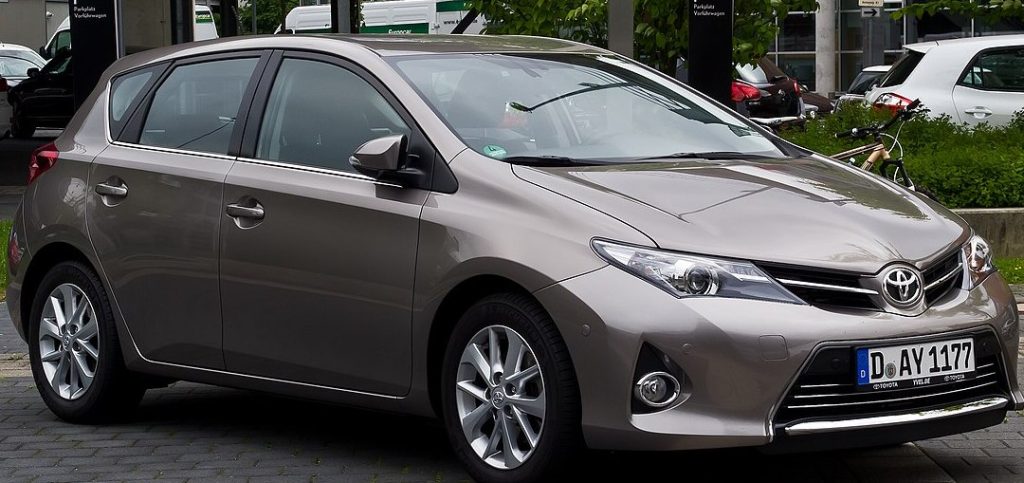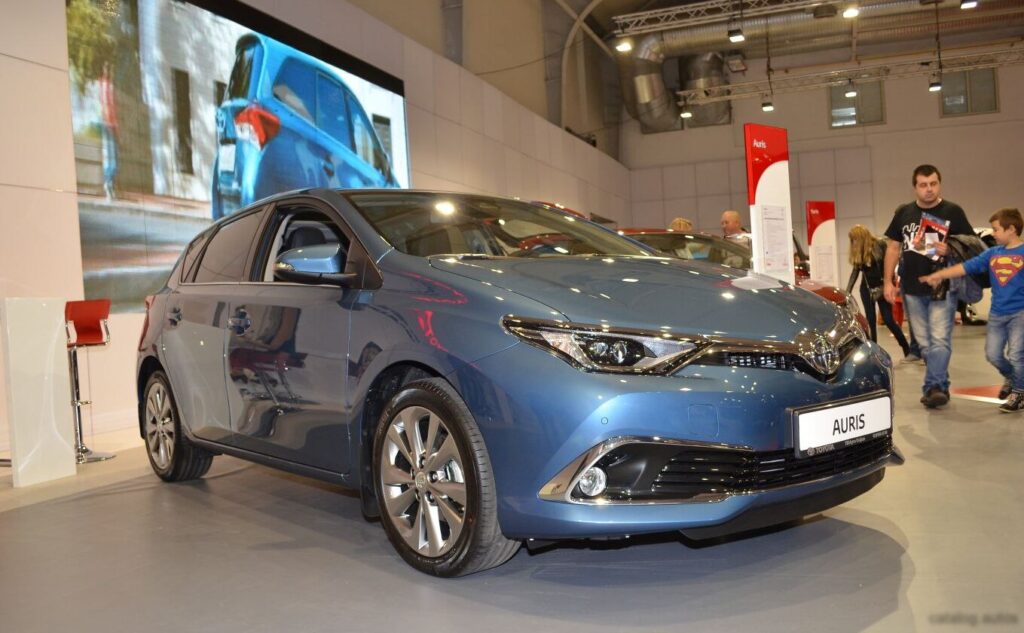
The Toyota Auris II, specifically the 1.2-liter (116 horsepower) variant with Start&Stop technology produced from 2015 to 2018, represented a key offering in Toyota’s European compact hatchback lineup. This iteration of the Auris, a facelift of the second-generation model (introduced in 2012), aimed to balance fuel efficiency with reasonable performance, targeting buyers seeking a practical and economical daily driver. Positioned as a mid-range option, it sat between the base 1.2L manual and the more powerful 1.6L engine choices. The Auris II competed directly with vehicles like the Volkswagen Golf, Ford Focus, and Opel Astra in the highly competitive C-segment.
Technical Specifications
| Brand | Toyota |
| Model | Auris |
| Generation | Auris II (facelift 2015) |
| Type (Engine) | 1.2 (116 Hp) start&stop |
| Start of production | 2015 |
| End of production | 2018 |
| Powertrain Architecture | Internal Combustion engine |
| Body type | Hatchback |
| Seats | 5 |
| Doors | 5 |
| Fuel consumption (urban) | 6.5 l/100 km (36.2 US mpg, 43.5 UK mpg, 15.4 km/l) |
| Fuel consumption (extra urban) | 4.8 l/100 km (49 US mpg, 58.9 UK mpg, 20.8 km/l) |
| Fuel consumption (combined) | 4.8 l/100 km (49 US mpg, 58.9 UK mpg, 20.8 km/l) |
| CO2 emissions | 112 g/km |
| Fuel Type | Petrol (Gasoline) |
| Acceleration 0 – 100 km/h | 10.1 sec |
| Acceleration 0 – 62 mph | 10.1 sec |
| Acceleration 0 – 60 mph | 9.6 sec |
| Maximum speed | 200 km/h (124.27 mph) |
| Emission standard | Euro 6 W |
| Weight-to-power ratio | 10.9 kg/Hp, 91.7 Hp/tonne |
| Weight-to-torque ratio | 6.8 kg/Nm, 146.2 Nm/tonne |
| Power | 116 Hp @ 5200 rpm |
| Power per litre | 96.9 Hp/l |
| Torque | 185 Nm @ 1500-4000 rpm (136.45 lb.-ft. @ 1500-4000 rpm) |
| Engine layout | Front, Transverse |
| Engine Model/Code | 8NR-FTS |
| Engine displacement | 1197 cm3 (73.05 cu. in.) |
| Number of cylinders | 4 |
| Engine configuration | Inline |
| Compression ratio | 10:1 |
| Number of valves per cylinder | 4 |
| Fuel injection system | Direct injection |
| Engine aspiration | Turbocharger, Intercooler |
| Valvetrain | DOHC |
| Engine oil capacity | 4 l (4.23 US qt | 3.52 UK qt) |
| Coolant capacity | 6.2 l (6.55 US qt | 5.46 UK qt) |
| Kerb Weight | 1265-1425 kg (2788.85 – 3141.59 lbs.) |
| Max. weight | 1805 kg (3979.34 lbs.) |
| Max load | 380-540 kg (837.76 – 1190.5 lbs.) |
| Trunk (boot) space – minimum | 360 l (12.71 cu. ft.) |
| Fuel tank capacity | 50 l (13.21 US gal | 11 UK gal) |
| Max. roof load | 75 kg (165.35 lbs.) |
| Permitted trailer load with brakes (12%) | 1300 kg (2866.01 lbs.) |
| Permitted trailer load without brakes | 450 kg (992.08 lbs.) |
| Permitted towbar download | 55 kg (121.25 lbs.) |
| Length | 4330 mm (170.47 in.) |
| Width | 1760 mm (69.29 in.) |
| Height | 1475 mm (58.07 in.) |
| Wheelbase | 2600 mm (102.36 in.) |
| Front track | 1515 mm (59.65 in.) |
| Rear track | 1515 mm (59.65 in.) |
| Minimum turning circle | 11.0 m (36.09 ft.) |
| Drivetrain Architecture | Front wheel drive |
| Number of gears | 6 gears, manual transmission |
| Front suspension | Independent, type McPherson with coil spring and anti-roll bar |
| Rear suspension | Double wishbone |
| Front brakes | Disc |
| Rear brakes | Disc |
| Assisting systems | ABS (Anti-lock braking system) |
| Steering type | Steering rack and pinion |
| Power steering | Electric Steering |
| Tires size | 205/55 R16 |
| Wheel rims size | 6.5J x 16 |
Powertrain & Engine Architecture
The heart of this Auris variant is the 8NR-FTS engine, a 1.2-liter turbocharged inline-four cylinder gasoline engine. This engine is part of Toyota’s ‘New Global Architecture’ (NGA) engine family, designed for efficiency and reduced emissions. The 8NR-FTS utilizes direct fuel injection and a twin-scroll turbocharger with an intercooler to deliver a balance of power and fuel economy. The engine’s DOHC (Double Overhead Camshaft) valvetrain, with four valves per cylinder, contributes to its responsiveness. The Start&Stop system, standard on this model, automatically shuts off the engine when the vehicle is stationary (e.g., at traffic lights) to further reduce fuel consumption and emissions. The engine is transversely mounted at the front of the vehicle. The 6-speed manual transmission was the standard offering, providing drivers with direct control over gear selection.
Driving Characteristics
The 1.2-liter turbocharged engine provides adequate performance for everyday driving. While not particularly sporty, the 116 horsepower and 185 Nm (136 lb-ft) of torque offer sufficient power for merging onto highways and overtaking slower traffic. The turbocharger provides a noticeable boost in power from around 1500 rpm, offering a relatively flat torque curve that makes the engine feel responsive in most situations. Compared to the higher-output 1.6L engine, the 1.2L feels less powerful, especially at higher speeds. However, the 1.2L’s lighter weight and more efficient engine contribute to better fuel economy. The 6-speed manual transmission is well-matched to the engine, with gear ratios designed to maximize fuel efficiency and provide reasonable acceleration. The gear ratios are slightly taller than those found in the 1.6L variant, prioritizing economy over outright performance.
Equipment & Trim Levels
The 1.2-liter Auris typically came equipped with a reasonable level of standard features. These included air conditioning, power windows, power mirrors, a touchscreen infotainment system with Bluetooth connectivity, and a suite of safety features such as ABS, Vehicle Stability Control (VSC), and multiple airbags. Higher trim levels offered additional features like alloy wheels, a rearview camera, automatic climate control, and upgraded upholstery. Interior upholstery was typically cloth, with options for partial leather trim on higher-spec models. The dashboard layout was functional and straightforward, prioritizing ease of use over stylistic flair.
Chassis & Braking
The Auris II utilizes a McPherson strut front suspension and a double wishbone rear suspension, providing a comfortable and controlled ride. The suspension is tuned for comfort rather than outright sportiness, absorbing bumps and imperfections in the road effectively. Braking duties are handled by disc brakes on all four wheels, providing adequate stopping power for the vehicle’s weight and performance. ABS (Anti-lock Braking System) is standard, enhancing safety during emergency braking situations. Stabilizer bars are fitted to both the front and rear axles to reduce body roll during cornering.
Market Reception & Comparison
The 1.2-liter Auris was generally well-received by critics as a practical and economical choice in the compact hatchback segment. Its fuel efficiency was a major selling point, and its comfortable ride and reasonable level of equipment made it an appealing option for buyers seeking a reliable and affordable car. Compared to the 1.6L variant, the 1.2L offered better fuel economy but less performance. The 1.2L also tended to be slightly cheaper to insure and maintain. However, some reviewers noted that the engine could feel strained when fully loaded or driving uphill.
Legacy
The 8NR-FTS engine, found in this Auris variant, has proven to be a relatively reliable powertrain. While some early examples experienced minor issues with the turbocharger, these were generally addressed through software updates and improved manufacturing processes. Today, used examples of the 1.2-liter Auris are readily available and represent a good value for buyers seeking an economical and reliable compact hatchback. The engine’s relatively simple design and readily available parts contribute to its affordability and ease of maintenance. The Auris II, in general, has established a reputation for dependability, making it a popular choice in the used car market.