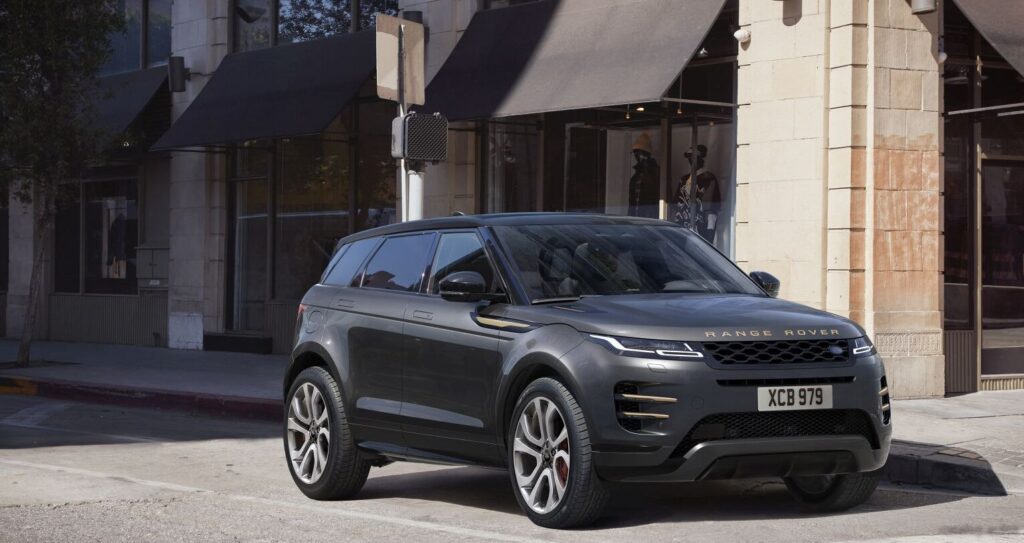
The Land Rover Range Rover Evoque II 2.0 Sd4 (240 Hp) Mild Hybrid AWD Automatic represents a significant iteration within the second generation of the Evoque, produced from 2019 to 2020. Positioned as a mid-to-upper trim level, this variant blended diesel efficiency with respectable performance and the added benefits of mild hybrid technology. It aimed to appeal to buyers seeking a premium compact SUV with all-weather capability and a more refined driving experience than the base models. The Evoque II, built on the Premium Transverse Architecture (PTA) platform, sought to improve upon the original Evoque’s success by offering increased interior space, enhanced technology, and a more sophisticated design.
Technical Specifications
| Brand | Land Rover |
| Model | Range Rover Evoque |
| Generation | Range Rover Evoque II |
| Type (Engine) | 2.0 Sd4 (240 Hp) Mild Hybrid AWD Automatic |
| Start of production | 2019 |
| End of production | 2020 |
| Powertrain Architecture | MHEV (Mild Hybrid Electric Vehicle) |
| Body type | SUV |
| Seats | 5 |
| Doors | 5 |
| Fuel consumption (combined) | 6.2 l/100 km (37.9 US mpg, 45.6 UK mpg, 16.1 km/l) |
| CO2 emissions | 163 g/km |
| Fuel Type | Diesel |
| Acceleration 0 – 100 km/h | 7.7 sec |
| Acceleration 0 – 62 mph | 7.7 sec |
| Acceleration 0 – 60 mph | 7.3 sec |
| Maximum speed | 225 km/h (139.81 mph) |
| Emission standard | Euro 6 |
| Weight-to-power ratio | 8.1 kg/Hp, 122.8 Hp/tonne |
| Weight-to-torque ratio | 3.9 kg/Nm, 255.8 Nm/tonne |
| Power | 240 Hp @ 2400 rpm |
| Power per litre | 120.1 Hp/l |
| Torque | 500 Nm @ 1500-2500 rpm (368.78 lb.-ft. @ 1500-2500 rpm) |
| Engine layout | Front, Transverse |
| Engine Model/Code | Ingenium / 204DTA |
| Engine displacement | 1999 cm3 (121.99 cu. in.) |
| Number of cylinders | 4 |
| Engine configuration | Inline |
| Cylinder Bore | 83 mm (3.27 in.) |
| Piston Stroke | 92.35 mm (3.64 in.) |
| Compression ratio | 15.5:1 |
| Number of valves per cylinder | 4 |
| Fuel injection system | Diesel Commonrail |
| Engine aspiration | Turbocharger, Intercooler |
| Valvetrain | DOHC |
| Engine oil capacity | 6.5 l (6.87 US qt | 5.72 UK qt) |
| Coolant capacity | 11.2 l (11.83 US qt | 9.85 UK qt) |
| Kerb Weight | 1955 kg (4310.04 lbs.) |
| Trunk (boot) space – minimum | 591 l (20.87 cu. ft.) |
| Trunk (boot) space – maximum | 1383 l (48.84 cu. ft.) |
| Fuel tank capacity | 65 l (17.17 US gal | 14.3 UK gal) |
| AdBlue tank capacity | 17.2 l (4.54 US gal | 3.78 UK gal) |
| Permitted trailer load with brakes (12%) | 2000 kg (4409.25 lbs.) |
| Permitted trailer load without brakes | 750 kg (1653.47 lbs.) |
| Length | 4371 mm (172.09 in.) |
| Width | 1904 mm (74.96 in.) |
| Width with mirrors folded | 1996 mm (78.58 in.) |
| Width including mirrors | 2100 mm (82.68 in.) |
| Height | 1649 mm (64.92 in.) |
| Wheelbase | 2681 mm (105.55 in.) |
| Front track | 1626 mm (64.02 in.) |
| Rear track | 1632 mm (64.25 in.) |
| Front overhang | 880 mm (34.65 in.) |
| Rear overhang | 810 mm (31.89 in.) |
| Ride height (ground clearance) | 212 mm (8.35 in.) |
| Drag coefficient (Cd) | 0.325 |
| Minimum turning circle | 11.6 m (38.06 ft.) |
| Approach angle | 25.0° |
| Departure angle | 30.6° |
| Ramp-over angle | 20.7° |
| Climb angle | 45.0° |
| Wading depth | 600 mm (23.62 in.) |
| Drive wheel | All wheel drive (4×4) |
| Number of gears | 9 |
| Gearbox type | Automatic transmission |
| Front suspension | Independent type McPherson |
| Rear suspension | Independent multi-link suspension |
| Assisting systems | ABS (Anti-lock braking system) |
| Steering type | Steering rack and pinion |
| Power steering | Electric Steering |
| Tires size | 225/65 R17; 235/65 R17; 235/60 R18; 235/50 R20; 245/45 R21 |
| Wheel rims size | 7.0J x 17; 8.0J 18; 8.0J x 20; 8.0J x 21 |
Powertrain & Engine Architecture
At the heart of the Evoque II 2.0 Sd4 lies Land Rover’s Ingenium engine family, specifically the 204DTA four-cylinder diesel. This 1999cc engine utilizes a cast aluminum block and head, designed for both efficiency and refinement. The engine employs a sophisticated turbocharger and direct injection system, delivering 240 horsepower at 2400 rpm and a substantial 500 Nm (368 lb-ft) of torque between 1500 and 2500 rpm. The “Sd4” designation indicates a single-turbo configuration. The mild hybrid system, a 48-volt setup, incorporates a Belt-integrated Starter Generator (BiSG) which assists the engine during acceleration and enables smoother start-stop functionality, improving fuel economy. The engine is paired with a ZF-sourced nine-speed automatic transmission, known for its wide gear ratios and smooth shifts. This transmission is crucial for balancing performance and fuel efficiency.
Driving Characteristics
The 2.0 Sd4 Automatic offers a comfortable and capable driving experience. While not overtly sporty, the engine provides ample torque for everyday driving and confident overtaking. The nine-speed transmission is generally responsive, although some drivers have noted occasional hesitancy in downshifts. The all-wheel-drive system provides excellent traction in various conditions, making it a suitable vehicle for inclement weather or light off-road excursions. Compared to the lower-powered diesel variants, the 240 hp version offers noticeably quicker acceleration (0-60 mph in approximately 7.3 seconds). Compared to the petrol variants, the diesel provides superior fuel economy and a more relaxed cruising experience due to the higher torque output at lower engine speeds.
Equipment & Trim Levels
The 2.0 Sd4 typically came well-equipped, often including features like leather upholstery, heated front seats, a touchscreen infotainment system with navigation, and a suite of driver-assistance technologies such as lane departure warning and autonomous emergency braking. Optional extras included a panoramic sunroof, premium audio systems, adaptive cruise control, and various cosmetic enhancements. Trim levels varied by market, but generally, the 2.0 Sd4 sat in the mid-to-upper range, offering a balance of luxury and performance. Interior materials were generally of high quality, reflecting Land Rover’s premium brand image.
Chassis & Braking
The Evoque II utilizes an independent suspension setup, with McPherson struts at the front and a multi-link system at the rear. This configuration provides a comfortable ride quality while maintaining reasonable handling characteristics. Brakes are typically disc brakes all around, providing adequate stopping power. The chassis is reinforced to handle the increased torque output of the 2.0 Sd4 engine. Stabilizer bars are fitted front and rear to reduce body roll during cornering. The Evoque’s Terrain Response system allows drivers to select different driving modes optimized for various surfaces, such as grass, gravel, snow, and mud.
Market Reception & Comparison
The Range Rover Evoque II 2.0 Sd4 was generally well-received by automotive critics. It was praised for its stylish design, comfortable interior, and capable all-wheel-drive system. The diesel engine was noted for its fuel efficiency and strong torque output. However, some reviewers criticized the infotainment system for being occasionally laggy and the ride quality for being slightly firm on certain road surfaces. Compared to competitors like the BMW X2 and Audi Q3, the Evoque offered a more distinctive design and a more luxurious interior, but often at a higher price point. The mild hybrid system was seen as a positive step towards improving fuel economy and reducing emissions.
Legacy
The Ingenium engine family has proven to be relatively reliable, although some owners have reported issues with the diesel particulate filter (DPF), particularly on vehicles used primarily for short journeys. The nine-speed automatic transmission has also been known to experience occasional software glitches, but these are typically addressed with software updates. On the used car market, the Evoque II 2.0 Sd4 holds its value reasonably well, reflecting its desirability and reputation for quality. It remains a popular choice for buyers seeking a stylish and capable compact SUV with a diesel engine.