
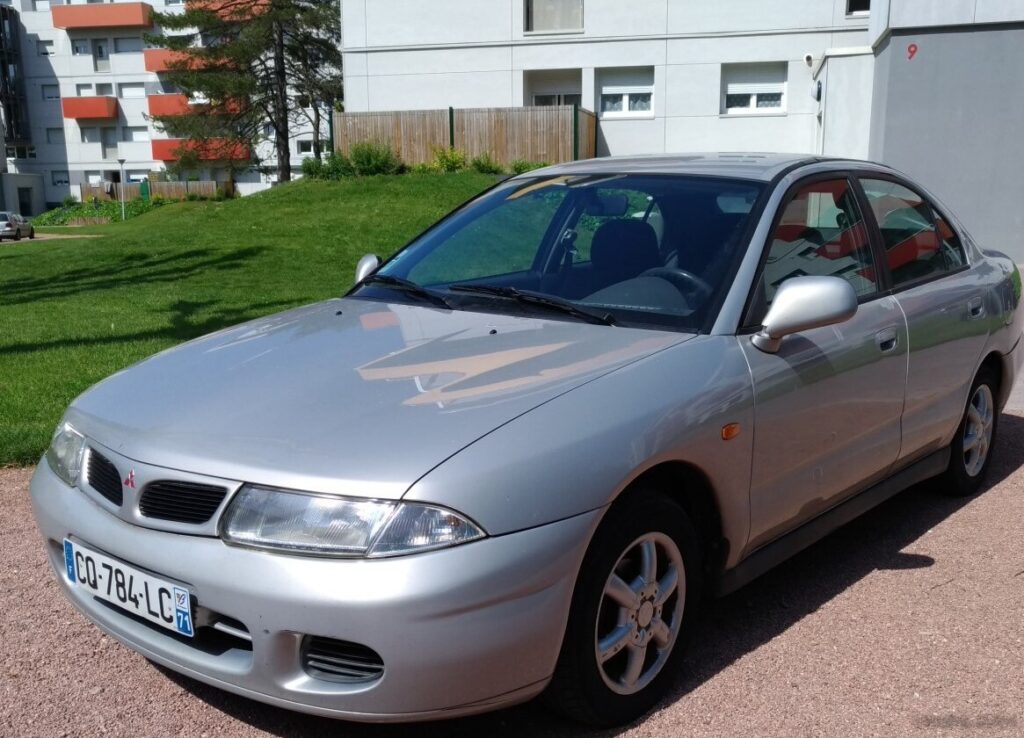
The Mitsubishi Carisma 1.8, produced between 1995 and 2000, represented a significant step forward for Mitsubishi’s presence in the competitive European compact sedan market. Positioned as a mid-range offering within the Carisma lineup, it aimed to provide a balance of performance, comfort, and affordability. The Carisma, internally designated as the DA series, was a collaborative effort with Chrysler, sharing its platform with the Chrysler Neon and Eagle Talon. This 1.8-liter variant, delivering 116 horsepower, was a popular choice for buyers seeking a more spirited driving experience than the base models, while remaining more economical than the higher-performance options.
Technical Specifications
| Brand | Mitsubishi |
| Model | Carisma |
| Generation | Carisma |
| Type (Engine) | 1.8 (116 Hp) |
| Start of production | 1995 |
| End of production | 2000 |
| Powertrain Architecture | Internal Combustion engine |
| Body type | Sedan |
| Seats | 5 |
| Doors | 4 |
| Fuel consumption (urban) | 8.7 l/100 km (27 US mpg, 32.5 UK mpg, 11.5 km/l) |
| Fuel consumption (extra urban) | 5.4 l/100 km (43.6 US mpg, 52.3 UK mpg, 18.5 km/l) |
| Fuel consumption (combined) | 6.7 l/100 km (35.1 US mpg, 42.2 UK mpg, 14.9 km/l) |
| Fuel Type | Petrol (Gasoline) |
| Acceleration 0 – 100 km/h | 10.2 sec |
| Acceleration 0 – 62 mph | 10.2 sec |
| Acceleration 0 – 60 mph | 9.7 sec |
| Maximum speed | 200 km/h (124.27 mph) |
| Weight-to-power ratio | 9.7 kg/Hp, 102.7 Hp/tonne |
| Weight-to-torque ratio | 7 kg/Nm, 143.4 Nm/tonne |
| Power | 116 Hp @ 5500 rpm |
| Power per litre | 63.2 Hp/l |
| Torque | 162 Nm @ 4500 rpm (119.49 lb.-ft. @ 4500 rpm) |
| Engine layout | Front, Transverse |
| Engine displacement | 1834 cm3 (111.92 cu. in.) |
| Number of cylinders | 4 |
| Engine configuration | Inline |
| Cylinder Bore | 81 mm (3.19 in.) |
| Piston Stroke | 89 mm (3.5 in.) |
| Compression ratio | 10:1 |
| Number of valves per cylinder | 4 |
| Fuel injection system | Multi-port manifold injection |
| Engine aspiration | Naturally aspirated engine |
| Valvetrain | OHC |
| Kerb Weight | 1130 kg (2491.22 lbs.) |
| Max. weight | 1660 kg (3659.67 lbs.) |
| Max load | 530 kg (1168.45 lbs.) |
| Trunk (boot) space – maximum | 460 l (16.24 cu. ft.) |
| Fuel tank capacity | 60 l (15.85 US gal | 13.2 UK gal) |
| Length | 4435 mm (174.61 in.) |
| Width | 1710 mm (67.32 in.) |
| Height | 1405 mm (55.31 in.) |
| Wheelbase | 2550 mm (100.39 in.) |
| Front track | 1455 mm (57.28 in.) |
| Rear (Back) track | 1475 mm (58.07 in.) |
| Drivetrain Architecture | The Internal combustion engine (ICE) drives the front wheels of the vehicle. |
| Drive wheel | Front wheel drive |
| Number of gears and type of gearbox | 5 gears, manual transmission |
| Front suspension | Spring Strut |
| Rear suspension | Coil spring |
| Front brakes | Ventilated discs |
| Rear brakes | Drum |
| Assisting systems | ABS (Anti-lock braking system) |
| Steering type | Steering rack and pinion |
| Power steering | Hydraulic Steering |
| Tires size | 185/65 R14 |
Powertrain & Engine Architecture
The heart of the Carisma 1.8 was the 4G93 inline-four cylinder engine. This 1.8-liter powerplant featured a single overhead camshaft (SOHC) design and multi-point fuel injection. The engine code, often found as 4G93, signified its place within Mitsubishi’s engine family. The 4G93 was known for its relatively simple design, contributing to its reliability. The engine produced 116 horsepower at 5,500 rpm and 162 Nm (119.49 lb-ft) of torque at 4,500 rpm. The engine’s compression ratio was 10:1. The Carisma 1.8 was typically paired with a five-speed manual transmission, although a four-speed automatic transmission was also available. The automatic transmission, while offering convenience, did slightly impact acceleration and fuel economy compared to the manual version. The four-speed automatic was a conventional hydraulic unit, prioritizing smooth shifts over outright performance.
Driving Characteristics
The Carisma 1.8 offered a reasonably engaging driving experience for its class. The 116 hp engine provided adequate power for everyday driving and highway cruising. Acceleration from 0 to 60 mph took around 9.7 seconds, which was competitive with other similarly sized sedans of the era. The five-speed manual transmission allowed drivers to make the most of the engine’s powerband, while the automatic transmission provided smooth, if somewhat less responsive, gear changes. The automatic’s gear ratios were tuned for fuel efficiency, resulting in a slightly more relaxed driving experience. The suspension, tuned for comfort, provided a compliant ride, although it wasn’t particularly sporty. Steering was light and precise, making the Carisma easy to maneuver in urban environments. The car felt stable at highway speeds, though wind noise was noticeable.
Equipment & Trim Levels
The Carisma 1.8 typically came equipped with features such as power steering, central locking, electric front windows, and an AM/FM radio. Higher trim levels, such as the GLX, added features like alloy wheels, air conditioning, a sunroof, and upgraded interior trim. Interior upholstery was typically cloth, with options for more premium materials on higher-spec models. The dashboard layout was functional and straightforward, with easy-to-read gauges and controls. Options like a CD player and upgraded sound systems were also available. The GLX trim also often included features like a trip computer and upgraded door panels.
Chassis & Braking
The Carisma utilized a front-engine, front-wheel-drive layout. The front suspension consisted of MacPherson strut springs, while the rear suspension employed a coil spring setup. Braking duties were handled by ventilated discs at the front and drum brakes at the rear. Anti-lock Braking System (ABS) was standard on many models, enhancing safety. The Carisma’s chassis was designed to provide a balance of rigidity and comfort, contributing to its stable handling characteristics. The front stabilizer bar helped to reduce body roll during cornering, while the rear suspension provided a comfortable ride over uneven surfaces.
Market Reception & Comparison
The Mitsubishi Carisma 1.8 was generally well-received by automotive critics. It was praised for its comfortable ride, spacious interior, and relatively affordable price. However, some critics noted that its styling was somewhat conservative compared to its rivals. Compared to the base 1.6-liter Carisma, the 1.8 offered a noticeable performance improvement. Against competitors like the Ford Focus, Opel/Vauxhall Astra, and Volkswagen Golf, the Carisma 1.8 held its own, offering a compelling package of features and value. Fuel economy was respectable, averaging around 35.1 US mpg in combined driving. The automatic transmission versions typically saw a slight decrease in fuel economy, around 2-3 mpg.
Legacy
The Mitsubishi Carisma, while not a groundbreaking vehicle, established Mitsubishi as a credible player in the European compact sedan market. The 1.8-liter engine proved to be relatively reliable, and well-maintained examples continue to be found on the used car market today. While not particularly sought after by collectors, the Carisma 1.8 represents a solid and dependable choice for buyers seeking an affordable and practical used car. Its simple mechanical design makes it relatively easy and inexpensive to maintain, and parts availability remains reasonable. The Carisma’s collaborative development with Chrysler also highlights a unique chapter in automotive history. The 4G93 engine, in particular, is known for its durability and is often found in other Mitsubishi models of the era, contributing to a readily available supply of replacement parts.
